Industry Anticipates 'Indirect Benefits' from Tariff Policies and End of War
Outlook for Diversified Oil Supply from the US, Canada, and Russia
Expectations for Improved Price Competitiveness... "Can Compete with China"

Domestic oil refiners, which recorded solid sales performance last year, are considering introducing or expanding imports of Canadian crude oil. This is because U.S. President Donald Trump announced a 25% tariff on products from Canada and Mexico, increasing the likelihood that Canadian crude oil will enter markets outside the U.S.
According to the domestic refining industry on the 17th, companies such as SK Energy, GS Caltex, and HD Hyundai Oilbank have recently begun analyzing the profitability of importing Canadian crude oil. Given the industry's characteristic where oil prices greatly impact corporate performance, securing crude oil at the lowest possible price is crucial. Canadian crude oil is known to be about $15 (approximately 21,600 KRW) cheaper per barrel than Middle Eastern crude.
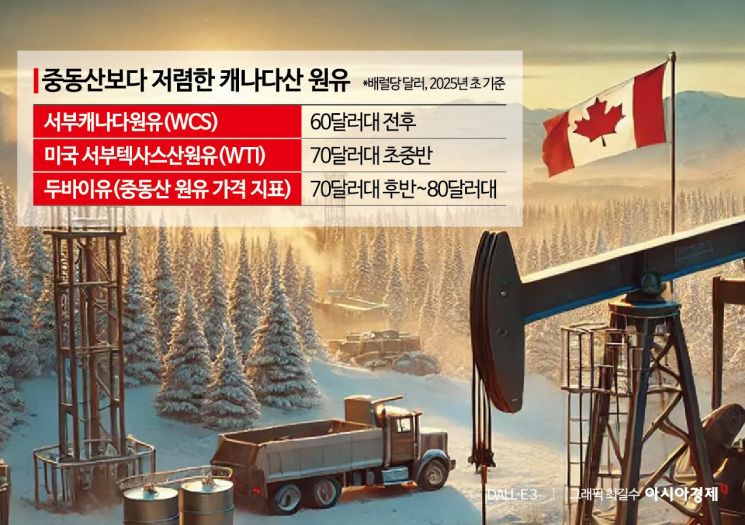
The reason domestic refiners are considering importing Canadian crude oil is that President Trump is targeting Canadian crude oil with tariffs to protect U.S. companies. Canada has exported most of its crude oil to U.S. refiners, but if the U.S. imposes tariffs on Canadian crude, there will be incentives to expand export destinations to Asian countries such as South Korea. Currently, South Korea sources nearly 70% of its crude oil imports from the Middle East.
Of course, there are many factors to consider regarding the import of Canadian crude oil. Industry insiders explain that comprehensive evaluation of crude oil type characteristics and additional transportation costs is necessary. A representative from the Korea Petroleum Association said, "Transportation costs must be considered, and various factors such as how to balance the import ratio with the traditionally imported Middle Eastern crude oil need to be thought through."
However, the industry assesses that the inauguration of the Trump administration has increased the possibility of diversifying crude oil supply sources. President Trump, in his inaugural speech, chanted the slogan "drill, baby, drill," indicating an expansion of fossil fuel production, and recently also declared an end to the Russia-Ukraine war. This has raised expectations that Russian crude oil could be released into the market. For Korean companies, if increased crude oil production leads to lower oil prices, they can import crude at lower prices and increase refining margins.
An official from the Petroleum Association also said, "Even if Canadian crude oil is not directly imported, it can indirectly benefit by affecting oil prices in other regions."

The industry also expects an increase in demand for petroleum products following the Russia-Ukraine war. A domestic refiner said, "So far, Russian crude oil has flowed into China at low prices, giving Chinese refiners a significant cost advantage over Korean companies," adding, "If the war ends, China's cost competitiveness is expected to weaken, and domestic refiners will be able to regain price competitiveness." Another industry insider forecasted, "As economic growth delayed by the war resumes, consumption of petroleum products is expected to increase."
The domestic refining industry expects to continue strong performance this year, following record exports of gasoline and diesel last year and President Trump's pro-oil stance. The four major domestic refiners (SK Innovation, GS Caltex, S-Oil, and HD Hyundai Oilbank) recorded sales in the refining sector of 49.8399 trillion KRW, 37.8028 trillion KRW, 28.8405 trillion KRW, and 28.7819 trillion KRW, respectively, last year.
© The Asia Business Daily(www.asiae.co.kr). All rights reserved.
![Clutching a Stolen Dior Bag, Saying "I Hate Being Poor but Real"... The Grotesque Con of a "Human Knockoff" [Slate]](https://cwcontent.asiae.co.kr/asiaresize/183/2026021902243444107_1771435474.jpg)

















