"Thorough Review of Whether Korea Zinc's Circular Shareholding Circumvention Violates the Law"
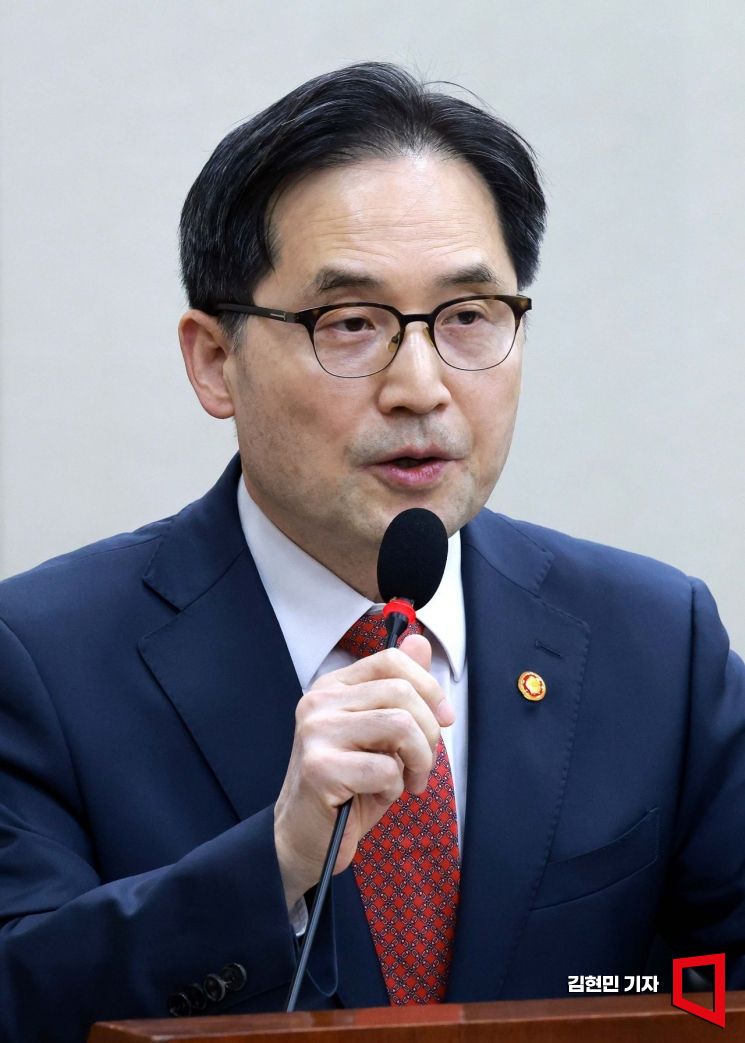 Fair Trade Commission Chairman Han Ki-jung is giving a proposal explanation related to the budget at the full meeting of the Political Affairs Committee held at the National Assembly on the 12th. Photo by Kim Hyun-min
Han Ki-jung, Chairman of the Korea Fair Trade Commission (KFTC), stated, "Regarding the illegal circumvention of circular shareholding by Korea Zinc, we will thoroughly review whether there has been a violation of the law through fact verification, data requests, and hearing opinions." Concerning concerns about trade friction related to the Platform Act (amendment to the Fair Trade Act), he said, "We will comprehensively consider changes in the trade environment and respond appropriately from the perspective of national interest to prevent trade issues from arising."
At a press briefing held on the 17th at the Government Complex Sejong, Chairman Han said, "Under the current Fair Trade Act, mutual shareholding and circular shareholding among domestic affiliates of companies belonging to restricted mutual shareholding business groups are generally prohibited, but there are no regulations regarding overseas affiliates."
The KFTC received a report at the end of last month alleging that Korea Zinc, the largest non-ferrous smelting business in Korea, violated mutual and circular shareholding regulations by purchasing shares of domestic affiliates through overseas affiliates during its management rights defense process. Under the current Fair Trade Act, large business groups with total assets exceeding 10 trillion won, such as Samsung, SK, and Hyundai Motor, are prohibited from creating new circular shareholdings through domestic affiliates, but there are no regulations concerning overseas affiliates.
Chairman Han stated, "There are no regulations regarding overseas affiliates, so it is difficult to recognize cases involving overseas affiliates as subjects of regulation. However, the complainant claims that Korea Zinc engaged in illegal acts to evade regulation by merely using the name of overseas affiliates. Therefore, we plan to carefully review whether there has been a violation of the Fair Trade Act through the usual case handling procedures."
Regarding calls for amendments to the Fair Trade Act prompted by this incident, Chairman Han said, "Currently, there is no circumstance to interpret the scope of regulation to include overseas affiliates. We plan to regulate overseas affiliates within the framework of the disclosure system, and if additional problems are found in the future, we will consider improving the system."
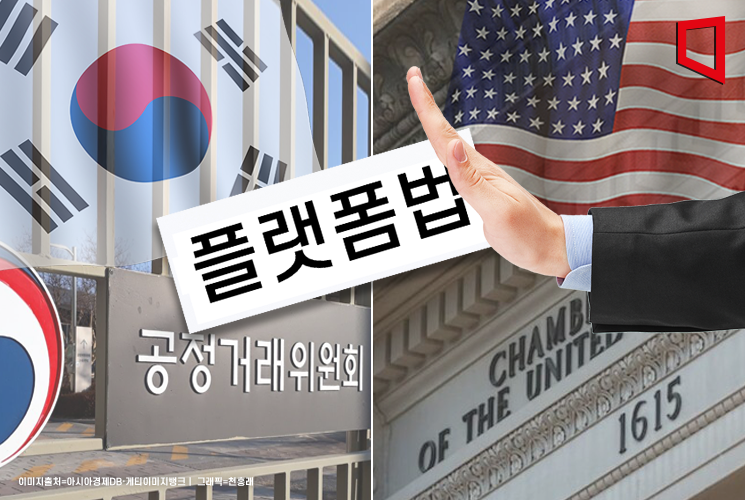
Regarding concerns about trade friction related to the Platform Act that the KFTC is promoting, he said, "We will consult with the National Assembly during the legislative discussion process to comprehensively consider changes in the trade environment following the inauguration of the Trump administration in the U.S., and we will continuously strengthen communication with the U.S. side."
Earlier, on the 6th (local time), Katherine Tai, the nominated U.S. Trade Representative (USTR), stated that "discrimination against American companies cannot be tolerated," targeting South Korea's legislative moves on the Platform Act. The U.S. raised concerns in last year's National Trade Estimate (NTE) report that the Platform Act would target only domestic big tech companies such as Google and Meta, and there have been worries that the Trump administration might use the Platform Act as a non-tariff barrier target when imposing reciprocal tariffs.
In response, Chairman Han emphasized, "We plan to respond appropriately to prevent trade issues from arising from the perspective of national interest."
Regarding the merger case of U.S.-based companies Synopsys and Ansys, he said, "Although it is a merger between overseas businesses, it is related to semiconductor design, which is directly linked to future industry competitiveness such as robotics and artificial intelligence (AI), and it has a significant impact on the domestic semiconductor market. We have conducted an in-depth review of concerns about competition restrictions in the market, and after submitting the agenda earlier this month, the full commission review is forthcoming."
The merger amount of Synopsys and Ansys, the leading suppliers of semiconductor design software headquartered in the U.S., is approximately $35 billion (about 50.5 trillion won). These companies count major domestic and international semiconductor firms such as Samsung Electronics, SK Hynix, Nvidia, and Apple as their main customers.
Chairman Han explained, "This case is the first to apply the 'voluntary remedy submission system for mergers' under the Fair Trade Act, which has been in effect since August last year. Synopsys has submitted a voluntary remedy plan, and the full commission review is scheduled."
Regarding the comprehensive improvement measures for subcontract payment currently underway, he said, "We recently formed a 'Task Force (TF) to Strengthen Subcontract Payment Guarantees' consisting of academia, legal circles, business associations, and experts, and the first meeting will be held next week. We will prepare a balanced plan that strengthens payment stability for small and medium enterprises while alleviating unreasonable burdens on the original contractors."
He added, "We are pushing for a revision of the notification to explicitly state that the practice of withholding part of subcontract payments as retention money in the construction industry constitutes an unfair special contract. The administrative notice was completed by the end of last month, and after review by the Regulatory Reform Committee, the revision is expected to be completed next month."
Chairman Han said, "To establish a prompt payment method in the distribution sector, we are conducting a written survey targeting 139 companies including department stores, TV home shopping, and shopping malls. We plan to analyze the survey results to review the appropriateness of the current payment deadlines and the need for system improvements."
Following the T-mep incident, a bill to shorten the payment settlement period in the online intermediary transaction sector was proposed under the Large-scale Distribution Business Act, and opinions have been raised that the current payment deadlines under the law are too long even in traditional retail sectors such as direct purchase and special contract purchase.
Regarding illegal activities in online advertising agencies, which have been causing increasing damage to small business owners, he said, "We have established a public-private joint advertising agency TF to prepare measures to remedy livelihood damages. Starting next month, quarterly TF meetings will be held, and investigations by private companies and police investigations will proceed."
© The Asia Business Daily(www.asiae.co.kr). All rights reserved.
![Clutching a Stolen Dior Bag, Saying "I Hate Being Poor but Real"... The Grotesque Con of a "Human Knockoff" [Slate]](https://cwcontent.asiae.co.kr/asiaresize/183/2026021902243444107_1771435474.jpg)
















