The Korea Electrotechnology Research Institute (KERI) announced on the 17th that Dr. Seo Jae-hwa's team at the Next-Generation Semiconductor Research Center has developed a technology to evaluate the radiation resistance of silicon carbide (SiC) power semiconductor devices in space environments and secure their reliability. This is expected to be a foundational technology to prevent radiation damage to next-generation materials for power semiconductors essential for rockets and satellites used in space exploration.
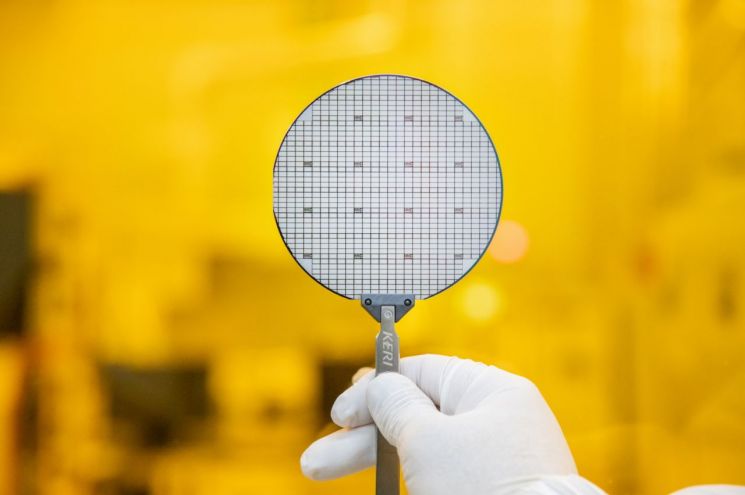 SiC power semiconductor developed by Korea Electrotechnology Research Institute. Photo by Jeon Gi-yeon
Space radiation is a risk factor that severely degrades the electrical characteristics of power semiconductors essential for aircraft, rovers, satellites, and more. Power semiconductors, which control current direction and power conversion and act like muscles in the human body, can cause adverse effects on rockets or satellites if problems occur.
Currently, silicon (Si) is the most widely used material for power semiconductors in space environments, but next-generation candidates such as silicon carbide (SiC) and diamond, which have high performance and durability, known as ‘wide bandgap (WBG) power semiconductors,’ are receiving great attention. In Korea, research has been limited to quantitatively analyzing radiation resistance at the silicon power semiconductor stage, but KERI has succeeded for the first time domestically in effectively evaluating the radiation resistance of SiC power semiconductors through high-energy space environment simulation.
The research team succeeded in simulating an extreme space radiation experimental environment by utilizing high-energy protons (100 MeV) from the accelerator facility owned by the Korea Atomic Energy Research Institute. Under these space environment conditions, KERI systematically analyzed the effects on domestically developed SiC power semiconductors, including voltage changes, increased leakage current due to exposure, and lattice damage. They also established design criteria to ensure long-term reliability when SiC power semiconductors are used as space components. The research results were recognized for their excellence and published as a paper in the SCI-level international journal in the field of nuclear and radiochemistry, ‘Radiation Physics and Chemistry.’
Dr. Seo Jae-hwa stated, “Setting various radiation impact parameters and experimenting with core components in similarly simulated environments is considered a core technology in the global space industry,” adding, “This technology will be applied not only in space and aviation but also in medical radiation devices, nuclear power generation and radioactive waste treatment facilities, and military and defense electronics in various fields.”
In future research, the team plans to expand the scope of the technology to evaluate the reliability of SiC power semiconductors under ultra-high-energy radiation conditions (above 200 MeV) and to develop ‘next-generation radiation-resistant power semiconductor’ devices.
© The Asia Business Daily(www.asiae.co.kr). All rights reserved.
![Clutching a Stolen Dior Bag, Saying "I Hate Being Poor but Real"... The Grotesque Con of a "Human Knockoff" [Slate]](https://cwcontent.asiae.co.kr/asiaresize/183/2026021902243444107_1771435474.jpg)















