Nissan CEO: "Production Bases May Relocate if Tariffs Are Imposed"
Ford Joins in Opposition... "Opportunities for Korean, Japanese, and European Automakers"
Global Credit Rating Agency Fitch Also Reviews Impact of US Tariffs
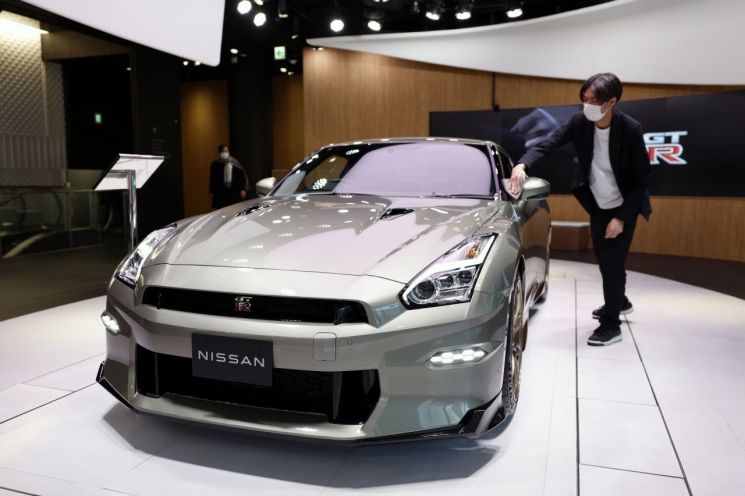 On the 6th (local time), the Nissan GT-R was displayed at the Nissan showroom in Tokyo, Japan. Makoto Uchida, CEO of Nissan, stated at a press conference held on the afternoon of the 13th regarding the failed merger between Nissan and Honda, "There are 320,000 vehicles exported from Mexico to the United States, and if high tariffs are imposed, we must prepare for that," adding, "If such a decision is made, production of those models can be relocated elsewhere." /EPA·Yonhap EPA Yonhap News
As the implementation of the US tariff policy against Mexico approaches in March, concerns among companies worldwide are growing. The automotive industry, which has production bases in Mexico, is expected to be significantly impacted, prompting top executives such as Nissan and Ford CEOs to unusually express their worries publicly.
Makoto Uchida, CEO of Nissan, stated at a press conference held on the afternoon of the 13th regarding the failed merger between Nissan and Honda, "Vehicles exported from Mexico to the US amount to 320,000 units, and if high tariffs are imposed, we must prepare for this," adding, "If such a decision is made, production of these models could be relocated elsewhere."
Last year, Nissan produced about 670,000 units in Mexico, exporting more than 456,000 of them, according to the Spanish media outlet UnoTV. Nissan ranks second in Mexico in terms of production and export volume, following General Motors (GM).
Ford, a traditional American automaker, also opposed the Trump administration's tariff policy. According to US CNBC, CEO Jim Farley said at a conference held in New York on the 11th, "If a 25% tariff is imposed on cars imported from Mexico and Canada, the US automotive industry will suffer unprecedented damage," adding, "This will provide tremendous opportunities for Korean, Japanese, and European automakers." Ford produces Maverick pickup trucks and Mustang Mach-E electric sport utility vehicles (SUVs) in Mexico, and engines in Canada.
The three major international credit rating agencies, including Fitch, have warned that if US tariffs on Mexico and Canada become a reality, it could negatively affect the credit metrics of global automakers. On the 10th (local time), Fitch noted, "A 25% tariff on Mexico could have a significant impact on global automakers." It classified four companies?Honda, GM, Nissan, and Stellantis?as having 'high' exposure to US tariff impacts. Hyundai Motor Company was classified as 'medium' exposure along with Ford, Toyota, and Volkswagen.
Domestic companies operating in Mexico are also facing significant concerns. Samsung Electronics, LG Electronics, Kia, Hyundai Mobis, and Hankook Tire have established local operations in Mexico, with high shares in home appliances, automobiles, steel, and tires. In a recent report by KB Securities, it was forecasted that if the US does not extend the 25% tariff exemption on Mexico and imposes a 10% tariff on Korean-made cars, even if domestic production in the US is maximized, Hyundai Motor and Kia's operating profits would decrease by approximately 1.9 trillion KRW and 2.4 trillion KRW, respectively.
However, GM is the only company in the industry offering an optimistic outlook, stating it can reduce tariff impacts by up to 50%. Mary Barra, GM CEO, said, "We can absorb 30-50% of additional costs in the short term without further capital investment," and indicated that they have prepared scenarios such as relocating some parts and vehicle production to other regions if tariffs persist long-term. Currently, GM's Mexican plants are key bases for producing low-cost electric vehicles and highly profitable large pickup trucks.
© The Asia Business Daily(www.asiae.co.kr). All rights reserved.
![Clutching a Stolen Dior Bag, Saying "I Hate Being Poor but Real"... The Grotesque Con of a "Human Knockoff" [Slate]](https://cwcontent.asiae.co.kr/asiaresize/183/2026021902243444107_1771435474.jpg)















