The Gyeonggi Province, known as the "heart of K-semiconductors," is drawing attention for its strategic moves to gain an advantage in the global semiconductor supremacy competition.
As of 2022, Gyeonggi Province accounts for 83% of the added value and 77% of the sales revenue in South Korea's semiconductor industry.
According to Gyeonggi Province on the 17th, since Governor Kim Dong-yeon's inauguration in 2022, the province has attracted a total semiconductor investment of 34.6 trillion KRW over the past two and a half years. It is also promoting the creation of the world's largest semiconductor mega cluster in Yongin and is building infrastructure to strengthen the competitiveness of the semiconductor industry, such as a semiconductor technology center. Additionally, efforts are being made to support the training and hiring of semiconductor specialists and to enact and pass the "Semiconductor Special Act."
First, after Governor Kim Dong-yeon's inauguration, Gyeonggi Province attracted next-generation research centers of the world's four major semiconductor equipment companies: Applied Materials (AMAT), ASML, Lam Research, and Tokyo Electron (TEL). It also succeeded in attracting investments from global semiconductor companies such as ON Semiconductor, Linde, Albak, ASM, and Entegris. As a result, by the end of 2024, the amount of semiconductor investment attracted to Gyeonggi Province is expected to reach 34.6 trillion KRW.
Meanwhile, Gyeonggi Province is developing a 360 trillion KRW advanced system semiconductor national industrial complex on a 7.28 million square meter site in the Idong and Namsa-myeon areas of Yongin. This will be linked with the Yongin Semiconductor Cluster (SK Hynix) and the Pyeongtaek Godeok Industrial Complex (Samsung Electronics), and is expected to grow into the world's largest semiconductor mega cluster.
The Yongin Advanced System Semiconductor Cluster National Industrial Complex plans to start land compensation this year, begin construction of the industrial complex next year, and complete it by 2031. Samsung Electronics plans to operate its first semiconductor fab by the end of 2030.
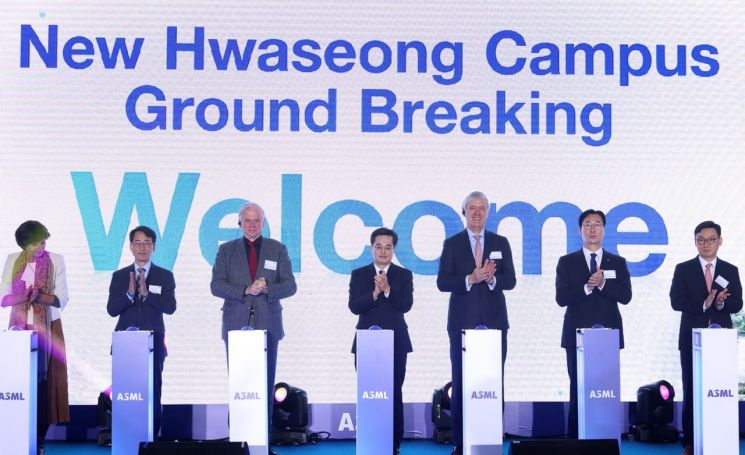 Kim Dong-yeon, Governor of Gyeonggi Province (center), is taking a commemorative photo with attendees at the groundbreaking ceremony of the ASML Hwaseong Semiconductor Cluster in November 2022. Photo by Gyeonggi Province
To strengthen the semiconductor ecosystem, Gyeonggi Province opened a semiconductor technology center within the Suwon Next-Generation Convergence Technology Institute in July last year to support prototype production and technology verification for small and medium enterprises. In September of the same year, it established a system semiconductor development support center in the 2nd Pangyo Techno Valley to enable fabless (semiconductor design specialized) companies to utilize advanced technical equipment and professional personnel.
Notably, the "Advanced Semiconductor Testbed (Minifab) Construction" project, which passed the government's preliminary feasibility study last November, is being carried out on a scale of 1 trillion KRW. Gyeonggi Province plans to collaborate with the government, Yongin City, and SK Hynix to significantly enhance the technological competitiveness of semiconductor materials, parts, and equipment (SoBuJang) companies.
Additionally, to address the semiconductor industry's manpower shortage, Gyeonggi Province established the Semiconductor Human Resources Development Center (G-SPEC) in 2023 and enacted the "Gyeonggi Province Semiconductor Industry Promotion and Support Ordinance" to strengthen administrative and institutional support. Last year, through semiconductor shared universities, nanotechnology workforce training, and semiconductor academy support projects, 1,227 semiconductor specialists were produced.
Furthermore, efforts are being made to pass the "Special Measures Act for Strengthening and Supporting the Semiconductor Industry Ecosystem," which was primarily proposed by Kim Tae-nyeon, a member of the Democratic Party representing Sujeong District, Seongnam City, Gyeonggi Province. Earlier, in May last year, Gyeonggi Province proposed the enactment of the Semiconductor Special Act at a meeting with the 22nd National Assembly elected members, focusing on designating advanced semiconductor special zones, supporting R&D for small and medium enterprises, establishing a semiconductor fund, and fostering specialized personnel.
Governor Kim Dong-yeon attended a National Assembly meeting related to the enactment of the Semiconductor Special Act held last year and emphasized, "Gyeonggi Province is the core of South Korea's semiconductor industry and has the optimal conditions to lead the global semiconductor market," adding, "We will lead the global supply chain through the creation of a semiconductor mega cluster and the establishment of an innovative semiconductor ecosystem."
© The Asia Business Daily(www.asiae.co.kr). All rights reserved.
![Clutching a Stolen Dior Bag, Saying "I Hate Being Poor but Real"... The Grotesque Con of a "Human Knockoff" [Slate]](https://cwcontent.asiae.co.kr/asiaresize/183/2026021902243444107_1771435474.jpg)















