Dried Gim, Abalone Jangajji, and Shrimp Jang Also Under Review for Designation
'Sakhin Hong-eo' (fermented skate) and 'Miyeokguk' (seaweed soup), representative foods of Korea, are expected to be designated as 'Traditional Seafood Foods' soon and exported overseas. Items such as dried gim (seaweed), abalone jangajji (pickled abalone), boiled conch, and shrimp jang (pickled shrimp) are also under review for suitability as 'Traditional Seafood Foods.'
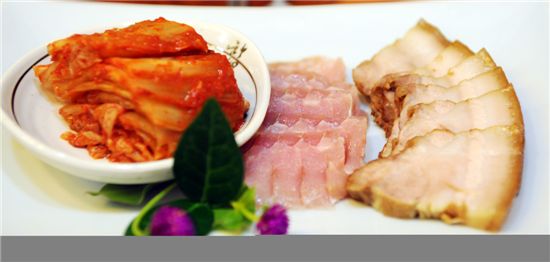 Hongeo Samhap
According to the National Fishery Products Quality Management Service (NFQS) under the Ministry of Oceans and Fisheries on the 17th, NFQS has determined through research that Sakhin Hong-eo is suitable for designation as a Traditional Seafood Food.
Once Sakhin Hong-eo is designated as a 'Traditional Seafood Food,' it will be added to the list of Traditional Seafood Foods through the revision of the announcement on 'Certified Items and Standard Specifications for Traditional Seafood Foods.'
NFQS recently commissioned related research to establish standard specifications for designating Miyeokguk as a Traditional Seafood Food. Through this research, NFQS also plans to review the suitability of dried gim, abalone jangajji, boiled conch, and shrimp jang as Traditional Seafood Foods.
An NFQS official stated that dishes such as chueotang (loach soup), nakji bokkeum (stir-fried octopus), and parae muchim (seasoned green laver) were also judged suitable for designation as Traditional Seafood Foods in previous investigations. The official added, "Standard specifications for these foods will also be developed through future research."
According to the Fisheries Food Industry Act, Traditional Seafood Foods are seafood products made primarily from domestic seafood, manufactured and cooked according to traditionally inherited methods, delivering Korea’s unique taste and aroma. They are designated through research and investigation. When an application for designation of a specific seafood product as a Traditional Seafood Food is received, NFQS conducts field investigations, reviews, and evaluations, followed by the preparation of standard specifications and revision of announcements to officially designate the product as a Traditional Seafood Food.
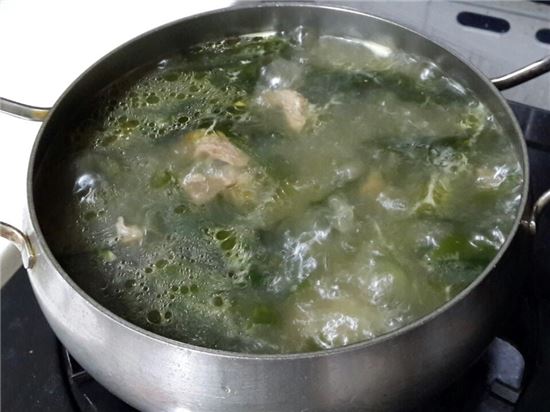 Miyeokguk. Photo by Asia Economy
Through this process, 22 types of salted seafood such as squid, myeongran (pollock roe), and changran (pollock roe with chili) and 44 items including seasoned gim, abalone porridge, and flower crab jang have been designated as Traditional Seafood Foods.
Foods designated as Traditional Seafood Foods become priority purchase targets for the government and local governments. Additionally, under the Fisheries Food Industry Act, the government and local governments must provide various support to promote the export and globalization of Traditional Seafood Foods.
The Korea Agro-Fisheries & Food Trade Corporation (aT) grants additional points to companies handling Traditional Seafood Foods when selecting participants for the 'Leading Seafood Food Organization Project,' which supports costs such as brand development and overseas marketing to strengthen seafood export competitiveness, or the 'Seafood Food Company Voucher Project,' which supports export expenses.
The Korea Fisheries Association also awards additional points when Traditional Seafood Foods receive international certification or the 'K-FISH' certification. K-FISH is the integrated seafood export brand of the Ministry of Oceans and Fisheries, operated since 2017 to enhance the overseas recognition of Korean seafood and expand export markets.
The export volume of companies certified with K-FISH has been increasing annually, accounting for 4.8% of total seafood exports in 2018 and 19.9% last year. To receive K-FISH certification, comprehensive evaluations including on-site assessments by a quality evaluation team are required, and Traditional Seafood Foods receive additional points in this process.
The Korea Fisheries Association also grants additional points to companies handling Traditional Seafood Foods when selecting support recipients for seafood marketing projects targeting overseas buyers.
A Ministry of Oceans and Fisheries official stated, "We are supporting the promotion and marketing targeting overseas buyers by assisting with K-FISH certification for verified foods such as Traditional Seafood Foods to actively facilitate their overseas promotion and marketing."
© The Asia Business Daily(www.asiae.co.kr). All rights reserved.
![Clutching a Stolen Dior Bag, Saying "I Hate Being Poor but Real"... The Grotesque Con of a "Human Knockoff" [Slate]](https://cwcontent.asiae.co.kr/asiaresize/183/2026021902243444107_1771435474.jpg)














