AI Developed to Solve Particle Collision Equations in Fusion Reactors
by UNIST Professors Lee Jimin and Yoon Euisung's Team
High accuracy with error level of 10^-5, published in the Journal of Computational Physics
An artificial intelligence capable of simulating the plasma state inside a nuclear fusion reactor 1000 times faster than before has been developed.
A research team led by Professors Lee Jimin and Yoon Euisung from the Department of Nuclear Engineering at UNIST developed a deep learning-based AI model called ‘FPL-net’ that accelerates the solution of mathematical equations describing the plasma state.
 Professor Lee Jimin.
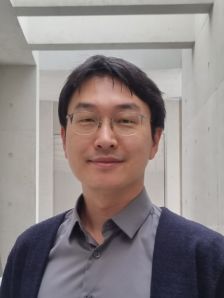 Professor Yoon Eui-sung.
In nuclear fusion power generation, also known as the 'artificial sun' technology, the interior of the reactor must be maintained in a high-temperature plasma state similar to the actual sun. Plasma is a state in which matter is separated into negatively charged electrons and positively charged ion particles, and accurately predicting collisions between these particles in this state is a key factor in maintaining a stable nuclear fusion reaction.
The plasma state is represented by mathematical models, one of which is the 'Fokker-Planck-Landau equation' (FPL). The Fokker-Planck-Landau equation predicts collisions between positively and negatively charged particles, i.e., Coulomb collisions. Traditionally, iterative methods that gradually find solutions have been used to solve this equation, resulting in high computational costs and long processing times.
The FPL-net developed by the research team can find the solution to the equation in one step, unlike the iterative methods used previously. It can obtain solutions 1000 times faster than before, with a prediction error of 10^-5, demonstrating high accuracy.
The Fokker-Planck-Landau collision process conserves density, momentum, and energy. During the AI model training, functions were defined to ensure the conservation of these physical quantities, thereby improving accuracy.
The accuracy of the AI model was verified by checking thermal equilibrium simulations. If errors accumulate during continuous simulation processes, accurate thermal equilibrium cannot be achieved.
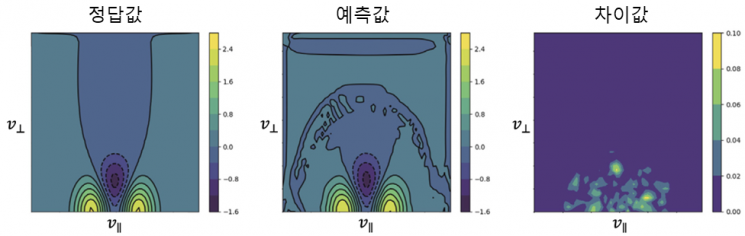 Example of the change in the probability density function of plasma due to collision, predicted by the developed AI.
The joint research team stated, “While maintaining accuracy, we reduced computation time by 1000 times compared to existing codes using CPUs by employing deep learning with GPUs. This will serve as a cornerstone for turbulence analysis codes simulating the entire nuclear fusion reactor and digital twin technology that implements realistic tokamaks in virtual computer spaces.” A tokamak is a special structure that confines plasma.
The researchers added, “However, this study is limited to electron plasma, and for practical applications, further research is needed to extend it to complex plasma environments with multi-species particles including impurities.”
This research was conducted with support from Ulsan National Institute of Science and Technology (UNIST), the National Research Foundation of Korea, and the Korea Institute of Energy Technology Evaluation and Planning, and was published in the international journal Journal of Computational Physics on February 15.
© The Asia Business Daily(www.asiae.co.kr). All rights reserved.
![Clutching a Stolen Dior Bag, Saying "I Hate Being Poor but Real"... The Grotesque Con of a "Human Knockoff" [Slate]](https://cwcontent.asiae.co.kr/asiaresize/183/2026021902243444107_1771435474.jpg)















