All 31 Sites Tested Found "Within Standards"
Last year, asbestos levels in the air at schools and asbestos dismantling sites in reconstruction and redevelopment projects within Seoul were all found to be within the standard limits.
The Seoul Institute of Health and Environment announced on the 17th that it tested airborne asbestos levels at schools and reconstruction and redevelopment sites with asbestos building materials covering an area of 5,000㎡ or more last year, confirming safety as all results were within the standards. According to Article 28 of the Asbestos Safety Management Act, the permissible asbestos emission limit around asbestos dismantling and removal sites is 0.01 fibers/cm³ or less.
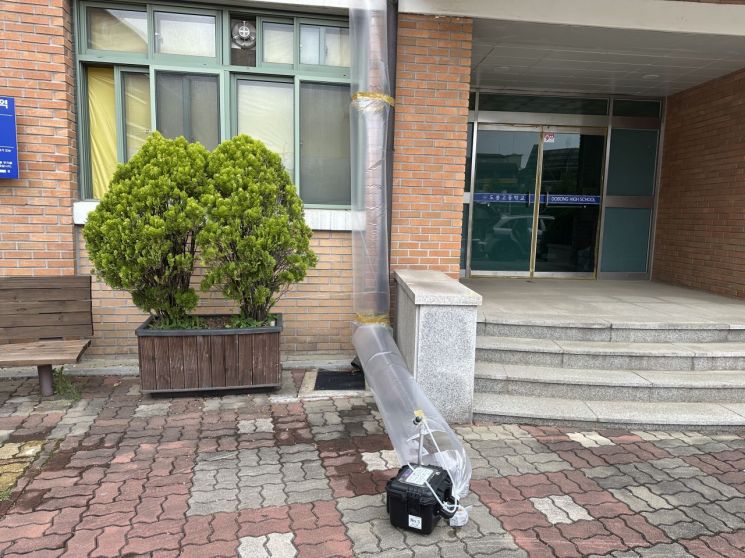 Negative pressure device exhaust vent at A High School where asbestos sample collection was conducted. Provided by Seoul Institute of Health and Environment
Asbestos is classified as a Group 1 carcinogen by the World Health Organization (WHO) and is known as the "silent killer." When inhaled through the respiratory system, it can cause diseases such as lung cancer, asbestosis, and mesothelioma.
The institute collects samples annually from asbestos dismantling sites upon requests from autonomous districts to verify compliance with asbestos emission standards and reports the results to the districts. Last year, a total of 31 sites were inspected, including 12 schools and 19 redevelopment and reconstruction project sites. Approximately 10 points per site were tested, totaling 311 points, all confirmed to be "within standards."
Although asbestos use has been completely banned since 2009, continuous monitoring is necessary due to the aging or dismantling of buildings constructed with asbestos materials in the past. According to the "3rd Basic Asbestos Management Plan," the number of asbestos buildings has been decreasing by about 4.5% annually through approximately 20,000 dismantling and removal operations each year since the asbestos ban.
This year, the institute plans to establish a more accurate asbestos monitoring system by developing technology to effectively manage landscaping stones containing asbestos in rivers and parks.
Park Ju-seong, Director of the Institute of Health and Environment, stated, "Since asbestos has harmful effects on the human body, thorough management is essential. We will continue to conduct accurate and prompt asbestos inspections at dismantling and removal sites to alleviate the concerns and anxieties of Seoul citizens and make our best efforts."
© The Asia Business Daily(www.asiae.co.kr). All rights reserved.
![Clutching a Stolen Dior Bag, Saying "I Hate Being Poor but Real"... The Grotesque Con of a "Human Knockoff" [Slate]](https://cwcontent.asiae.co.kr/asiaresize/183/2026021902243444107_1771435474.jpg)















