Syphilitic Uveitis Cases Increase 8.7-Fold Over 9 Years
"Avoid Risky Sexual Contacts and Get Tested Immediately If Suspected"
Following Japan, syphilis cases are also on the rise domestically.
Recently, the Korea Disease Control and Prevention Agency (KDCA) announced that a total of 3,100 cases of sexually transmitted infections were reported through medical institutions in December last year. Among these, the number of reported syphilis cases reached 222, marking a 15.0% increase in just one month. Syphilis is a disease caused by infection with the pathogen Treponema pallidum. It is mainly transmitted through sexual contact but can also be contracted via vertical transmission from mother to fetus during pregnancy or through blood transmission.
The origin of syphilis is not definitively established, but there are coexisting theories that it existed in Europe from the late 15th century and that it spread worldwide after being transmitted to Europe following Christopher Columbus's exploration of the Americas. Once considered an incurable disease, syphilis cases sharply declined after the development of penicillin treatment in the mid-20th century. However, recently, syphilis cases have been increasing again. Syphilis, which was previously classified as a fourth-class infectious disease subject to sample surveillance, was upgraded to a third-class infectious disease last year and is now subject to full surveillance.
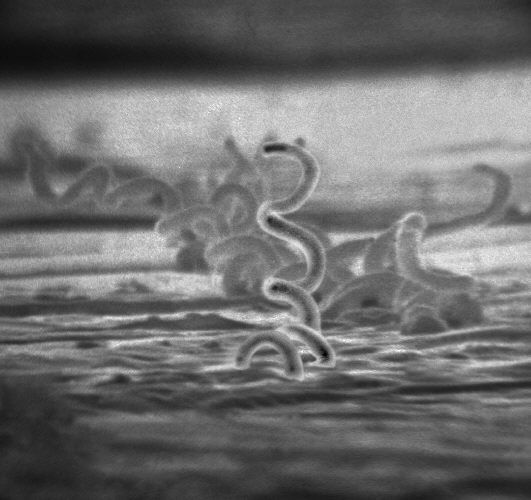 Treponema pallidum
According to infectious disease statistics from the KDCA, the total number of syphilis patients last year was 2,786. This is the highest number since the syphilis reporting system was implemented and represents a 2.7-fold increase compared to 1,015 cases in 2014, ten years ago. Among these, 3.3% (93 patients) were infected overseas. This trend is related to the recent surge in syphilis cases in countries such as Japan and the United States. In the U.S., syphilis infections reached 207,255 cases in 2022, the highest since 1950. Japan also recorded 13,228 syphilis cases in the same year.
Syphilis is generally divided into primary, secondary, and tertiary stages. Primary syphilis presents as a painless ulcer at the site of bacterial invasion. This ulcer lasts about 3 to 6 weeks and naturally heals without special treatment. The name "syphilis" (梅毒) comes from the ulcer’s resemblance to a plum blossom. If untreated in the primary stage, it progresses to the secondary stage, where symptoms include non-itchy skin rashes, fever, sore throat, fatigue, headache, and muscle pain. Without treatment in the secondary stage, the syphilis bacteria remain dormant in the body for several years. In the final tertiary stage, the bacteria invade internal organs, the central nervous system, eyes, heart, liver, and bones, causing severe complications. Tertiary syphilis can occur 10 to 30 years after the initial infection.
Recently, cases of vision loss risk due to syphilis complications have also increased domestically.
The latest issue of the international journal Sexually Transmitted Infections published research results from a joint team including Professor Sujeong Song from the Department of Ophthalmology at Kangbuk Samsung Hospital, Professor Eunah Kim from the Department of Ophthalmology at Changwon Samsung Hospital, and Professor Surak Ryu from the College of Medicine at Hanyang University. The team analyzed big data on syphilis patients (448,085 individuals) from the Health Insurance Review and Assessment Service and found that 1.4% developed ocular complications due to syphilis infection.
The most common complication was uveitis, with the number of patients increasing from 0.18 per 100,000 people in 2010 to 1.58 per 100,000 in 2019, an 8.7-fold increase over nine years. Syphilitic uveitis typically developed 2 to 3 years after syphilis diagnosis. Additionally, patients with metabolic diseases such as hypertension, diabetes, and dyslipidemia had about a 1.5 times higher risk of developing syphilitic uveitis compared to those without these conditions. Inflammation of the uvea can damage surrounding tissues such as the retina, sclera, cornea, and vitreous body, potentially leading to cataracts, glaucoma, and in severe cases, blindness.
The study showed that uveitis infections were particularly prominent among men in their 30s (21.2% of male syphilis patients) and women in their 20s (18.2% of female syphilis patients). Regarding this, Professor Sujeong Song of Kangbuk Samsung Hospital’s Department of Ophthalmology stated, "Although syphilis is known primarily as a sexually transmitted infection, if left untreated, it can invade all parts of the eye and cause severe inflammation. Among these, syphilitic uveitis poses a high risk of blindness if severe, so early detection and infection prevention efforts are essential."
The World Health Organization (WHO) recommends safe sexual practices, including condom use, as the best measure to prevent syphilis infection. The KDCA also urges people to avoid risky sexual contacts such as prostitution and casual encounters and to get tested immediately at nearby urology or obstetrics and gynecology clinics if infection is suspected to prevent confirmed cases of syphilis and other sexually transmitted infections.
© The Asia Business Daily(www.asiae.co.kr). All rights reserved.
![Clutching a Stolen Dior Bag, Saying "I Hate Being Poor but Real"... The Grotesque Con of a "Human Knockoff" [Slate]](https://cwcontent.asiae.co.kr/asiaresize/183/2026021902243444107_1771435474.jpg)














