Disagreements Inside and Outside the Democratic Party Over 35 Trillion Won Supplementary Budget Proposal
Pro-Lee Faction Emphasizes Need for Livelihood Recovery Support Fund, Signals Willingness to Negotiate
Non-Lee Faction Suggests AI Vouchers, Targeted Support for Low-Income Groups, and Financial Assistance
The Democratic Party of Korea proposed a supplementary budget to provide a 250,000 won livelihood recovery support fund, but disagreements arose regarding the approach and content. Within the party, in response to concerns both inside and outside, there were calls for swift supplementary budget formulation, stating, "This is not the time to leisurely crunch numbers at a desk."
Moon Jin-seok, a pro-Lee Jae-myung (pro-Lee) faction member of the Democratic Party, expressed his frustration on social media on the 14th, saying, "There are various opinions about the 'nationwide 250,000 won livelihood recovery support fund' included in the Democratic Party's supplementary budget proposal, and it is truly frustrating." Earlier, the Democratic Party proposed a supplementary budget worth 35 trillion won, requesting an increase in expenditures of 24 trillion won to revitalize domestic demand through livelihood recovery consumption coupons, and 11 trillion won for economic growth through expanded investment in artificial intelligence (AI) and semiconductors. In particular, regarding the livelihood recovery support fund of 250,000 won per person, opposition has continued not only from the People Power Party but also within the Democratic Party itself.
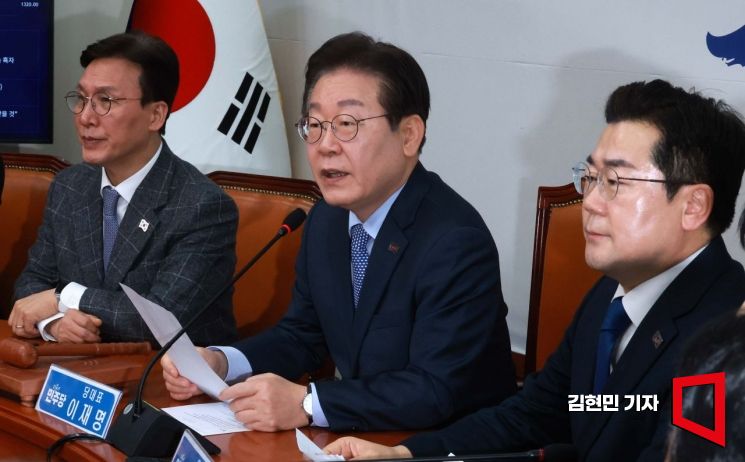 Lee Jae-myung, leader of the Democratic Party of Korea, is speaking at the Supreme Council meeting held at the National Assembly on the 14th. At this meeting, Lee criticized the ruling party, saying, "They only talk about supplementary budgets, but when it comes to concrete discussions, it seems they have no intention of actually doing it." February 14, 2025. Photo by Kim Hyun-min
Rep. Moon diagnosed, "Right after the inauguration of the Yoon Seok-yeol government, the real wage growth rate of workers recorded negative figures for two consecutive years, and all citizens are tightening their belts, while merchants are being driven to close their businesses due to the economic downturn," calling it "an unprecedented crisis where livelihoods have collapsed." He said, "Saying that consumption stimulation is necessary but offering criticism without concrete alternatives is politics without a soul," and added, "The majority of the people feel the utility of universal welfare, and this is a time when decisive action is needed for recovery and growth; it is not the time to leisurely crunch numbers at a desk." He continued, "It is time to make every effort to restore the economy," and "We should put aside minor differences and unite our strength for the people's livelihood." His stance is that the urgent fire must be put out first.
Democratic Party lawmaker Ahn Do-gul, a former vice minister of the Ministry of Economy and Finance, also explained the economic significance of the supplementary budget solution proposed by the Democratic Party through social media. He said, "The livelihood recovery support fund introduced to overcome the COVID-19 crisis in 2020-21 was analyzed to be highly effective in stimulating consumption and restoring sales for small business owners," and explained, "Considering the current livelihood economy situation, which is more difficult than during the COVID-19 period due to domestic demand stagnation and internal shocks, the livelihood recovery support fund was included."
Rep. Ahn also stated that if the government and ruling party make better proposals for restoring small business sales as initially promised, "I am willing to give up the livelihood recovery support fund," and "Considering economic effects and fiscal conditions, a better alternative will be prepared through consultations in the ruling-opposition-government national policy consultation body."
However, disagreements arose not only from the People Power Party but also within the Democratic Party regarding the 250,000 won livelihood recovery support fund. Gyeonggi Province Governor Kim Dong-yeon said, "I agree with providing the livelihood recovery support fund, but there are two problems with giving 250,000 won equally to all citizens in terms of marginal propensity to consume and policy consistency," and explained, "If the livelihood recovery support fund is given to the bottom 25% income bracket, it could amount to 1 million won per person." He suggested concentrating support on the lower-income groups.
Former National Assembly Secretary-General Lee Kwang-jae also proposed on social media, "Let's focus on supporting low-income groups and stimulating consumption," and suggested, "With just 1 trillion won, for example, interest could be reduced by 1% for 20 million small loan borrowers of 5 million won each. The financial market should be actively utilized."
Former Minister of SMEs and Startups Park Young-sun proposed, "If vouchers are created and used for small business owners and self-employed, AI digital promotion, AI startups, and youth, the same 250,000 won could save small business owners, self-employed, SMEs, startups, and motivate youth, serving as a primer for various sectors of the Korean economy and becoming a capital circulation engine larger than 13 trillion won."
Former Prime Minister Kim Boo-kyum argued against insisting on the 250,000 won livelihood recovery fund, which the People Power Party opposes. Through social media, Kim said, "How long will we continue political strife over the supplementary budget?" and urged, "Let's generously concede as our Democratic Party."
© The Asia Business Daily(www.asiae.co.kr). All rights reserved.
![Clutching a Stolen Dior Bag, Saying "I Hate Being Poor but Real"... The Grotesque Con of a "Human Knockoff" [Slate]](https://cwcontent.asiae.co.kr/asiaresize/183/2026021902243444107_1771435474.jpg)















