Trump Checks Samsung at the Time: "A Fair Measure"
Tim Cook Remains Silent on U.S. Tariff Risks
Apple's Over 90% Reliance on China... Production Base Relocation Expected
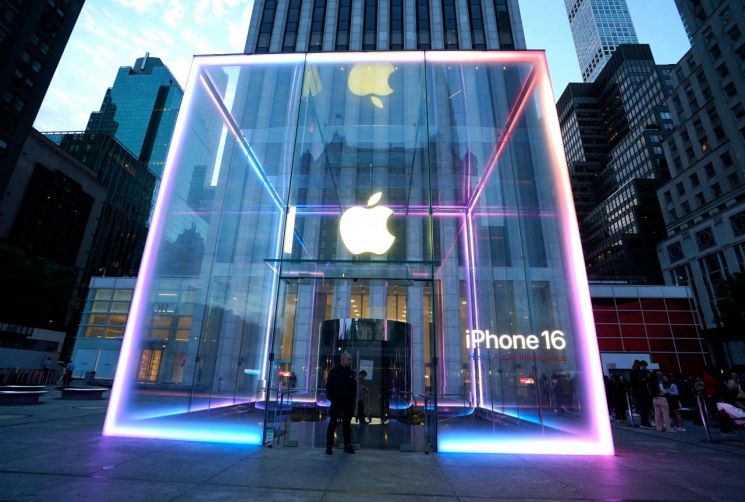 On September 20 last year, when the iPhone 16 series was released, a line of buyers formed in front of the Apple Store in New York. On the 13th (local time), U.S. President Donald Trump announced that he would not apply tariff exemptions to Apple. /AFP·Yonhap AFP Yonhap News Photo by AFP
Apple, which was exempted from tariffs during the first Trump administration, is unlikely to receive such exceptions under the second administration. Unlike six years ago, there is speculation that Apple, which produces about 90% of all its products including the iPhone in China, may shift its production bases to neighboring countries such as India this time.
On the 13th (local time), U.S. President Donald Trump announced that he would not apply tariff exemptions to Apple, which produces more than 90% of its products including the iPhone in China.
At the White House office in Washington DC on the same day, when asked whether he would consider exceptions or exemptions, President Trump said, "In Apple's case, we allowed tariff exemptions during the first term," adding, "Samsung was making products in Korea, so Samsung did not have to pay taxes."
He further explained, "At that time, the taxes were targeted at China, and Apple was producing many products in China. So we did that, but if not, it would not have been fair."
He then emphasized again, saying, "But now it applies to everyone. This is much simpler and a better way."
During the first Trump administration in 2019, Apple requested tariff exemptions on Chinese-made products such as the iPhone, and the Trump administration approved it. Apple also promised to relocate some Mac computer manufacturing bases from China to the U.S., but ultimately, this promise was not fulfilled.
As of 2023, more than 95% of Apple products, including the iPhone, iPad, and MacBook, are produced in China. Apple is making efforts to diversify its production bases to countries like India and Vietnam, but the majority of production remains concentrated in China.
The market is paying attention to the impact of the first Trump administration's policy on Apple. Apple CEO Tim Cook did not respond to concerns about tariffs on Chinese-made products during the Q1 earnings conference call on the 30th of last month.
MarketWatch noted, "Apple may expand its production bases outside China," adding, "The current 10% tariff rate is lower than the previously expected maximum of 60%, but it may encourage Apple to move production bases outside China."
India is being eyed as a candidate for the next production base. Business Standard recently reported that over the past few years, more than 10% of iPhone production has been shifted to major manufacturers within India.
Wamsi Mohan, an analyst at Bank of America (BofA), analyzed that Apple is likely to move production to India without raising prices. He told MarketWatch, "Apple can work with manufacturing partners to expand production in India and ship those products to the U.S. Other Apple products manufactured in Vietnam, Malaysia, and elsewhere can operate in the same way."
There are also concerns that, like other consumer goods, the price burden could be passed on to the final consumers, the American public. Gary Shapiro, president of the Consumer Technology Association (CTA), said, "Tariffs are taxes imposed not on foreign governments or companies, but on American consumers," and predicted, "Increased tariffs on products imported from Canada, China, and Mexico will cause inflation and raise prices for technology products, automobile manufacturing, and services."
© The Asia Business Daily(www.asiae.co.kr). All rights reserved.
![Clutching a Stolen Dior Bag, Saying "I Hate Being Poor but Real"... The Grotesque Con of a "Human Knockoff" [Slate]](https://cwcontent.asiae.co.kr/asiaresize/183/2026021902243444107_1771435474.jpg)















