Government Maintains Bleak Economic Outlook
Cites Delayed Domestic Demand Recovery and Persistent Difficulties for Vulnerable Groups
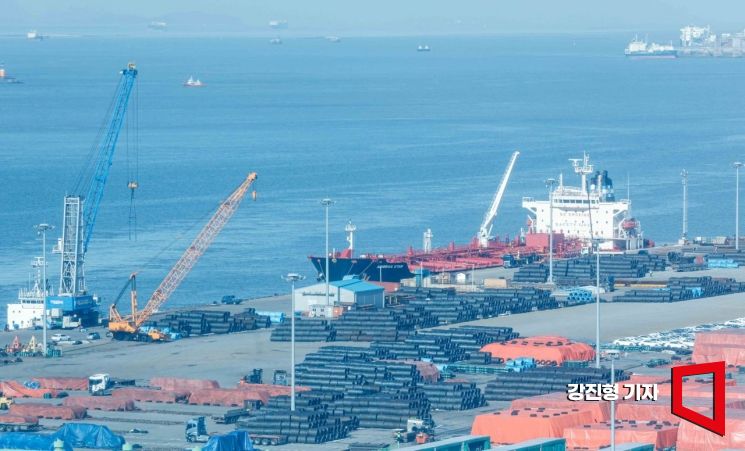 Steel products are piled up at the export yard of Pyeongtaek Port in Gyeonggi on the 13th, as major countries such as Japan, the United Kingdom, and the European Union (EU) rush to respond following President Donald Trump’s signing of a proclamation imposing a 25% tariff without exception on steel and aluminum products imported into the United States. 2025.2.13. Photo by Kang Jin-hyung
The government continues to diagnose the economy as bleak. After expressing concerns about employment slowdown last month, the government this month issued a negative assessment, stating that the recovery of domestic demand has been delayed, exacerbating difficulties for vulnerable groups. At the same time, it expressed caution by noting increased uncertainty in the trade environment, including the imposition of tariffs both domestically and internationally.
On the 14th, the Ministry of Economy and Finance stated in the February issue of the 'Recent Economic Trends (Green Book)' that "the recovery of domestic demand such as consumption and construction investment has been delayed, and difficulties in employment centered on vulnerable sectors persist, while economic sentiment has weakened due to domestic and international uncertainties, increasing downward pressure on the economy."
This is an explanation that the government maintained its negative diagnosis of the economy, as it did in the previous month's economic assessment which stated, "Downward pressure on the economy is increasing due to economic contraction caused by domestic and international uncertainties," but with more specific expressions.
Cho Sung-jung, head of the Economic Analysis Division at the Ministry of Economy and Finance, explained, "The perception that downward pressure on the economy has increased, as in last month, remains the same. Rather than presenting a particularly new perception, we added the phrase 'delayed domestic demand recovery' reflecting the fourth quarter GDP performance of last year." He added, "It is not that a completely new perception was reflected, but more specific expressions were used due to the domestic political situation that worsened sentiment at the end of the year and the impact of tariff measures by the new U.S. administration."
This month, the evaluation of the employment situation, which was mentioned for the first time since January last year in last month's Green Book, was continued. In particular, expressions were added indicating that the employment situation worsened mainly among vulnerable groups. Cho explained, "This month, since the number of employed persons increased, we used expressions about employment difficulties centered on vulnerable groups such as youth, construction workers, daily workers, and small business owners, rather than employment slowdown."
According to the 'January Employment Trends' announced by Statistics Korea on the same day, the number of employed persons aged 15 and over increased by 135,000 compared to a year earlier, but the number of employed persons in construction decreased by 169,000, marking the largest decline since the industry classification revision in 2013. Due to the ongoing construction recession since last year, the decline has continued for nine months, with the decrease widening. The number of manufacturing workers also decreased by 56,000.
Regarding the global economy, it was also assessed that "amid ongoing geopolitical risks, uncertainty in the trade environment has expanded due to the realization of tariffs imposed by major countries."
Recent domestic demand indicators are unfavorable. In particular, private consumption recovery has been delayed due to frozen consumer sentiment following the martial law incident in December last year. The Consumer Sentiment Index remained subdued at 91.2 in January this year, following 88.4 in December. A Consumer Sentiment Index below 100 indicates a negative perception of the economic situation.
Retail sales in December last year also decreased by 0.6% compared to the previous month. The growth rate of domestic card approvals dropped from 5.4% in November to 1.7% in December. Domestic sales of passenger cars decreased by 10.5% in January this year. The construction recession continues as well. Construction output in December increased by 5.9% in building construction compared to the previous month but decreased by 10.9% in civil engineering, resulting in an overall increase of only 1.3%. Construction investment in the fourth quarter of last year (GDP preliminary estimate) decreased by 3.2% compared to the previous quarter.
Exports, another pillar of the economy, also declined by 10.3% year-on-year in January due to reduced working days during the Lunar New Year holiday. However, daily average exports were $2.46 billion, up 7.6% from the previous year, showing a solid trend. The Ministry of Economy and Finance stated that "amid ongoing geopolitical risks, uncertainty in the trade environment has expanded due to the realization of tariffs imposed by major countries."
The Ministry of Economy and Finance said, "The government will actively respond to uncertainties in the trade environment, including support for Korean companies affected by U.S. tariffs and the establishment of a strategic fund for advanced industries," and added, "Through the first quarter livelihood economy response plan, we will swiftly prepare improvement measures for the livelihood economy in various sectors such as jobs, low-income finance, and small business owners by mobilizing all available means."
© The Asia Business Daily(www.asiae.co.kr). All rights reserved.
![Clutching a Stolen Dior Bag, Saying "I Hate Being Poor but Real"... The Grotesque Con of a "Human Knockoff" [Slate]](https://cwcontent.asiae.co.kr/asiaresize/183/2026021902243444107_1771435474.jpg)















