Youth Employment Drops by 218,000 in January
Employment Rate for Ages 15-29 Falls 1.5 Percentage Points to 44.8%

Despite the overall positive trend in employment, the youth employment slump continues. This is due to the declining working-age population caused by low birth rates and the growing trend of irregular and experienced hires, which are unfavorable to young job seekers. On the other hand, employment among the elderly is increasing, supported by senior job opportunities. There are also forecasts that this job polarization may gradually intensify starting this year.
Youth Employment Rate Declines for 9 Consecutive Months... Senior Jobs Increase Significantly
According to the 'January Employment Trends' released by Statistics Korea on the 14th, the number of employed persons last month was 27.878 million, an increase of 135,000 compared to the previous year. The employment rate for those aged 15 and over was 61.0%, unchanged from the previous year. The employment rate for the 15-64 age group, the OECD comparison standard, rose by 0.1 percentage points to 68.8% during the same period.
In contrast, youth employment indicators continued to show a sluggish trend. The number of employed youth aged 15-29 last month decreased by 218,000 compared to the same month last year, the largest drop since January 2021 (-314,000). The employment rate stood at 44.8%, down 1.5 percentage points from January last year, marking the largest decline in four years since January 2021 (-2.9 percentage points). The recovery trend is also slow to appear. The youth employment rate has been declining for nine consecutive months since May last year (-0.7 percentage points), the longest streak since the COVID-19 period from March 2020 to February 2021.
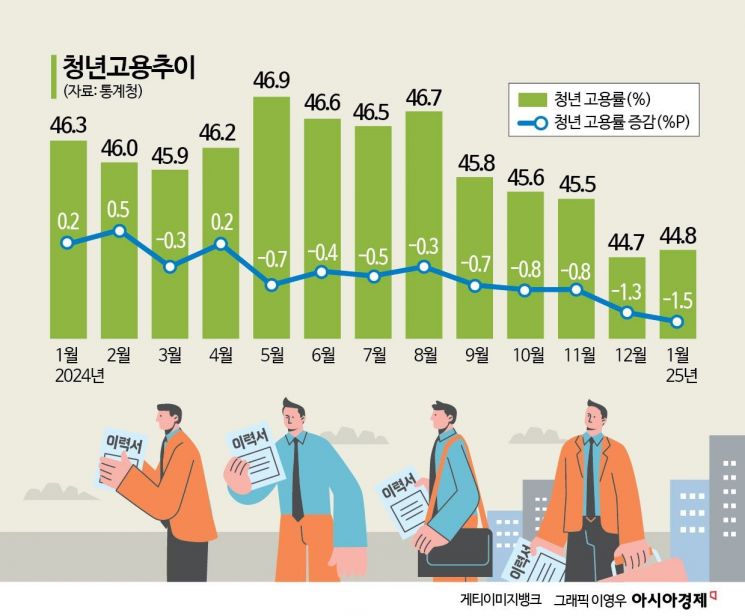
The worsening youth employment indicators are attributed to changes in hiring methods. Gong Mi-sook, Director of the Social Statistics Bureau at Statistics Korea, said, "(Youth employment) increased after COVID-19 but has recently been declining," adding, "There is an analytical report indicating that irregular and experienced hires are working against youth employment." Typically, when irregular and experienced hiring becomes popular, the number of unemployed job seekers decreases, while the population classified as 'inactive'?those not participating in the labor market?increases. Comparing last year and this year, youth unemployment decreased from 246,000 to 230,000, but the inactive population increased from 403,000 to 434,000.
Nevertheless, the overall employment indicators remained favorable due to a significant increase in employment among the elderly. The number of employed persons aged 60 and over increased by 340,000, far exceeding the total employment increase of 135,000. Without the elderly aged 60 and over, employment would have been negative. The employment rate for this group rose by 1.0 percentage point to 42.3% compared to the same month last year. This is believed to be influenced by the government's accelerated fiscal spending, which advanced the timing of senior job supply from February to January.
The polarization of jobs between the elderly and youth generations is expected to intensify starting this year. This is due to the long-term low birth rate and aging population, which have reduced the working-age population (15-64 years) and rapidly increased the proportion of elderly people. Jang Ju-seong, Director of the Human Resources Policy Division at the Ministry of Economy and Finance, explained, "There is an analysis by the Korea Development Institute (KDI) suggesting that the negative effects of the declining working-age population will begin to take full effect this year," adding, "There are concerns that the increase in the number of employed persons may be limited this year."
Ongoing Construction Industry Slump... Largest Employment Decline Since 2013
By industry, employment in construction decreased by 169,000, showing the largest decline. The prolonged downturn in the construction market has led to the biggest drop since related statistics began being compiled in 2013. Employment in construction has been declining for nine consecutive months, with the decrease widening. Manufacturing employment also fell by 56,000. Although semiconductor export conditions remain favorable, employment has been declining for seven consecutive months since July last year. Retail and wholesale trade employment decreased by 91,000.
On the other hand, employment increased in health and social welfare services (119,000), professional, scientific, and technical services (98,000), and information and communication industries (81,000).
The unemployment rate remained at 3.7%, unchanged from the previous year. The number of unemployed persons increased by 11,000 to 1.083 million. Among the youth, the number of unemployed decreased by 16,000 compared to a year ago, with the unemployment rate steady at 6.0%.
The economically inactive population was 16.713 million, an increase of 150,000 (0.1%) from a year earlier. By gender, the number of inactive males rose by 172,000 (2.8%) to 6.406 million compared to the same month last year, while inactive females decreased by 157,000 (1.5%) to 10.307 million.
The inactive population classified as 'resting' increased across all age groups. Among the economically inactive, the 'resting' population by age group increased compared to the same month last year in those aged 60 and over (42,000), those in their 20s (37,000), and those in their 50s (33,000). The number of discouraged workers rose by 6,000 to 404,000 compared to the same month last year.
© The Asia Business Daily(www.asiae.co.kr). All rights reserved.


















