The Trump administration's review of the subsidy payment conditions under the CHIPS and Science Act (CSA) is expected to lead to changes in the business strategies of Samsung Electronics and SK Hynix. As regulations to curb China's semiconductor industry are likely to be strengthened, Korean companies are expected to face greater difficulties in operating their businesses in China. There is also a possibility of a reduction in the subsidy amount.
According to the semiconductor industry on the 14th, Samsung Electronics and SK Hynix were allocated a total of $5.195 billion (approximately 7.5 trillion KRW) in CSA subsidies. Samsung Electronics is investing $37 billion (approximately 49 trillion KRW) to build semiconductor production facilities in Taylor, Texas, while SK Hynix plans to invest $3.87 billion (approximately 5.1 trillion KRW) in Indiana to construct a next-generation high-bandwidth memory (HBM) packaging plant.
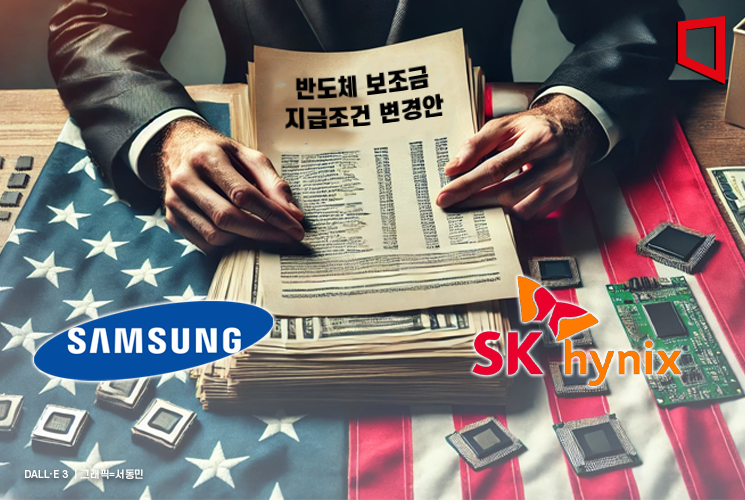
With the subsidy amount and production facility construction plans already set, sudden changes are expected to pose a burden on Korean companies. The Trump administration is reportedly considering easing corporate social responsibility burdens in the subsidy payment conditions while strengthening the excess profit sharing ratio and regulations related to China.
The existing subsidy conditions include provisions such as employing unionized workers, providing affordable childcare services, and sharing up to 75% of excess profits. As companies have expressed concerns about operational burdens, there is talk of easing social responsibility requirements. Accordingly, Samsung Electronics and SK Hynix may benefit from reduced labor costs in their U.S. investments.
On the other hand, the possibility of stricter restrictions on Chinese investments by companies receiving subsidies is increasing, which is expected to place a heavier burden on Samsung Electronics and SK Hynix's operations of production facilities in China. Currently, companies receiving CSA subsidies are prohibited from expanding semiconductor manufacturing capabilities in China for ten years, but the Trump administration is considering applying this rule more strictly.
Samsung Electronics operates a NAND flash factory in Xi'an, China, and SK Hynix owns a DRAM production facility in Wuxi, China. If additional regulations are introduced, these companies may face difficulties in maintaining and upgrading their production facilities. In particular, if the introduction of advanced semiconductor manufacturing equipment in China is restricted, production efficiency is likely to decline significantly.
The U.S. government is likely to adjust its subsidy policy to strengthen the semiconductor supply chain within the United States. It may require companies receiving subsidies to expand semiconductor production volume domestically and to make additional investments in back-end (packaging) and research and development (R&D) facilities. There is also a possibility that conditions will be added requiring that semiconductors produced in the U.S. be supplied preferentially to American companies. In this case, Samsung Electronics and SK Hynix may face pressure to expand their production facilities in the U.S. Furthermore, if provisions requiring access to semiconductor production facilities by U.S. national security agencies such as the Department of Defense remain, concerns over technology and trade secret leaks are expected to increase.
An official from a major semiconductor company expressed concern, saying, "Subsidies amounting to trillions of won are a significant sum for companies, so any changes in payment conditions will inevitably have a considerable impact on investment plans." He added, "Since the Trump administration's review of subsidy policies could bring about greater changes than expected, careful responses are necessary. Companies need to thoroughly examine strategies on how to balance production investments in the U.S. with business operations in China."
© The Asia Business Daily(www.asiae.co.kr). All rights reserved.

















