Declaration of Global Trade War
Actual Implementation Begins After April
Renegotiation of Semiconductor Subsidies
Concerns Rise for Samsung and SK
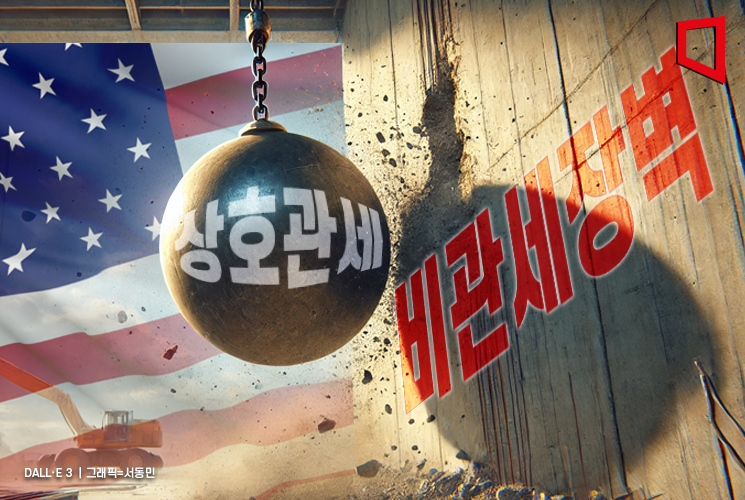
On the 13th (local time), U.S. President Donald Trump signed a presidential memorandum containing mutual tariff measures, effectively declaring a trade war to the world. While Europe is the most blatantly threatened, the situation is dire for South Korea as well, where the Korea-U.S. Free Trade Agreement (FTA) has become virtually meaningless. The U.S. has announced that the implementation date for mutual tariff measures will be April 1. This gives a grace period of about one month and a half. Additionally, concerns have grown among domestic companies such as Samsung Electronics and SK Hynix as the U.S. is also revising the CHIPS and Science Act (CSA) to strengthen its semiconductor industry dominance.
At 1 p.m. that day, President Trump signed the presidential memorandum on imposing mutual tariffs in the White House Oval Office, stating, "I have decided to impose mutual tariffs for the sake of 'fairness,'" and added, "It will be fair to everyone, and no other country can complain."
Mutual tariffs mean that the U.S. imposes tariffs on goods from other countries at the same rate as those countries impose on U.S. goods. White House Press Secretary Karoline Leavitt justified the mutual tariff measures by citing the "Golden Rule" from the Bible, saying the reason for imposing mutual tariffs is based on very simple logic. This reflects President Trump's determination to respond to 100% tariffs with 100% tariffs.
President Trump said that Howard Lutnick, the nominee for Secretary of Commerce, would review both tariff and non-tariff barriers of other countries to determine tariff rates. Lutnick indicated that tariffs would be negotiated and differentiated on a country-by-country basis, saying, "We will handle it one-on-one by country." He also said, "The administration-level study on this issue will be completed by April 1," signaling that the actual application of mutual tariffs will take place after April 1.

Mutual tariffs themselves serve as a card for negotiations favorable to the U.S. A senior White House official said in a pre-briefing that the administration would set mutual tariffs tailored by country, considering "unfair and discriminatory taxes or extraterritorial taxes," including tariffs and value-added taxes imposed by trading partners on U.S. products. The example of value-added tax applies to Europe.
South Korea, which does not impose mutual tariffs under the Korea-U.S. FTA, is also expected to fall within the scope of concern. President Trump had shown dissatisfaction with the Korea-U.S. FTA during his first term. In 2017, he even mentioned withdrawing from the Korea-U.S. FTA but later retracted the statement. A senior White House official explained in a pre-briefing that the administration is focusing "like a laser beam" not only on tariffs imposed by trading partners but also on what are called non-monetary or non-tariff barriers.
Especially, South Korea is in a difficult position to actively respond to trade relations with the U.S. due to its internal situation amid the impeachment crisis. Victor Cha, a senior adviser at the Center for Strategic and International Studies (CSIS), said, "This is not something experts can handle from the bottom up; the national leader must meet President Trump to respond."
The three major U.S. stock indices closed higher that day. The Dow Jones Industrial Average rose 0.77%, the S&P 500 index jumped about 1%, approaching its previous high, and the tech-heavy Nasdaq Composite surged 1.5%. The market showed some relief based on the learning effect from previous trade negotiations involving tariffs with Canada and Mexico after President Trump played the negotiation card. The fact that mutual tariffs are not applied immediately improved investor sentiment somewhat. Although the U.S. Producer Price Index (PPI) for January exceeded market expectations, it slowed compared to the previous month, which also had an impact.
Along with this, the U.S. is applying comprehensive pressure for a U.S.-centered global industrial restructuring by utilizing other legislative amendments. Reuters reported that the Trump administration is pushing for renegotiation of subsidies under the CHIPS and Science Act (CSA), citing sources that some semiconductor subsidy payments may be delayed. The CSA provides a total of $52.7 billion over five years, including $39 billion in direct subsidies and $13.2 billion in research and development (R&D) subsidies to semiconductor companies building factories in the U.S.
The reason for the Trump administration's renegotiation is presumed to be that some companies have expanded investments in China and other countries after receiving subsidies. A source said the White House is displeased with companies that announced significant plans to enter China and other countries after receiving CSA subsidies. Samsung Electronics and SK Hynix, which agreed to invest in the U.S. and receive subsidies under the act, also have manufacturing facilities in China and may be affected.
David Isaacs, Vice President of Government Affairs at the Semiconductor Industry Association, said, "Manufacturing incentives and research programs must continue without interruption," adding, "We are ready to work with members of the Trump administration to streamline program requirements and achieve the shared goal of strengthening U.S. leadership in semiconductor technology."
© The Asia Business Daily(www.asiae.co.kr). All rights reserved.
![Clutching a Stolen Dior Bag, Saying "I Hate Being Poor but Real"... The Grotesque Con of a "Human Knockoff" [Slate]](https://cwcontent.asiae.co.kr/asiaresize/183/2026021902243444107_1771435474.jpg)
















