Presence Grows in the Domestic Industrial Sector
Thanks to the strong performance in biosimilars (biopharmaceutical generics) and new drug development and sales, Korean pharmaceutical and bio companies are rewriting their performance history. Amid a domestic industrial sector struggling with deteriorating results due to the global recession and protectionism, their presence is becoming increasingly prominent.
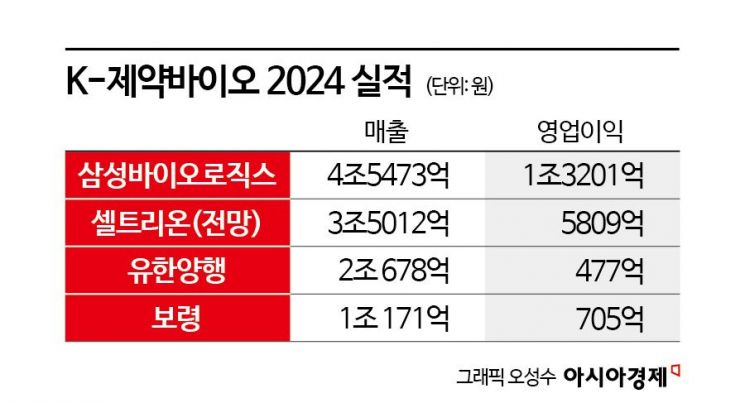
According to the Financial Supervisory Service's electronic disclosure on the 14th, Samsung Biologics opened a new horizon by becoming the first Korean pharmaceutical and bio company to surpass 4 trillion won in sales last year. Samsung Biologics announced that its consolidated sales last year reached 4.5473 trillion won, with an operating profit of 1.3201 trillion won. Compared to 2023, sales increased by 23% (852.7 billion won) and operating profit rose by 19% (206.4 billion won). Samsung Biologics recorded orders worth 5.4035 trillion won last year alone, including three contract manufacturing organization (CMO) contracts in global markets such as the United States.
Another 'Bio Big 2' company, Celltrion, is also expected to reach an all-time high of about 3.5 trillion won. According to the consensus (average securities firm forecast) by financial information provider FnGuide, Celltrion is projected to achieve sales of 3.5012 trillion won and operating profit of 580.9 billion won last year. Compared to the previous year, sales are expected to increase by 60.9%, while operating profit is forecasted to decrease by 10.8%.
Celltrion recorded sales of 2.1764 trillion won and operating profit of 651.5 billion won in 2023. The rise in Celltrion's sales is attributed to increased biosimilar sales. In particular, in the autoimmune disease sector, as of the third quarter of last year, Remsima SC (generic name infliximab, subcutaneous injection form) held a 25% market share, and Upaliima (generic name adalimumab) held a 17% market share in the five major European countries, continuing their growth trend.
Yuhan Corporation became the first domestic pharmaceutical company to join the '2 trillion won club.' Yuhan's sales have been increasing for five consecutive years. The company disclosed that its consolidated sales last year rose 11.2% year-on-year to 2.0678 trillion won. This growth is attributed to increased licensing revenue following the approval of the domestic new drug for non-small cell lung cancer, Rexaza (lazertinib), in the United States and Europe last year.
Boryung also surpassed 1 trillion won in sales for the first time since its founding. Last year, it recorded consolidated sales of 1.0171 trillion won. This represents an 18.3% increase from 859.6 billion won the previous year, with operating profit rising 3.2% to 70.5 billion won. The growth of chronic disease specialty drugs, including the hypertension new drug 'Kanab Family,' and the joint sales and marketing of HK Innoen's gastroesophageal reflux disease new drug 'K-CAB' are considered direct contributing factors.
© The Asia Business Daily(www.asiae.co.kr). All rights reserved.
![Clutching a Stolen Dior Bag, Saying "I Hate Being Poor but Real"... The Grotesque Con of a "Human Knockoff" [Slate]](https://cwcontent.asiae.co.kr/asiaresize/183/2026021902243444107_1771435474.jpg)
















