Financial Services Commission Holds 3rd Virtual Asset Committee Meeting
Unveils Roadmap for Corporate Participation in Virtual Asset Market
Financial Companies Excluded... General Corporations to Be Considered Mid- to Long-Term
From the second half of this year, a total of approximately 3,500 corporations registered as professional investors will be able to trade virtual assets. The Financial Services Commission announced that after issuing real-name accounts convertible to cash to non-profit organizations and virtual asset exchanges in the first half of this year, it plans to pilot trading transactions for professional investors from the second half of the year.
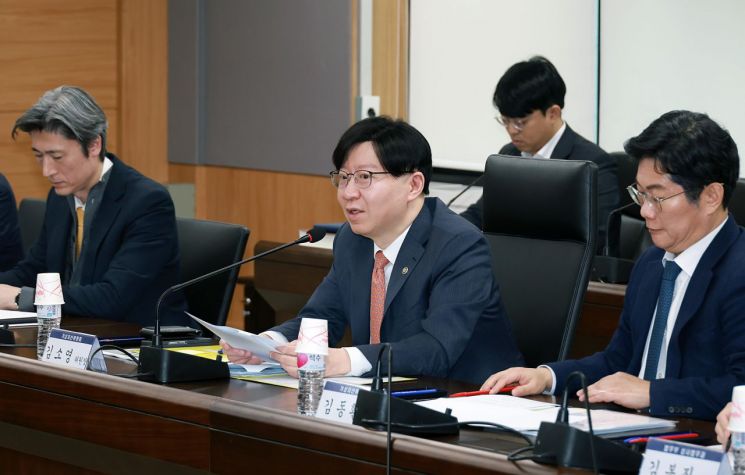 Kim So-young, Vice Chairman of the Financial Services Commission, held the 3rd Virtual Asset Committee meeting on the morning of the 13th at the Seoul Government Complex. Together with related ministries, agencies, and private committee members, they conducted a final discussion and review of the government's policy consideration regarding the "allowance of corporate participation in the virtual asset market." Photo by Financial Services Commission
On the 13th, the Financial Services Commission held the 3rd 'Virtual Asset Committee' meeting chaired by Vice Chairman Kim So-young at the Government Seoul Office in Jongno-gu, Seoul, and announced that it will gradually allow corporate participation in the virtual asset market.
Corporate virtual asset trading has been fundamentally restricted since 2017 due to government regulations. At that time, the government banned corporate virtual asset trading to mitigate overheated speculative phenomena, considering that corporate trading posed greater risks of money laundering and market overheating compared to individuals. To this day, banks have conventionally limited the opening of real-name accounts under corporate names.
Vice Chairman Kim So-young stated, "There was consensus on the need to allow corporate market participation, considering overseas cases where the virtual asset ecosystem is mainly corporate-driven and the enhancement of global regulatory consistency," adding, "We intend to gradually promote the issuance of real-name accounts for corporations within the scope that does not undermine user protection and market stability."
In the first half of this year, the issuance of real-name accounts for sales aimed at cash conversion will be permitted. For non-profit corporations receiving donations and sponsorships, such as designated donation organizations and universities that ensure transparency in fundraising and utilization and are supervised by relevant authorities, the issuance of corporate real-name accounts will be allowed from the second quarter. Support will also be provided to establish minimum 'internal control standards.'
In the case of virtual asset exchanges, virtual assets received as fees can be converted to cash and used for operating expenses such as personnel costs and tax payments. However, since conflicts of interest with users may arise due to large-scale sales by exchanges, a joint 'sale guideline' will be established by operators and then sequentially permitted.
From the second half of the year, pilot issuance of real-name accounts for trading for investment and financial purposes will be allowed for some institutional investors with risk tolerance capabilities. Specifically, this applies to about 3,500 corporations registered as professional investors under the Capital Markets Act, excluding financial companies but including listed companies.
Vice Chairman Kim explained, "This reflects the fact that professional investors under the Capital Markets Act can already invest in derivatives, which carry the highest risk and volatility," and added, "The pilot scope was selected considering the high demand from these corporations for blockchain-related businesses and investments."
For general corporations that are not professional investors, a mid- to long-term review will be conducted after carefully analyzing the virtual asset market situation and pilot results, and once the second phase of legislation and related systems such as foreign exchange and taxation are completed.
As corporate participation in the virtual asset market expands through this pilot, corresponding supplementary measures will also be strengthened. These include preparing 'trading guidelines' that encompass enhanced verification of transaction purposes and fund sources by banks to prevent money laundering, recommendations to utilize third-party virtual asset custody and management institutions, and expanded disclosures to investors. Since there are differences in capabilities among individual professional investors, the final decision on issuing real-name accounts will be made through detailed reviews by banks and exchanges.
The commission viewed that the risks of the virtual asset market could affect the entire financial system. Therefore, rather than directly permitting virtual asset trading, considering the recent active global discussions on tokenization of financial assets and blockchain infrastructure utilization, it plans to support the issuance of token securities (STO) through legislation. Various policy measures, including expanding blockchain-related investments in the financial sector, will also be pursued.
The committee agreed on the need to actively participate in parliamentary discussions for the institutionalization of token securities. Currently, bills to amend the Electronic Securities Act and the Capital Markets Act have been submitted to the National Assembly to institutionalize token securities by accepting them as a form of electronic securities and introducing issuer account management institutions to enable token securities issuance without linkage to securities firms.
© The Asia Business Daily(www.asiae.co.kr). All rights reserved.

















