Operating Loss Reduced to 900 Million Won, Sales Reach 537 Billion Won Last Year
Driven by White Board Paper Price Hike and Raw Material Cost Stabilization
KleanNara succeeded in significantly reducing its operating loss last year, thanks in part to an increase in the price of white board paper. With the company facing a structural downturn due to digital transformation, attention is now focused on whether KleanNara can return to profitability this year for the first time in three years through the development of eco-friendly and new material products.
According to the electronic disclosure system on February 13, KleanNara's operating loss last year was 902 million won, a 95.2% reduction compared to the previous year's 18.91 billion won. During the same period, sales increased by 4.3% to 537.05 billion won. Net loss also decreased by 28.2%, from 30.84 billion won to 22.14 billion won, reflecting an overall improvement in performance.
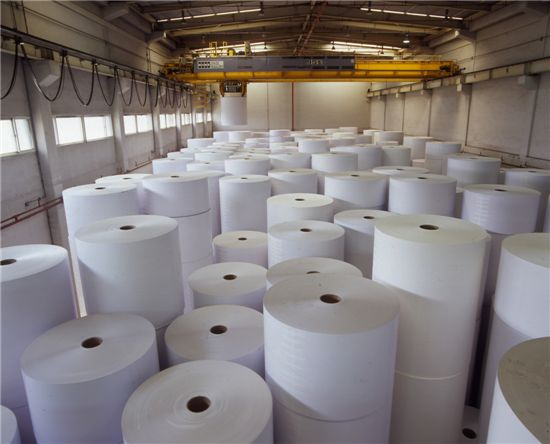
As the second-largest company in the white board paper industry and with its main revenue coming from this segment, KleanNara began to see its profitability significantly deteriorate in 2022 due to rising raw material costs. White board paper refers to thick paper made by mixing pulp and waste paper. The price of pulp, a key raw material for white board paper, soared in 2022 due to the impact of the Ukraine-Russia war, reaching an all-time high of $1,030 per ton in December of that year. As a result, in 2023, KleanNara posted an operating loss of nearly 20 billion won, swinging into the red.
Industry experts believe that the recent improvement in performance is the result of both an increase in white board paper prices and the stabilization of key raw material costs. In March 2023, KleanNara decided to reduce the discount rate for SC Manila board paper from 30% to 20% in response to the sharp rise in raw material costs. By lowering the discount rate that was typically applied to the base price, the company effectively increased the unit price by 10%.
Additionally, the stabilization of pulp prices-which had been volatile due to global instability-at around $600 per ton also played a role. An industry insider commented, "The industry considers a stable pulp price to be around $600 per ton. While pulp prices exceeded $800 per ton at the beginning of last year, they dropped to $665 per ton by December, showing significant stabilization. The combination of higher unit prices and a decline in pulp prices-which account for 60% of white board paper costs-appears to have greatly improved profitability."
Nevertheless, it remains uncertain whether KleanNara will be able to achieve a return to profitability this year for the first time in three years. This is because demand for printing paper continues to decline due to digital transformation, and countries such as China and Malaysia are expanding their production facilities for printing and industrial paper, intensifying cutthroat competition in the global market. In addition, the continued high exchange rate means that the company must reflect the increased costs of pulp imports in its product prices.
In response, KleanNara plans to enhance its price competitiveness in the global market by streamlining production processes, while also seeking breakthroughs through the development of eco-friendly and new material products. The company is also focusing on developing new eco-friendly products such as wet wipes and sanitary pads. A KleanNara representative stated, "We plan to strengthen our price competitiveness and expand our presence in export markets by optimizing production processes and reducing energy consumption. At the same time, we will continue to seek opportunities for new product development and entry into new markets, such as high value-added products, to enhance our competitiveness in the domestic market."
© The Asia Business Daily(www.asiae.co.kr). All rights reserved.
















