Ruling Party Leadership Gathers at Constitutional Amendment Debate
"Authority Should Be Transferred to Local Governments"
Regarding the Myung Taegyun Special Prosecutor Act, Oh Says
"Political Situation Should Not Be Swayed by a Single Criminal's Statement"
"Prosecution Should Resolve Political Uncertainty Through a Swift Investigation"
"Constitutional Court Trial Is Underway"
Oh Remains Reserved but Effectively Confirms Candidacy
On the 12th, Seoul Mayor Oh Se-hoon mentioned impeachment proceedings against President Yoon Suk-yeol when asked about his potential bid for the next presidential election, stating, "It is not too late to discuss an early presidential election after the conclusion of that decision." While maintaining his previous general stance, he did not deny his intention to run, leading to interpretations that he may have effectively confirmed his candidacy if an early election is held.
When reporters outside the constitutional amendment debate held at the National Assembly that morning asked Mayor Oh about being mentioned as a potential next presidential candidate from the ruling party, he said, "The Constitutional Court is currently conducting a trial," and added, "I think it is not too late to discuss an early presidential election after that conclusion." He further stated, "In that sense, it is not desirable to interpret this constitutional amendment debate as linked to the presidential election campaign."
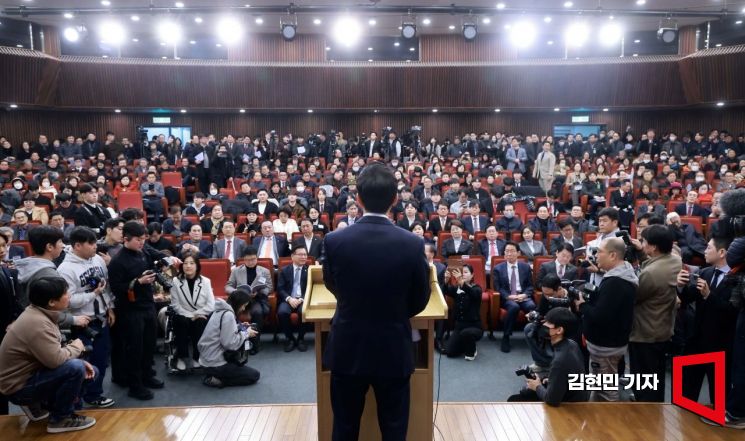 Seoul Mayor Oh Se-hoon is delivering the opening remarks at the "Local Decentralization Constitutional Amendment Forum to Overcome the 1987 System" held at the National Assembly Library on the 12th. 2025.2.12 Photo by Kim Hyun-min
At the 'Constitutional Amendment Debate for Overcoming the 1987 System' held that day, Mayor Oh ignited the push for a constitutional amendment that boldly transfers central government powers to local governments. The event was attended by about 60 members of the ruling People Power Party, including party leaders such as Kwon Young-se, the party's emergency committee chairman, and Kwon Seong-dong, the floor leader, who collectively supported Mayor Oh's constitutional amendment proposal.
Mayor Oh has advocated for the need for constitutional amendment since the emergency martial law incident last year. His intention is to change the political system to break the vicious cycle where the presidential autocracy and the legislative dominance of a large opposition party lead to political conflicts. At the New Year's press conference, he said, "A constitutional amendment, including restructuring the power system to reduce the leader's risk and check parliamentary power, is necessary."
Regarding the day's topic of 'local decentralization,' he has emphasized it in various events and lectures last year. Mayor Oh said, "It should not be superficial local decentralization but substantial authority. In other words, only foreign affairs, security, and defense powers should remain with the president, and all other powers should be boldly transferred to metropolitan local governments." He proposed, "The current national tax to local tax ratio is 7 to 3, but we should boldly shift it to 5 to 5 or more, completely transferring fiscal authority to local governments. From setting and collecting taxes to using tax revenues, all authority should be given to local governments."
The People Power Party leadership also supported the constitutional amendment, backing Mayor Oh as a potential 'presidential candidate.' Floor leader Kwon emphasized the need for constitutional amendment again on this day, following his speech the previous day at the National Assembly's negotiation group representative speech. He explained, "The current political situation arose from a direct clash between presidential and parliamentary powers. It is evidence that checks and balances were not properly maintained." He added, "While the focus of discussions had been on how to limit the president's autocratic power, the current situation requires focusing on how to limit the autocratic power of the legislature and how to achieve mutual checks and balances."
He also raised issues with the autocratic presidential system. Regarding the constitutional amendment proposal, he said, "I propose a constitutional amendment that overcomes the drawbacks of the autocratic presidential system, where excessive power is concentrated in the president, by adopting a local decentralization model that delegates all domestic authority to local governments as part of a major national restructuring." He emphasized, "I want to offer hope that system improvements through this opportunity can lead to a national restructuring that enables a quantum leap in economic development for South Korea, which has remained at a per capita income of $35,000 for years, with local decentralization as the core." He added that discussions should also include mechanisms for mutual checks between the cabinet and the legislature, adjustments to the presidential term, and a prime ministerial responsibility system.
Because of this, many interpreted the debate as linked to a presidential campaign. The questions about whether Mayor Oh would run in an early presidential election were in the same context.
Mayor Oh has previously taken a defensive stance on running for president. At last month's New Year's press briefing, he said, "I am deeply considering it," but drew a line by saying, "It is too early to talk about whether I will run." However, he also expressed his willingness not to avoid responsibility and role, stating, "The capabilities I have built as a four-term Seoul mayor are not personal but public assets." At that time, Mayor Oh said, "Now, the people want to see normal leadership and rational governance by normal people. They want a leader who can be infinitely humble in the face of governance know-how, knowledge, and information," thus presenting a concrete direction for the future leader image.
On the allegations related to Myung Tae-gyun, which had hindered Mayor Oh, he also gave additional remarks that day. Regarding the 'Myung Tae-gyun Special Prosecutor Act' proposed by the six opposition parties including the Democratic Party, he said, "The prosecution investigation is delayed, so the Democratic Party brings up the special prosecutor. Everyone knows that such repetition is undesirable." He added, "It is never desirable to allow statements from a single criminal to sway the political situation," and urged the prosecution to "resolve political uncertainty through a swift investigation."
He continued, "The prosecution has secured Mr. Myung's phone and whereabouts, so why are they not investigating or delaying the investigation?" He said, "If the investigation is delayed and undesirable statements from Mr. Myung shake the political order, that is the prosecution's responsibility." Mayor Oh, who had previously supported submitting an impeachment motion against President Yoon in the National Assembly, said again that day, "I have long held the position that we should seek a legal judgment through impeachment, and that position has not changed at all."
Regarding allegations of election fraud raised within the ruling party, he said, "Many people are raising issues about poor election management," and stressed the need to improve voting procedures, including early voting. On early voting, he stated, "Our party talks about early voting close to the main vote or early voting just before the main vote, and I agree with that part."
© The Asia Business Daily(www.asiae.co.kr). All rights reserved.

















