People Power Party Shifts Toward Extra Budget Negotiations
Disagreements Remain Over Prerequisites and Conditions
With the People Power Party expressing a flexible stance on the formulation of an additional supplementary budget (extra budget), the likelihood of early execution of the extra budget-expected to serve as a catalyst for economic recovery-has increased. However, as differences in opinion between the ruling and opposition parties over the prerequisites for the extra budget remain significant, the need for a resolution through high-level negotiations between party leaders is also being discussed.
On February 12, Park Chandae, floor leader of the Democratic Party of Korea, said at the Supreme Council meeting held at the National Assembly, "Our economy could enter an irrecoverable state, so we urgently need to resuscitate it through a supplementary budget. Since the People Power Party has also acknowledged the necessity of an extra budget, we must proceed with discussions as quickly as possible. In such a time-sensitive situation, attaching various preconditions or blaming the opposition to delay the process is an admission by the People Power Party of its irresponsibility and incompetence."
Previously, on February 11, Kwon Seongdong, floor leader of the People Power Party, opened the door to negotiations during his speech as the representative of the negotiation bloc, stating, "We do not oppose discussions on the extra budget." However, he set several preconditions: restoring the budget that was unilaterally reduced by the opposition last year, prohibiting the allocation of funds for local currency programs, and passing the Special Semiconductor Act within the February session.
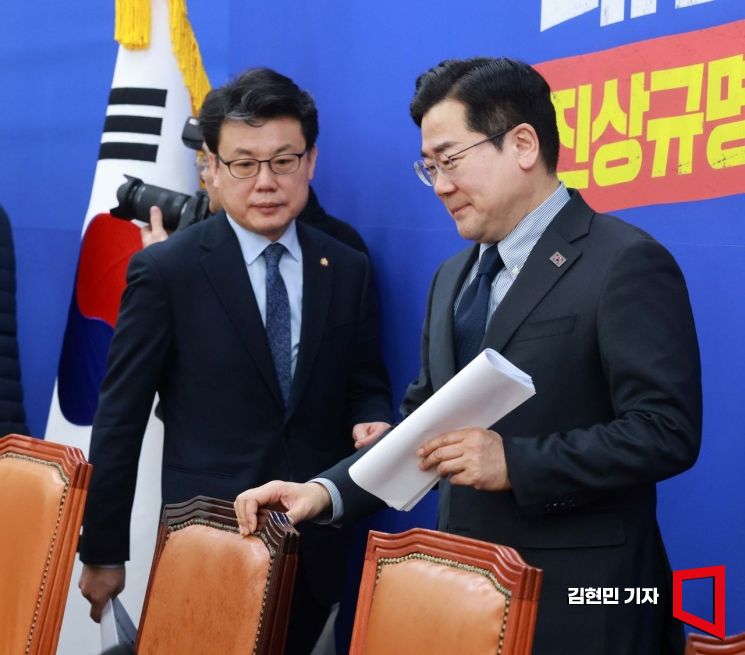 Park Chandae, floor leader of the Democratic Party of Korea, is attending the floor strategy meeting held at the National Assembly on February 11, 2025. Photo by Kim Hyunmin
Jin Sungjoon, policy committee chair of the Democratic Party, criticized this stance in a KBS radio interview, saying, "It reflects their unwillingness to hand over the political initiative to the opposition." Regarding the Special Semiconductor Act, he stated, "Issues such as exceptions to the 52-hour workweek for research personnel and others should be discussed with more time, and we should address the agreed-upon parts first." He also argued that a significant portion of the budget the ruling party wants restored consists of special activity funds for the prosecution, for which no supporting documents have been submitted, and which are unrelated to public welfare. Regarding the Special Semiconductor Act, Jin reiterated, "The issue of exceptions to the 52-hour workweek for research personnel and others should be discussed with more time, and we should address the agreed-upon parts first."
On the other hand, the People Power Party is raising the level of pressure, insisting that the Special Semiconductor Act must include exceptions to the 52-hour workweek. The issue is that the government-opposition consultative body, which remains stalled, is virtually the only negotiation channel for the extra budget.
It is known that the People Power Party prefers a one-shot approach to the extra budget, where the government-opposition consultative body determines the items and formulates the budget bill, rather than having the government draft it alone. Regarding the stalled negotiations, Policy Committee Chair Jin commented, "There seem to be issues that cannot be decided at the working level," adding, "It appears this needs to be handed over to a meeting between party leaders."
Moreover, there are concerns that the actual time available for negotiations is running out. This is because a ruling on the impeachment trial of President Yoon Suk Yeol is expected at the end of February or early March. Considering the potential political turmoil and shock from a possible early presidential election after the ruling, it is argued that the extra budget must be addressed quickly, before these events unfold.
© The Asia Business Daily(www.asiae.co.kr). All rights reserved.

















