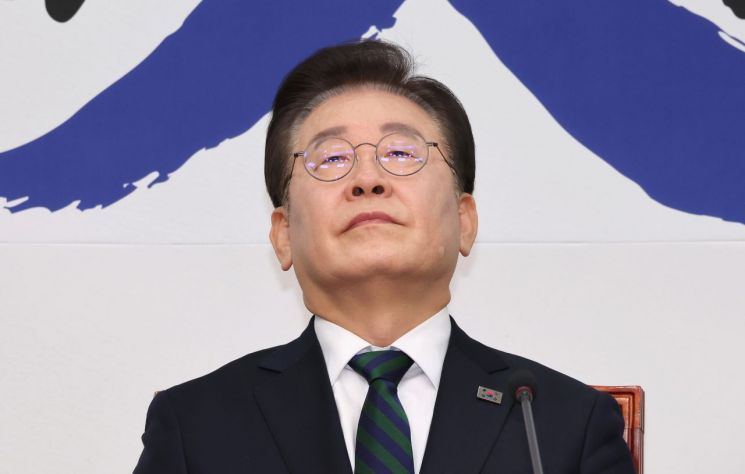
 Democratic Party leader Lee Jae-myung listens to the remarks of committee members at the Supreme Council meeting held at the National Assembly on the 12th. Photo by Yonhap News
The ruling and opposition parties have broadly agreed to take the lead on 'parameter reform' related to pension reform, adjusting contribution rates and income replacement rates. However, concerns about a deadlock have already emerged due to significant differences between the parties over preliminary issues such as the discussion participants and the direction of 'structural reform.'
According to the National Assembly on the 12th, Lee Jae-myung, leader of the Democratic Party of Korea, and Kwon Seong-dong, floor leader of the People Power Party, recently expressed their willingness to push forward pension reform over two consecutive days, opening the door to discussions. In his party representative speech on the 10th, Lee proposed, "Let's start reforming from parts where agreement is immediately possible," to which Kwon responded the day before by saying, "I will accept discussing parameter reform first," creating an atmosphere of hopeful agreement.
However, looking at the details, the ruling and opposition parties still remain on parallel tracks regarding pension reform. Although Kwon mentioned 'prior parameter reform,' he set the precondition that both parties must agree on the formation of a special committee on pension reform. The People Power Party insists that specific matters should be discussed within the pension reform special committee, which is likely to be composed equally by both parties, while the Democratic Party argues that parameter reform should be handled by the Health and Welfare Committee, where the opposition holds a majority, and structural reform should be discussed separately. Unless the discussion participants and positions on structural reform are settled, parameter reform will also be difficult.
It is also problematic that Choi Sang-mok, Acting Prime Minister and Minister of Economy and Finance, expanded the front by calling for reform that involves 'paying more and receiving less.' At the Cabinet meeting the day before, Acting Prime Minister Choi said, "If the National Pension becomes insolvent, the confusion and repercussions are unpredictable," and emphasized the need for a social consensus on 'paying more and receiving less.' While the ruling and opposition parties remain deadlocked over even narrowing the 1 percentage point gap in the income replacement rate, Acting Prime Minister Choi has instead expanded the discussion to structural reform.
In response to criticism from the Democratic Party that this "contradicts the direction of National Assembly discussions," a government official explained, "Acting Prime Minister Choi merely expressed a fundamental position on pension reform and did not refer to matters currently under discussion by the ruling and opposition parties in the National Assembly." However, since Acting Prime Minister Choi, as the Deputy Prime Minister for Economy, holds a strong belief in the urgent need for a sustainable pension structure, it is expected that his voice will grow louder once trilateral discussions among the ruling party, opposition, and government intensify.
The ongoing power struggle between the ruling and opposition parties over the Semiconductor Special Act and supplementary budget formulation, which has prevented even scheduling a National Policy Council meeting, is also expected to act as an obstacle. The policy chiefs of both parties held a closed-door meeting the day before to discuss the schedule and agenda for a four-party National Policy Council meeting to discuss pension reform and the Semiconductor Special Act but failed to find common ground.
© The Asia Business Daily(www.asiae.co.kr). All rights reserved.
![Clutching a Stolen Dior Bag, Saying "I Hate Being Poor but Real"... The Grotesque Con of a "Human Knockoff" [Slate]](https://cwcontent.asiae.co.kr/asiaresize/183/2026021902243444107_1771435474.jpg)















