Yoo Sang-im Attends 'AI Action Summit' as Korea's Chief Delegate
Discusses Technological Cooperation with the US, EU, and Singapore
60 Countries Adopt Joint Declaration Outlining Concrete Implementation Plans... US and UK Abstain
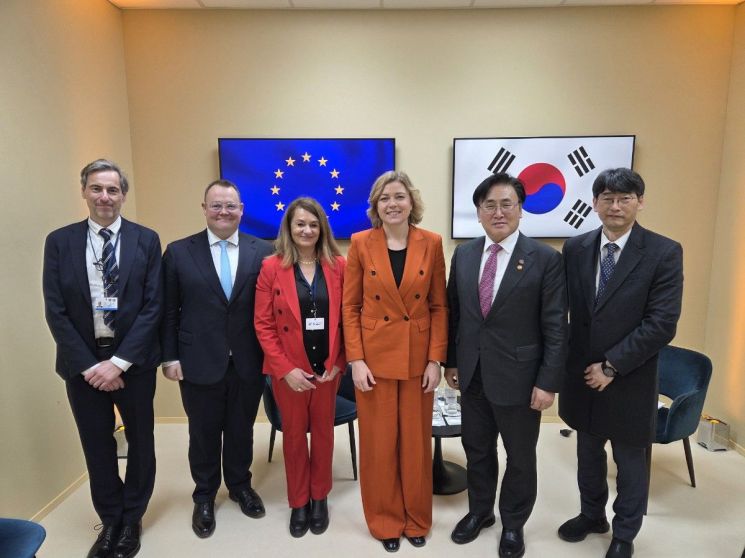
Yoo Sang-im, Minister of Science and ICT, emphasized the need for technical solutions, stating that "power consumption due to artificial intelligence (AI) is rapidly increasing, raising concerns." On the 11th, the Ministry of Science and ICT announced that through bilateral meetings with major countries such as the United States, the EU, and Singapore, they sought ways to strengthen cooperation in the AI field.
Minister Yoo attended the 3rd International AI Summit held in Paris, France, on the 10th (local time) and pointed out the issue of AI power consumption during the session on "Securing Competitiveness and Sustainability of the Global AI Ecosystem." Yoo stated, "According to recent research, the current power consumption of AI systems worldwide is comparable to the total power consumption of a single country," adding, "There are studies suggesting that power consumption due to AI systems could increase up to tenfold."
As a solution, Minister Yoo introduced South Korea's plan to develop low-power, high-performance AI semiconductors. Additionally, he shared Korea's key policies for sustainable AI, including the AI Basic Act?the second of its kind in the world?the National AI Computing Center to be established this year through public-private collaboration, AI education programs nurturing talent from primary and secondary education to top-level experts, and the Digital Inclusion Act for socio-economic sustainability, proposing global cooperation for sustainable AI.
During the summit, Minister Yoo also focused on strengthening cooperation with major countries. In a meeting with Lynn Parker, Deputy Director for Science and Technology Policy at the White House, they reviewed the current status of bilateral cooperation in science and technology and shared AI policies. He also met with the EU’s Vice-President for Technology Sovereignty, Security, and Democracy, and Singapore’s Minister for Digital Development and Information, discussing various cooperation measures in science and technology, including joint technology development, mutual recognition systems for standards, and collaboration under Horizon Europe.
The summit, which concluded on the 11th, was attended by about 1,000 participants from 87 countries worldwide, with French President Macron and Indian Prime Minister Modi serving as co-chairs. A declaration on "Inclusive and Sustainable AI for Humanity and the Planet," involving 60 countries, was adopted. This declaration includes concrete implementation plans based on the values of "Safety," "Innovation," and "Inclusion" presented at the previous "AI Seoul Summit." Key initiatives include the launch of AI platforms and incubators for public good, establishment of an AI Energy Observatory, and creation of a network to monitor AI’s impact on jobs. India announced its intention to host the next AI summit at this event. However, the United States and the United Kingdom, perceiving the declaration as regulatory, did not participate, while China joined, highlighting visible fractures within the international community regarding AI.
© The Asia Business Daily(www.asiae.co.kr). All rights reserved.
![Clutching a Stolen Dior Bag, Saying "I Hate Being Poor but Real"... The Grotesque Con of a "Human Knockoff" [Slate]](https://cwcontent.asiae.co.kr/asiaresize/183/2026021902243444107_1771435474.jpg)











