Large-Scale Disposal of Raw Seaweed Expected to Continue for Now
Dried Seaweed Prices Up 31.9% Compared to Last Year
Although the price of dried seaweed is soaring above 145 won per sheet, 6,000 tons of raw seaweed were discarded last month. The price of dried seaweed has risen by more than 30% compared to a year ago, but the price of raw seaweed at production sites has plummeted by over 50%. Seaweed production this month is also expected to increase by about 30% compared to the same period last year, so the phenomenon of raw seaweed disposal is likely to continue for the time being.
The National Federation of Fisheries Cooperatives (Suhyup) announced on the 12th that 5,989 tons of raw seaweed were discarded last month at production site auction markets in Jeonnam, Jeonbuk, Gyeongin, Chungnam, and Busan.
In Jeonnam, a representative raw seaweed production area, 5,296 tons were discarded. This was followed by Gyeongin (386 tons), Jeonbuk (208 tons), Chungnam (73 tons), and Busan (26 tons) in order of the amount of raw seaweed disposal. The increase in raw seaweed disposal is due to better harvest conditions this year compared to last year. The surge in raw seaweed production was influenced by new aquaculture farm permits from the Ministry of Oceans and Fisheries and the proliferation of illegal raw seaweed farming.
As raw seaweed production exceeds the demand from seaweed processing companies, more raw seaweed that fails to be auctioned off is being discarded. The Korea Maritime Institute analyzed that raw seaweed production in Jeonnam last month increased by 17.6% compared to the same period last year, while production in Busan and Chungnam rose by 76.9% and 64.9%, respectively.
A Suhyup official explained that many fishermen entered the raw seaweed farming business last year due to good seaweed exports and high prices, leading to a sharp increase in seaweed production. The official also mentioned that many fishermen have engaged in illegal seaweed farming at unauthorized farms.
This large-scale disposal of raw seaweed at production sites is expected to continue for the time being. Raw seaweed is usually harvested from January to May. The Korea Maritime Institute forecasted that raw seaweed production this month will increase by 26.8% compared to the same period last year, and production next month will also rise by 13.9% compared to the same period last year.
Due to this abundant supply, unlike the rising price of dried seaweed, the price of raw seaweed at production sites has fallen. The average auction price of raw seaweed in January was 762 won per kilogram. This is 54.0% cheaper than the same period last year (1,655 won) and 36.0% lower than in 2023 (1,191 won).
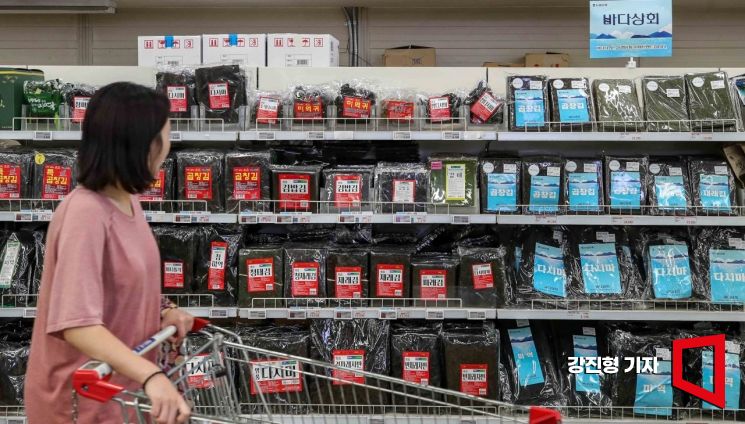
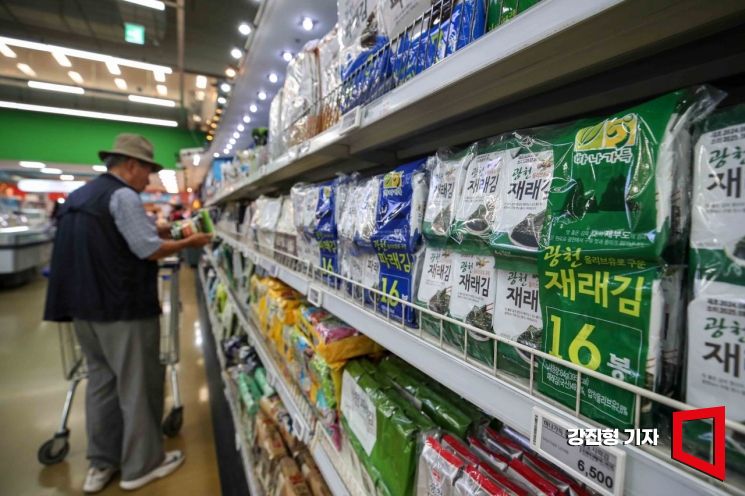 On the 5th, gim (seaweed) is displayed on the sales stand at Hanaro Mart Yangjae branch in Seocho-gu, Seoul. Ahead of the major Korean holiday Chuseok, prices of key seafood products such as dried yellow corvina and gim are rising. According to the Korea Agro-Fisheries & Food Trade Corporation, the price of dried yellow corvina increased by 37.1% compared to a year ago, reaching 2,763 won per fish. The retail price of gim, which was below 100 won per sheet at the beginning of the year, rose to 135 won per sheet as of the previous day, marking a 38% increase compared to a year ago. Photo by Kang Jin-hyung aymsdream@
On the other hand, the price of dried seaweed remains at about 1.5 times the average level. According to the Korea Agro-Fisheries & Food Trade Corporation (aT), as of the previous day, the price of dried seaweed was 145 won per sheet. This is 55.5% higher than the average year and 31.9% higher than last year.
The Ministry of Oceans and Fisheries is reviewing with local fisheries cooperatives a plan to pilot contract farming for some raw seaweed farms in Jeonnam to reduce raw seaweed disposal and stabilize seaweed supply. In April last year, the ministry considered designating seaweed as a contract farming item like fruit as part of a seaweed supply stabilization plan, but ultimately did not implement it.
© The Asia Business Daily(www.asiae.co.kr). All rights reserved.
![Clutching a Stolen Dior Bag, Saying "I Hate Being Poor but Real"... The Grotesque Con of a "Human Knockoff" [Slate]](https://cwcontent.asiae.co.kr/asiaresize/183/2026021902243444107_1771435474.jpg)
















