Nine Medals at Winter Asian Games: A New Record
Silver in Speed Skating Team Pursuit
Perfect Teamwork with Jeong Jaewon and Park Sangwon
"I Am Happy Like It's a Hobby"
"Aiming for Next Year's Olympics"
Lee Seung-hoon, the living legend of Korean speed skating, has become the all-time highest medalist in the Winter Asian Games.
On the 11th, Lee Seung-hoon won a silver medal in the men's team pursuit at the 2025 Harbin Winter Asian Games held at the Heilongjiang Ice Training Center speed skating oval in Harbin, China. He added a valuable medal by teaming up with juniors Jeong Jae-won and Park Sang-won. With this, he earned his ninth medal in total at the Winter Asian Games.
Lee Seung-hoon became a triple crown winner at the 2011 Astana-Almaty Winter Asian Games by winning gold medals in the 5000m, 10000m, and mass start events. He also added a silver medal in the team pursuit, collecting four medals at the Astana-Almaty Games alone. Six years later, at the 2017 Sapporo Winter Asian Games, he won four gold medals. He won consecutive gold medals in the 5000m, 10000m, and mass start events, and upgraded the team pursuit medal to gold, achieving four crowns.
By adding one silver medal at this Harbin Games, his total medal count at the Winter Asian Games reached nine, consisting of seven golds and two silvers. This surpassed the previous record of eight medals held by speed skater Lee Kyu-hyuk (4 gold, 3 silver, 1 bronze) and short track skater Kim Dong-sung (3 gold, 3 silver, 2 bronze), making him the sole record holder.
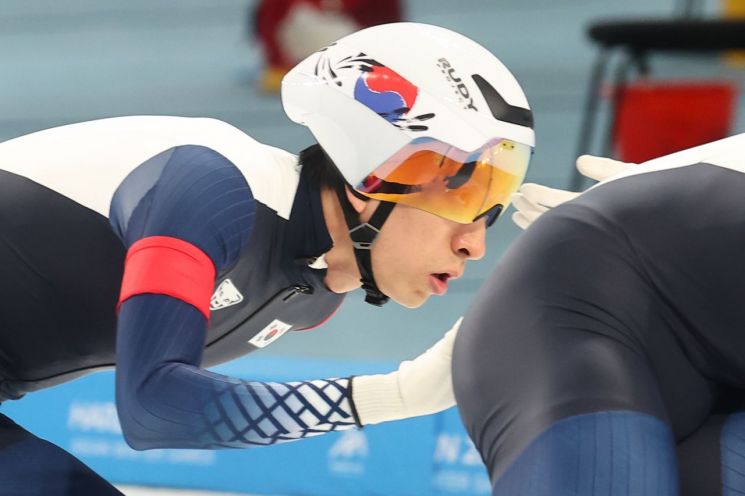 The living legend of speed skating, Lee Seung-hoon, is seen pushing his teammates and racing fiercely in the men's team pursuit speed skating event at the Harbin Winter Asian Games, held on the 11th at the Heilongjiang Ice Training Center Oval in Harbin, China. With the silver medal he won that day, Lee Seung-hoon earned his ninth Winter Asian Games medal, becoming the Korean athlete with the most Winter Asian Games medals in history.
 [Photo by Yonhap News]
Although his friends Lee Sang-hwa and Mo Tae-bum, who opened the golden era of Korean speed skating (Lee Seung-hoon was born in 1988, while Lee Sang-hwa and Mo Tae-bum were born early in 1989), have retired quite some time ago, Lee Seung-hoon is still actively skating on the ice. He has no plans to retire yet. He aims to win another Olympic medal at the 2026 Milan-Cortina d'Ampezzo Winter Olympics next year.
Regarding his feelings about becoming the all-time highest medalist at the Asian Games, Lee Seung-hoon said, "I feel somewhat calm," and added, "Now skating feels like a hobby, and I am happy." He continued, "I thought the 2022 Beijing Winter Olympics would be my retirement stage, but seeing many people in the Netherlands skating happily with a relaxed mindset changed my perspective a lot, and I started looking forward to the next Olympics."
So far, Lee Seung-hoon has won two gold medals, three silver medals, and one bronze medal at the Olympics.
He amazed the world by winning the gold medal in the 10000m and silver medal in the 5000m at his Olympic debut at the 2010 Vancouver Winter Olympics. This achievement was especially notable because it came just a few months after he switched from short track to speed skating.
During middle and high school, he was a promising short track skater but failed to qualify for the national team in 2009, losing to Lee Jung-su and Sung Si-bak. Instead of giving up, he switched back to speed skating, which he originally learned, and after re-challenging for the national team, he made a miraculous appearance at the Vancouver Olympics. At the time he won the gold in the 10000m, he had only completed the 10000m race three times in his career.
At the 2018 Pyeongchang Winter Olympics, he won his second Olympic gold medal by becoming the inaugural champion in the newly adopted official mass start event.
If he adds another medal at the 2026 Milan-Cortina d'Ampezzo Winter Olympics, he will achieve the remarkable record of winning Olympic medals in five consecutive Games. Lee Seung-hoon won silver medals in the team pursuit at both the 2014 Sochi and 2018 Pyeongchang Winter Olympics, and earned a bronze medal in the mass start at the 2022 Beijing Winter Olympics.
© The Asia Business Daily(www.asiae.co.kr). All rights reserved.
![Clutching a Stolen Dior Bag, Saying "I Hate Being Poor but Real"... The Grotesque Con of a "Human Knockoff" [Slate]](https://cwcontent.asiae.co.kr/asiaresize/183/2026021902243444107_1771435474.jpg)















