Powell Appears at Senate Monetary Policy Hearing
"No Reason to Rush Additional Rate Cuts"
On Tariff-Driven Inflation: "A Possible Outcome"
Interest Rate Futures Market Sees 49% Chance of June Hold
Amidst U.S. President Donald Trump's barrage of 'tariff bombs,' Jerome Powell, Chairman of the U.S. Federal Reserve (Fed), reaffirmed a cautious monetary policy stance, indicating no rush to cut the benchmark interest rate. He also made it clear that President Trump does not have the legal authority to dismiss Fed members, including himself, despite Trump's public pressure for rate cuts. As inflation concerns spread due to Trump's comprehensive tariff threats, there are even speculations that the Fed may keep rates steady for an extended period or possibly raise them.
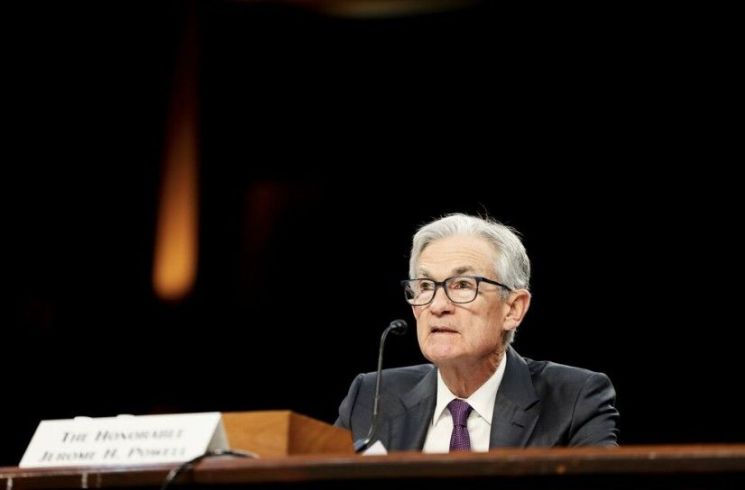
On the 11th (local time), during the semiannual monetary policy report to the U.S. Senate Banking Committee, Chairman Powell stated, "We are in a fairly good position in the economy and want to see more progress on inflation," adding, "Our policy rate is in a good place, and there is no reason to rush additional rate cuts."
The Fed began a monetary easing cycle last September, cutting rates three times from a peak of 5.25-5.5% to 4.25-4.5%, and then held rates steady for the first time last month.
He explained, "If policy constraints are reduced too quickly or too much, it could hinder progress on inflation," and "At the same time, if policy constraints are reduced too slowly or too little, it could excessively weaken economic activity and employment." This underscored the Fed's intention to maintain the current rate level for an extended period if inflation does not fall to the 2% target and the economy remains robust. However, he also left open the possibility of resuming rate cuts if employment unexpectedly weakens.
Regarding the possibility of President Trump dismissing Fed members after publicly pressuring for rate cuts, Powell firmly stated, "That is clearly not legally permissible."
During the congressional hearing, numerous questions were raised about Trump's trade policies, including tariff increases, but Powell avoided direct answers as before.
Instead, he said, "It is not the Fed's role to create or comment on tariff policies; that is the responsibility of elected officials," adding, "Our job is to respond to these matters prudently and reasonably and conduct monetary policy to fulfill our mission."
However, when Senator Ruben Gallego (Arizona, Democrat) asked whether tariffs could lead to inflation increases, Powell acknowledged, "That is a possible outcome," recognizing tariffs as a potential inflationary factor.
He also expressed his belief in free trade. Powell said, "The standard case for free trade and all of that still logically holds," adding, "When there is one very large country that does not follow the rules, the system (of free trade) does not work well."
Since President Trump began imposing tariff measures immediately after his inauguration on the 20th of last month, experts have expressed concerns about a possible rebound in inflation. The day before, Trump announced a 25% tariff on all steel and aluminum products entering the U.S. starting from the 12th of next month. He also indicated that reciprocal tariff measures would be announced within this week, with plans to impose item-specific tariffs on automobiles, semiconductors, pharmaceuticals, and more soon. These successive tariff hikes are expected to raise import prices and consumer prices, leading to speculation that the Fed's high-interest-rate stance will be prolonged.
The market is already pricing in a high likelihood of rate stability in the first half of the year. According to the Chicago Mercantile Exchange (CME) FedWatch, the federal funds futures market on this day reflected a 49% probability that the Fed will keep the benchmark rate at the current 4.25-4.5% level in June, up from 36.4% a week ago.
There is also talk of a possible 'U-turn' by the Fed to raise rates. Adam Posen, President of the Peterson Institute for International Economics (PIIE), said in an interview with Asia Economy last month that due to concerns about 'Trumflation' (inflation caused by Trump's policies), "the Fed will begin raising rates between July and September and increase the benchmark rate by 0.75 to 1.0 percentage points by the end of 2025 compared to now."
As Chairman Powell reiterated a cautious approach to rate cuts, bond yields have been rising. The U.S. 10-year Treasury yield, a global benchmark for bond yields, rose 4 basis points (1bp=0.01 percentage points) from the previous trading day to 4.53%, while the 2-year Treasury yield, sensitive to monetary policy, moved up 2 basis points to around 4.29%.
© The Asia Business Daily(www.asiae.co.kr). All rights reserved.
![Clutching a Stolen Dior Bag, Saying "I Hate Being Poor but Real"... The Grotesque Con of a "Human Knockoff" [Slate]](https://cwcontent.asiae.co.kr/asiaresize/183/2026021902243444107_1771435474.jpg)















