The ‘Suchon District Urban Development Project’ in Pyeongtaek City, Gyeonggi Province, which was on the brink of collapse due to the cancellation of business permits, will proceed normally thanks to Gyeonggi Province’s proactive administration.
The Pyeongtaek Suchon District Urban Development Project is a development plan to supply 3,927 housing units and establish urban infrastructure such as roads, parks, and elementary schools on approximately 385,326㎡ near Chilwon-dong, Pyeongtaek City. Although the project was initiated in 2017, it faced the risk of permit cancellation due to difficulties in funding caused by the real estate market downturn and overlapping regulations under the Farmland Act.
According to the current ‘Farmland Act,’ a general corporation must complete farmland conversion consultations to own farmland. The original project implementer, Company A, acquired farmland incorporated into the Suchon District after completing the consultation but went out of business in 2014. The issue arose when Company B, the current project implementer, acquired the farmland in 2016 and proceeded with the project, but due to Company A’s closure and changes in the project method, the validity of the farmland conversion consultation was interrupted. The key question was whether Gyeonggi Province could allow a new farmland conversion consultation without requiring disposal of the farmland.
Considering the willingness to proceed with the project, Gyeonggi Province reviewed the possibility of farmland conversion consultation as part of its proactive administrative efforts. During this process, it was discovered that the farmland ownership issue was linked to regulations such as the obligation to dispose of farmland, and that the Ministry of Government Legislation’s authoritative interpretation had not been formalized.
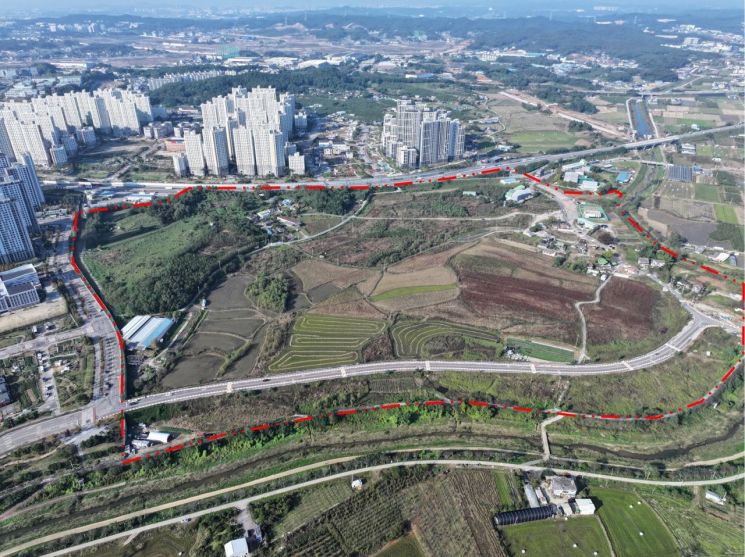 Aerial view of the Pyeongtaek Suchon District urban development project site. Provided by Gyeonggi Province
Subsequently, after legal advice from the Ministry of Agriculture, Food and Rural Affairs and Gyeonggi Province’s legal counsel, a preliminary consultation with the Board of Audit and Inspection was requested in November last year. As a result, the Board recently responded by citing Gyeonggi Province’s opinion that farmland conversion consultation can be conducted again without disposing of the farmland. The Board stated that it considered the legality of the farmland acquisition process, the absence of intentional acts such as speculation, and the lack of practical benefits from project cancellation.
Accordingly, the project permit cancellation and disposal and reacquisition of the farmland have been avoided, allowing the project to continue, thereby enabling the project implementer to save costs and time such as taxes.
The Pyeongtaek Suchon District Urban Development Project is scheduled for completion in 2029, with a project cost of 2.5 trillion KRW and is expected to create over 12,000 new jobs. It is anticipated to expand employment opportunities for local residents and revitalize the local economy, which has been struggling due to the economic downturn.
Park Jong-min, Director of the Gyeonggi Province Department of Agriculture, Fisheries and Life Sciences, stated, "This is a good example of actively reflecting the complainant’s position during the farmland conversion permit process, and it is expected to have a positive impact on other cases in the future."
© The Asia Business Daily(www.asiae.co.kr). All rights reserved.
![Clutching a Stolen Dior Bag, Saying "I Hate Being Poor but Real"... The Grotesque Con of a "Human Knockoff" [Slate]](https://cwcontent.asiae.co.kr/asiaresize/183/2026021902243444107_1771435474.jpg)















