3rd AI Summit Concludes
Joint Declaration Emphasizes 'Human Rights and Sustainability' in AI Development
60 Countries Sign, but US and UK Abstain
Regulation vs. Innovation Conflict Becomes More Pronounced
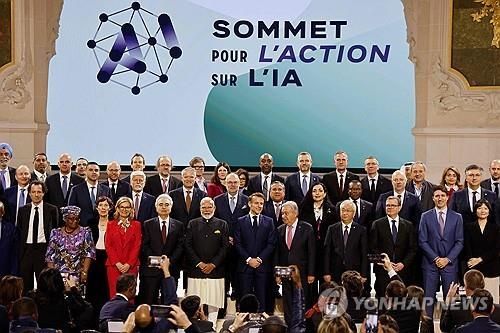
At the 3rd AI Summit held in Paris, France, the 'Paris Declaration' emphasizing inclusivity and sustainability was adopted, but the refusal of the United States and the United Kingdom to sign highlighted clear differences in the international community's stance on AI governance. There is also an assessment that approaches to AI are divided into a 'tripartite structure' among the US, Europe, and China.
On the 11th (local time), the French presidential office announced that after a two-day meeting, the 'Declaration on Inclusive and Sustainable Artificial Intelligence for Humanity and the Planet' was adopted. Sixty countries, including China and India, participated in signing, but the US and the UK chose not to participate. The US currently leads the competition as a major AI power, and the UK is the country that produced DeepMind, the developer of the Go AI AlphaGo.
The declaration emphasized the protection of human rights, gender equality, linguistic diversity, consumer protection, and intellectual property rights in AI development. Notably, AI and energy issues were addressed for the first time in a multilateral environmental context, and the need to raise awareness of AI's impact on the labor market and to promote technological development in a positive direction was stressed.
The signatory countries underscored the importance of strengthening AI governance coordination and preventing market monopolies. Furthermore, the declaration highlighted the need for global-level reflection integrating safety, sustainable development, innovation, respect for international law, and human rights protection.
This declaration has made the international community's differing positions on AI more distinct. US Vice President JD Vance stated in a speech that day, "Excessive regulation can hinder innovative industries," maintaining a minimal regulation stance. His speech was his first major international address since taking office last month, and he defended the AI industry and opposed regulation in a more aggressive tone than other speakers.
The UK's refusal to sign the declaration is interpreted as an attempt to follow the US position. According to the UK BBC, the UK government denies this, stating, "We do not know the reasons or position of the US (non-participation)," but a Labour Party member said, "The UK cannot strategically escape the US sphere of influence." It was also interpreted that if the UK is perceived to adopt an overly restrictive approach, US AI companies might cease cooperation with UK regulatory agencies.
There is also analysis that the US-Europe-China tripartite line regarding AI is becoming clearer. Indian media CNBC-TV18 reported that "Under President Donald Trump, the US supports a minimal intervention approach to promote innovation, while Europe is strengthening control through strict regulations to ensure safety and accountability," and "China is rapidly expanding AI through state-supported large tech companies, competing to gain an advantage in the global competition, deepening the tripartite divide."
© The Asia Business Daily(www.asiae.co.kr). All rights reserved.
![Clutching a Stolen Dior Bag, Saying "I Hate Being Poor but Real"... The Grotesque Con of a "Human Knockoff" [Slate]](https://cwcontent.asiae.co.kr/asiaresize/183/2026021902243444107_1771435474.jpg)















