Avoids Answering Questions on Tariffs and Trade Policy
"Tariff Policy Is Not the Fed's Job... We Respond with Monetary Policy"
On Tariff-Driven Inflation: "It Is a Possible Outcome"
Jerome Powell, Chairman of the U.S. Federal Reserve (Fed), reaffirmed the monetary policy stance of not rushing to cut the benchmark interest rate. He also made it clear that President Donald Trump, who publicly pressured for rate cuts, does not have the legal authority to dismiss Fed members, including himself.
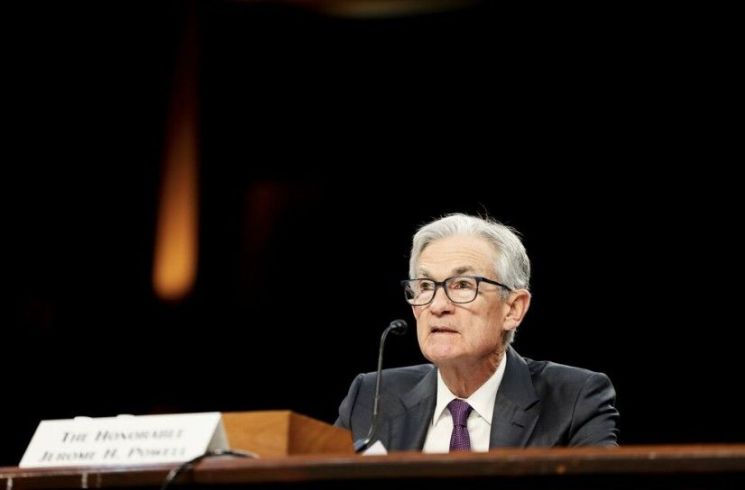
On the 11th (local time), during the semiannual monetary policy report to the U.S. Senate Banking Committee, Chairman Powell stated, "We are in a fairly good position in the economy and want to see more progress on inflation," adding, "Our policy rate is in a good place, and there is no reason to rush additional rate cuts."
The Fed began a monetary easing cycle last September, cutting rates three consecutive times from a peak of 5.25-5.5% to 4.25-4.5%, and then held rates steady for the first time last month.
He explained, "If policy constraints are eased too quickly or too much, it could hinder progress on inflation," and "At the same time, if policy constraints are eased too slowly or too little, it could excessively weaken economic activity and employment."
This essentially means that if inflation does not fall to the 2% target and the economy remains robust, the current interest rate level will be maintained for a prolonged period. However, he also left open the possibility of resuming rate cuts if employment unexpectedly weakens.
Regarding a question about the possibility of President Trump dismissing Fed members, Powell said, "That is clearly not legally permissible."
President Trump, since his presidential campaign, has expressed dissatisfaction with the Fed's high interest rate policy and has repeatedly vowed to dismiss Chairman Powell if he returns to the White House. On the 23rd of last month, during a virtual speech at the World Economic Forum (WEF, Davos Forum), he publicly pressured the Fed by stating he would "demand an immediate rate cut."
During the congressional session, numerous questions were raised about President Trump's trade policies, including tariff increases. Powell took a cautious stance, responding that it is not the Fed's role to intervene in trade policy.
He emphasized, "It is not the Fed's job to create or comment on tariff policy; that is the responsibility of elected officials," adding, "Our job is to respond to this carefully and reasonably and conduct monetary policy to fulfill our mission."
However, when Senator Ruben Gallego (Arizona, Democrat) asked whether tariffs could lead to higher inflation, Powell acknowledged, "It is a possible outcome," admitting that tariffs could be a factor in rising prices.
Regarding the U.S. fiscal deficit issue, he stated, "The U.S. federal budget is on an unsustainable path," and "Now is the right time to start addressing this issue (reducing the fiscal deficit)."
© The Asia Business Daily(www.asiae.co.kr). All rights reserved.

















