Head of the Korean Buddhist Cultural Foundation, Mandang Sunim, Holds New Year's Press Conference
Temple Food to Be Registered as National Intangible Cultural Heritage Within This Year
Efforts to Revitalize Templestay Programs for Foreigners
Plan to Increase Personnel Expenses to Secure Talented Staff
An attempt is being made to register temple food as a national intangible cultural heritage. The Korean Buddhist Cultural Foundation of the Jogye Order of Korean Buddhism announced on the 11th that it has finalized and organized the standard category concept and will soon apply for registration as a national intangible heritage.
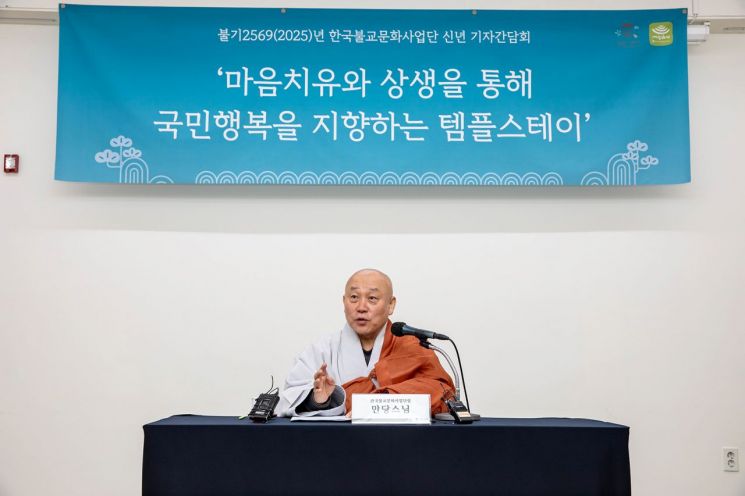 Mandang Sunim, head of the Korean Buddhist Cultural Project Group of the Jogye Order of Korean Buddhism, is holding a press conference on the morning of the 11th at the Templestay Integrated Information Center located in Jongno-gu, Seoul.
On the 11th, Mandang Sunim, head of the Korean Buddhist Cultural Foundation of the Jogye Order, held a New Year's press conference at the Templestay Integrated Information Center in Jongno-gu, Seoul, and shared plans related to temple food and Templestay projects.
Mandang Sunim said, "The results of the service for standardizing temple food will be released," and added, "We plan to designate it as a national intangible cultural heritage within this year in consultation with the Cultural Heritage Administration." After domestic registration, efforts will be made to register it as a UNESCO Intangible Cultural Heritage. To raise interest in temple food, a grand temple food festival will be held for two days on June 7-8 at the aT Center in Yangjae-dong, Seoul. In August, an international academic symposium on temple food will be held by inviting researchers from world-renowned universities studying food science.
The Asia-Pacific Economic Cooperation (APEC) summit meeting to be held in Gyeongju this October is expected to serve as an opportunity to promote temple food worldwide. Mandang Sunim stated, “We will collaborate with the main temples around Gyeongju, such as Bulguksa, Tongdosa, and Beomeosa, to actively support foreign leaders and diplomatic envoys who want to experience temple culture and stay overnight, turning this into an opportunity to promote traditional culture.”
Efforts will also be made to revitalize Templestay programs for foreigners. According to data released by the foundation on this day, the total number of participants in Templestay last year was about 617,000, a 13% increase from the previous year. However, the number of foreign participants was about 78,000, a 6.4% decrease.
Regarding this, Mandang Sunim diagnosed, "There need to be many people who can actively use foreign languages, have a sense of mission, and sincerely engage in the work, but it is difficult to find such personnel." He added, "(The staff) often work from morning until 9 p.m., but the salary is low." He also mentioned that in rural areas, it is often difficult to commute because they live in mountain temples, saying, "I believe there is a need for motivation and wage support so that capable people can continuously work."
According to Mandang Sunim, last year the foundation used 11 billion won out of the 25 billion won government support budget to improve facilities at temples operating Templestay, and the remaining 14 billion won was used for operating expenses and personnel costs. However, Mandang Sunim explained that they are considering reducing facility expenses and increasing operating expenses in the future.
© The Asia Business Daily(www.asiae.co.kr). All rights reserved.
![Clutching a Stolen Dior Bag, Saying "I Hate Being Poor but Real"... The Grotesque Con of a "Human Knockoff" [Slate]](https://cwcontent.asiae.co.kr/asiaresize/183/2026021902243444107_1771435474.jpg)















