Jinwook Kim, Citi Economist, in Report:
"Expected Decrease of 0.11% to 0.22%"
Possibility of Negotiated Quota System as in First Term
Reciprocal Tariffs Expected to Have Limited Impact
"But Major Shock Possible if Applied to Automobiles and Home Appliances"
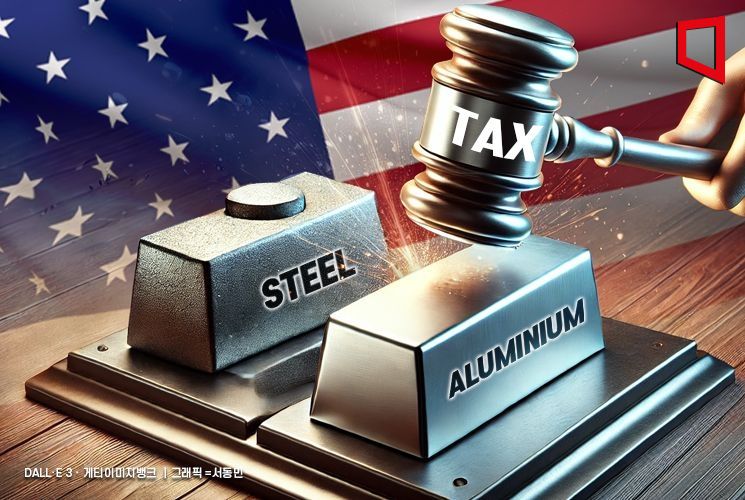
U.S. President Donald Trump’s decision to impose a 25% universal tariff on steel and aluminum is expected to have a negative impact on the South Korean economy, according to an analysis.
On the 11th, Citi economist Jinwook Kim stated in a report titled “How Could U.S. Steel and Aluminum Tariffs Affect South Korea’s Exports?” that “Although this is a rough estimate, the negative impact on the South Korean economy could result in an annual decrease of 0.11% to 0.22% in gross domestic product (GDP).” He cited statistics showing that last year, the U.S. accounted for 7%, 31%, and 20% of South Korea’s exports of steel, steel products, aluminum, and related products respectively, explaining that a direct impact is inevitable.
However, Kim noted that through negotiations with the first Trump administration in 2018, South Korea was granted a tariff exemption on 2.68 million tons of steel and steel products annually, adding that “there may be room for negotiations with the second Trump administration if necessary.” The Trump administration has decided to impose tariffs without exception, even on countries previously subject to quota systems. The White House announced that starting from the 12th of next month, it will revoke existing agreements with countries such as South Korea that had been granted tariff exemptions of 25%, stating that “these agreements have not been effective in addressing national security concerns or providing long-term alternatives.”
Kim also said that the impact of the reciprocal tariffs, which President Trump has pledged, on the South Korean economy would be limited. President Trump signed the tariff proclamation and stated, “Plans for reciprocal tariffs will be announced within the next two days.” According to data from Citi and the World Bank’s Integrated Trade Solution, as of 2021, South Korea’s weighted average tariff rate applied to U.S. imports was 4.4%, higher than the 0.0% tariff rate imposed by the U.S. on South Korean imports. Based on this, Kim predicted that reciprocal tariffs would be applied, particularly on livestock products, foodstuffs, and vegetables and fruits. Nevertheless, he analyzed that the impact on South Korea’s exports would be minimal. He said, “Food-related exports from South Korea to the U.S. account for only 1.5% of total exports to the U.S. and just 0.3% of South Korea’s total exports, so the direct negative impact is limited.”
However, Kim emphasized that if reciprocal tariffs are imposed on a wider range of products beyond specific items, the negative shock to South Korea could be greater. According to Citi, as of last year, the U.S. accounted for 49% of South Korea’s automobile exports, 49% of home appliance exports, 47% of battery exports, and 44% of computer SSD exports.
© The Asia Business Daily(www.asiae.co.kr). All rights reserved.
![Clutching a Stolen Dior Bag, Saying "I Hate Being Poor but Real"... The Grotesque Con of a "Human Knockoff" [Slate]](https://cwcontent.asiae.co.kr/asiaresize/183/2026021902243444107_1771435474.jpg)















