Sales Soar by 465% in Five Years
Museum Goods Craze Continues Despite Fewer Visitors
On the afternoon of the 11th, visitors holding paper shopping bags could be easily spotted in the passage connecting Ichon Station of the Seoul Subway and the National Museum of Korea, as well as in the plaza in front of the museum. These were shopping bags from the museum's souvenir shop. The National Museum of Korea's souvenir shop was bustling with people browsing and purchasing souvenirs. Dozens of people of all ages and nationalities filled the souvenir shop. Staff members were busy packaging products and handling payments without a break. Kim Young-ha (27), who was leaving the souvenir shop carrying museum goods (Museum + Goods, items sold at museum souvenir shops), said, "I bought this as a commemorative gift for a foreign friend," adding, "I thought it was a good gift that would remind my friend of Korea."
Interest in museum goods among the MZ generation (Millennials + Generation Z) appears to be increasing. Analysts suggest that this is due to the younger generation finding value in consuming products related to history and culture, combined with the museum's successful product planning.
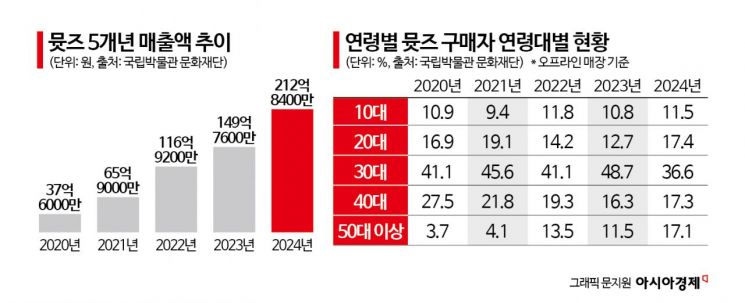
According to the National Museum Cultural Foundation on the 13th, last year's online and offline sales of museum goods amounted to approximately 21.284 billion KRW, marking a 465% increase over five years. Compared to 2023 (about 15 billion KRW), sales also rose by 42%.
Although the number of visitors to the National Museum of Korea last year was about 3.79 million, a 9.2% decrease from the previous year (about 4.18 million), offline sales of museum goods (11.756 billion KRW) grew by 24% compared to the previous year (9.477 billion KRW). The number of people purchasing museum goods online also increased significantly. Online sales last year reached 5.222 billion KRW, a 134% surge compared to 2.229 billion KRW the previous year.
Looking at the age distribution of offline museum goods buyers, those in their 20s and 30s accounted for 54% of total buyers. Among all buyers, people in their 30s made up 36.6%, and those in their 20s accounted for 17.4%. Since 2020, buyers in their 30s have consistently held the largest share. Recently, the proportion of buyers in their 40s has decreased, while that of those aged 50 and above has increased. On the day of the visit, not only young people but also individuals from various age groups were seen browsing museum goods in the shop.
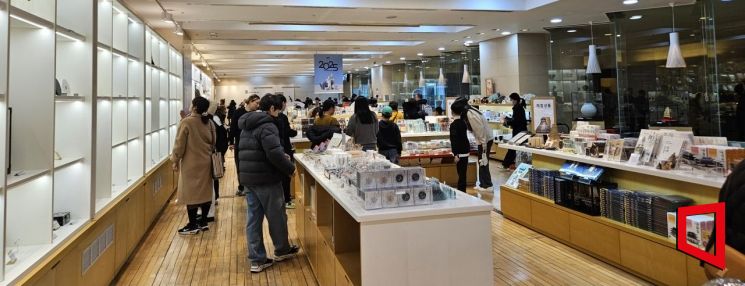 Around 3 p.m. on the 11th, the product hall of the National Museum of Korea was bustling with visitors. Photo by Choi Young-chan
The popular museum goods selected by the foundation in the second half of last year included ▲ Seokguram lighting ▲ Smile of Silla sauce bowl set ▲ Dancheong mechanical wired keyboard. The Seokguram lighting, which was also a selected work in last year's museum goods contest, became so popular that it was often out of stock. A foundation official explained the reason for the popularity of museum goods, saying, "As brand awareness and product quality have increased, more customers have sought out museum goods themselves."
Experts believe that the excellent planning of museum goods and the MZ generation consumers' 'value consumption' have led to the increase in sales.
Professor Lee Eun-hee of the Department of Consumer Studies at Inha University said, "Basically, consumers buy something because they want it, but there are many cases where consumers respond well when suppliers provide good products," adding, "It seems the suppliers planned well." Regarding the fact that the 20s and 30s age groups account for the largest share of sales, she said, "Products in museums are related to history, and for young people, the experience of connecting history with themselves through consumption can be very thrilling."
Professor Heo Kyung-ok of the Department of Consumer Industry at Sungshin Women's University evaluated, "The MZ generation places high value on consumption related to cultural heritage and cultural viewing," and added, "Even when consuming, there is a perception that it is better to buy products that help culture."
© The Asia Business Daily(www.asiae.co.kr). All rights reserved.


















