Operating Profit of 47.1 Billion KRW After Reflecting Retirement Benefit Obligations... Turned to Profit
Clear Improvement in Fundamental Profit Structure
All Retroactive Retirement Benefit Obligations Reflected Last Year
Minimal Impact This Year... Large-Scale Performance Improvement Expected
Emart succeeded in reversing its performance last year by strengthening its core business competitiveness, despite incurring large additional costs due to the Supreme Court's ruling on ordinary wages.
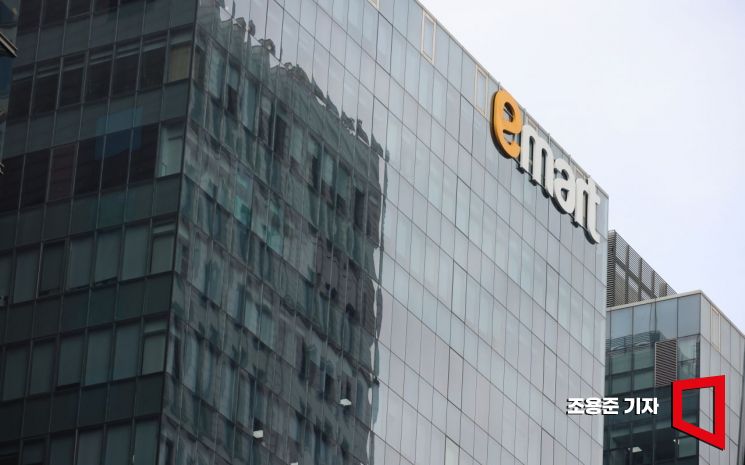
Emart announced on the 11th that its consolidated operating profit last year was 47.1 billion KRW, turning profitable compared to an operating loss of 46.9 billion KRW the previous year. This achievement was made despite reflecting a large one-time expense of 213.2 billion KRW, which included retirement benefit obligations and voluntary retirement compensation recognized in accounting without cash outflow due to the ordinary wage ruling. Excluding this, the actual operating profit last year increased by 307.2 billion KRW to 260.3 billion KRW compared to the previous year. During the same period, sales decreased by 1.5% year-on-year to 29.0209 trillion KRW. The operating loss in the fourth quarter of last year was 77.1 billion KRW, narrowing from 85.5 billion KRW in the same period of the previous year. Sales in this quarter decreased by 1.4% to 7.2497 trillion KRW.
Emart explained that the reason it bore a relatively large accounting cost for retirement benefit obligations due to the ordinary wage ruling is because it has a large workforce and a high proportion of long-term employees. As of the end of 2023, Emart employed 22,744 people, ranking within the top seven in South Korea. Additionally, due to the nature of the large discount store business, the proportion of overtime pay and holiday pay for holiday operations is high, increasing the cost burden from the rise in retirement benefit obligations.
An Emart official explained, "Despite difficult domestic and international conditions, the results are interpreted as a consequence of strengthening core business competitiveness and improving profitability based on strong reform and innovation efforts carried out over the past year."
By detailed business segment, Starfield Market Jukjeon, which was renewed and reopened in August last year, saw a 35% increase in visitor numbers and a 29% increase in sales compared to the same period last year by the end of December. Also, the fourth-quarter sales of four Emart stores that were renewed last year increased by 20% compared to the same period last year.
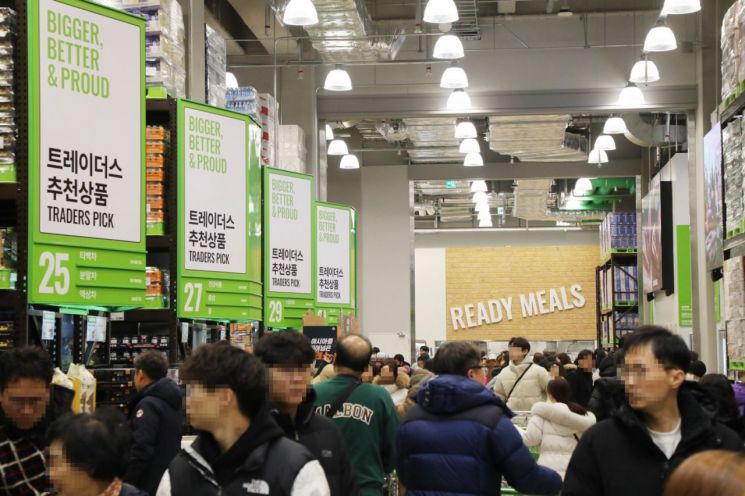
Emart’s warehouse-type discount store, Traders, led steady sales growth and operating profit improvement, with customer numbers increasing by 4.8% year-on-year last year. Annual operating profit last year recorded 92.4 billion KRW, a 59% increase from the previous year, and sales rose 5.2% to 176.8 billion KRW. The company analyzed that Traders’ differentiated product lineup, including cost-effective large-volume products that meet consumer needs in the era of high inflation, contributed to increased customer inflow. Traders is expected to strengthen its market competitiveness along with external growth, with new store openings planned for Magok (February) and Guwol (second half of the year) this year.
Major subsidiaries also contributed to performance improvement. First, SSG.com achieved an EBITDA (earnings before interest, taxes, depreciation, and amortization) profit of 5 billion KRW on an annual basis for the first time through continuous efforts to improve profitability, including efficient promotions, increased advertising revenue, and logistics cost reduction. This is an improvement of 34.5 billion KRW compared to the previous year.
SCK Company, which operates Starbucks, surpassed 3 trillion KRW in sales for the first time with 3.1001 trillion KRW. Operating profit also increased by 51 billion KRW to 190.8 billion KRW. Additionally, it achieved external growth by opening 116 new stores, surpassing 2,000 stores in total, and improved profitability through operational efficiency.
Shinsegae Property, which operates Starfield, achieved an annual operating profit surplus of 77.3 billion KRW, an increase of 61.3 billion KRW from the previous year, and Chosun Hotel & Resort recorded an operating profit of 41.5 billion KRW, up 3% year-on-year due to increased occupancy rates. In addition, Shinsegae Construction improved its annual operating loss by 53.8 billion KRW last year, reducing the scale of operating losses.
Emart plans to focus more on improving profitability by strengthening core business competitiveness this year. Emart and Traders will open three new stores and secure five additional new store sites to continuously expand market share.
Online platforms such as SSG.com and Gmarket will focus on sustainable growth by establishing a stable profit structure. SSG.com will reorganize its logistics system and focus on expanding delivery coverage by gradually increasing dawn delivery in regional areas and same-day delivery for Traders. Gmarket plans to strengthen its competitiveness as an open market by establishing a joint venture with Alibaba Group to expand global sales channels and focusing on branded product assortments.
An Emart official said, "The retroactive portion of the retirement benefit obligations was reflected all at once in the fourth quarter of last year," adding, "The impact of the ordinary wage ruling will be minimal from this year, so the scope of performance improvement will be greater." He also added, "We plan to continue focusing on strengthening core business competitiveness and improving profitability to achieve substantial results."
© The Asia Business Daily(www.asiae.co.kr). All rights reserved.
![Clutching a Stolen Dior Bag, Saying "I Hate Being Poor but Real"... The Grotesque Con of a "Human Knockoff" [Slate]](https://cwcontent.asiae.co.kr/asiaresize/183/2026021902243444107_1771435474.jpg)
















