Sintecabio (CEO Jeong Jong-seon) announced on the 10th (local time) that it has signed a second contract with a TPD development biotech company headquartered in Boston, USA.
This contract is an additional agreement following the interim evaluation results of the first contract, where the counterpart company expressed satisfaction with Sintecabio's methodology and interim results, further proving trust in Sintecabio's drug development candidate substance platform technology.
Additionally, the company expects to receive the first milestone payment within this month, marking the beginning of actual revenue generation and increasing confidence in the success of the AI drug platform. A company representative stated that the scale and duration of this contract are similar to the first contract, and if satisfactory results are achieved in this second contract, a third contract will be pursued, which is expected to proceed smoothly within this year.
In December last year, the company disclosed that the contract size for the single MSA (Master Service Agreement) for active substance discovery services is approximately KRW 1 billion, including the discovery of three active substances. They had already received one target and agreed to receive two additional targets in the first quarter of next year.
The client, a biotech company based in Boston, leads the field of Targeted Protein Degradation (TPD), which selectively degrades disease-causing proteins, and is a NASDAQ-listed company with a market capitalization of approximately KRW 3 trillion.
Generally, TPD consists of ▲a ligand (warhead) that binds to the target protein ▲a ligand (binder) that binds to the E3 ligase ▲and a ‘linker’ connecting the two proteins. Through this contract, Sintecabio will discover the ‘ligand (warhead) that binds to the target protein.’
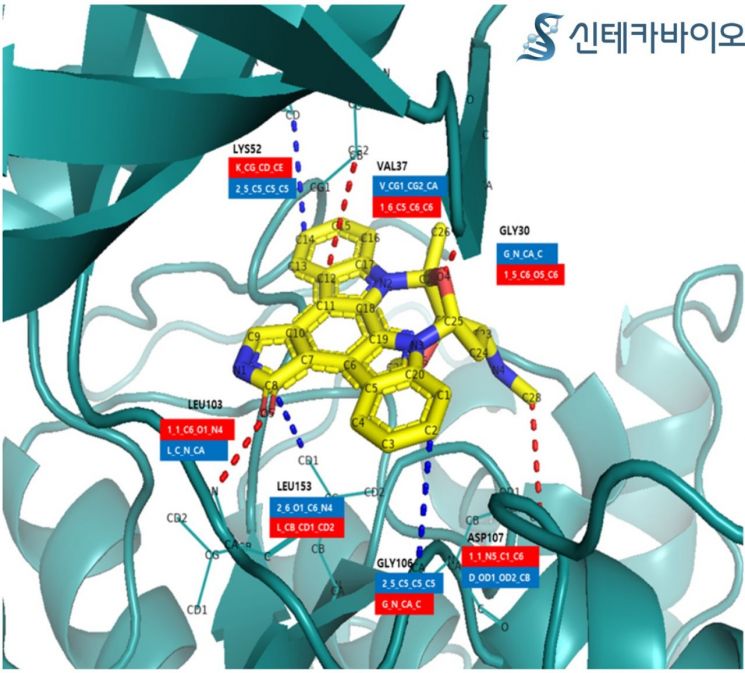
Sintecabio utilizes its self-developed AI drug platform ‘DeepMatcher’ to perform virtual screening and fine-tuning of a compound library based on 13 billion compounds using a language model, producing results. The characteristic of large-scale screening based on the language model is that it can complete screening of 13 billion compounds in just two hours, allowing generative AI methods to be repeated over 100 times until active substances are derived. According to a company representative, this theoretically enables Sintecabio to discover active substances for new targets that have never been previously identified.
This new language model-based virtual screening and fine-tuning of 13 billion compounds, ‘DeepMatcher,’ is expected to provide a new paradigm in areas where it has been difficult to create active substances. If it is confirmed that even challenging cases like TPD ligands (warheads) can be discovered, it will serve as a definitive validation of the language model.
TPD is a technology that removes target proteins causing diseases and is attracting attention as a next-generation drug platform. With bold investments from global pharmaceutical companies, the success of this project is seen as an opportunity for Sintecabio to leap forward as an AI drug development platform company leading the TPD drug development field.
Roots Analysis, a UK market research firm, recently reported that the TPD market size is expected to grow at a compound annual growth rate (CAGR) of 32%, reaching USD 6.94 billion (approximately KRW 9.4 trillion) by 2035. In fact, global big pharma companies such as Pfizer, Amgen, and Merck are showing interest in companies with TPD-related technologies. Pfizer signed contracts worth a total of USD 2.05 billion (approximately KRW 2.36 trillion) with US TPD companies in 2021.
A Sintecabio representative stated, “Through recent upgrades to our proprietary AI drug development platform ‘DeepMatcher,’ we can now derive active compounds with more diverse structures and confirm binding specificity to targets. We expect to overcome the limitations of existing AI-based small molecule discovery and optimization by exploring and optimizing active substances even for targets without disclosed protein-compound structural information.”
© The Asia Business Daily(www.asiae.co.kr). All rights reserved.
![Clutching a Stolen Dior Bag, Saying "I Hate Being Poor but Real"... The Grotesque Con of a "Human Knockoff" [Slate]](https://cwcontent.asiae.co.kr/asiaresize/183/2026021902243444107_1771435474.jpg)
















