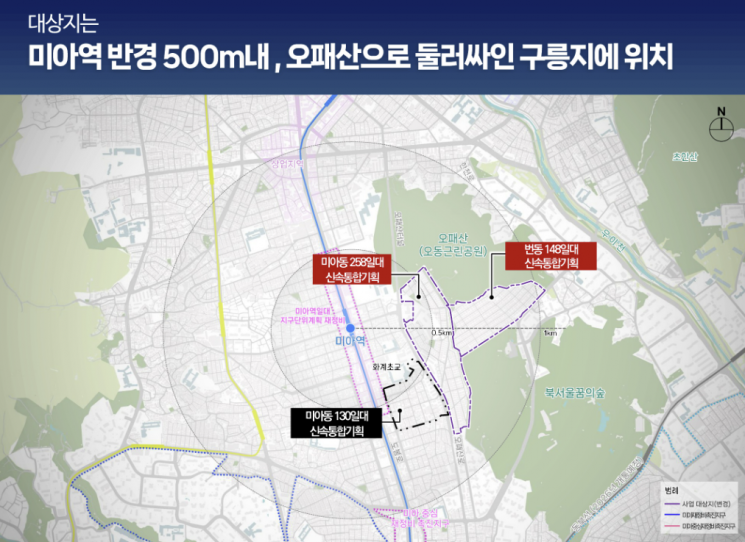
A low-rise residential area near Mia Station on Seoul Subway Line 4 will be reborn as a residential complex with 7,500 households.
On the 11th, Seoul City announced that it had finalized the rapid integrated planning for two sites in Mia-dong 258 and Beon-dong 148, Gangbuk-gu. By simultaneously promoting the planning of the two adjacent target sites, the plan is to transform the area into a large-scale residential complex that organically connects walking paths, green spaces, and landscapes, thereby dramatically increasing the feasibility of the project.
The target sites are classified as Type 1 residential areas on the slopes of Opaesan Mountain, with many landowners, which made development difficult. The area was densely packed with old houses, and due to height differences of over 60 meters causing walking inconvenience, most residents used village buses. However, the steep slopes and narrow roads also posed a high risk of traffic accidents.
Considering the conditions of the target sites, which had been excluded from development due to lack of profitability, the city applied various approaches to realize the project.
The zoning was upgraded from Type 1 to Type 2 residential areas, and customized urban plans such as height regulations were established. Through a maximum two-step zoning upgrade, a maximum of 25 floors were applied to Mia-dong 258 and up to 29 floors to Beon-dong 148, securing a total of 7,500 households. The project’s profitability was also improved by applying correction coefficients from the '2030 Seoul Metropolitan City Urban and Residential Environment Maintenance Basic Plan.' In particular, for Beon-dong 148, considering the currently overcrowded conditions compared to the zoning, the current floor area ratio (FAR) recorded in the building register was recognized as the standard FAR, which is expected to improve profitability when pursuing future maintenance plans.
Additionally, parks that had low utilization were incorporated into the district, expanded, and redeveloped, and infrastructure was complexified to promote efficient land use. The system of existing roads, which had a high risk of traffic accidents due to steep slopes, was also reorganized. The Opaesan-ro section will be widened from two lanes to four lanes, and a new road on the southeast side of Mia-dong will be constructed considering village bus routes to facilitate vehicle access within the complex and improve traffic flow from Mia to the Beon-dong area.
The plan also includes terrain formation measures reflecting the characteristics of the slopes. A deck-type site will be created, and resident convenience facilities will be installed under the deck, establishing a complex plan specialized for hilly areas. Vertical movement routes such as elevators, escalators, and sloped walkways will be secured within the complex to create a barrier-free environment convenient even for those with mobility difficulties.
Moreover, to form a harmonious landscape, sight corridors connecting the surrounding areas, the target sites, and the slopes of Opaesan Mountain will be secured, and height plans will be established to harmonize with the back mountain ridges such as Bulamsan Mountain.
With this planning confirmation, out of 149 rapid integrated planning target sites in the city, 91 sites (160,000 households) have completed planning. Among these 91 sites, 32 have been designated as maintenance zones, 4 have received project implementation plan approval, and 2 have started construction, with rapid integrated planning and follow-up procedures underway for residential environment maintenance and stable housing supply.
In Gangbuk-gu, rapid integrated planning is being promoted at a total of seven sites, including the two target sites this time. Among them, the Mia-dong 130 area was the site of a three-dimensional park pilot project inspected on-site last month by Seoul Mayor Oh Se-hoon. Planning began in March this year, aiming to complete the plan within the year.
Jo Nam-jun, head of Seoul City’s Urban Space Headquarters, stated, "This rapid integrated planning focuses on dramatically improving the aging residential environment, which has faced difficulties in project promotion, and transforming it into a pleasant residential complex that incorporates the natural environment of Opaesan Mountain."
© The Asia Business Daily(www.asiae.co.kr). All rights reserved.
![Clutching a Stolen Dior Bag, Saying "I Hate Being Poor but Real"... The Grotesque Con of a "Human Knockoff" [Slate]](https://cwcontent.asiae.co.kr/asiaresize/183/2026021902243444107_1771435474.jpg)















