Weakened Justification for Additional Exploration Funding
Project Uncertainty on the Rise
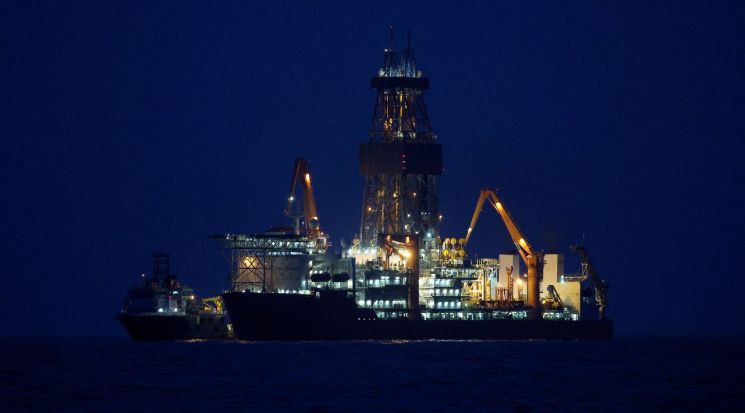
As gas indications discovered during the first exploratory drilling of the 'Daewang Whale Project' have been confirmed to be economically unviable, Korea National Oil Corporation (KNOC) is unlikely to proceed with the second drilling within this year. This is because the justification for securing additional exploration funding has weakened, and uncertainty surrounding the project is increasing as the issuance of bonds, considered the most stable option, has not yet been finalized.
A KNOC official stated in a phone interview with Asia Economy on the 11th, "The second drilling will not proceed within this year," adding, "The exact results of the first drilling will only be available by mid-year, and considering budget issues, a cautious approach is necessary."
This is due to difficulties in securing funds for additional drilling after the first drilling failed to achieve meaningful results. Had the first drilling been successful, government support or attracting overseas investment would have been relatively easier, but the lack of expected outcomes has disrupted the plans.
Low Possibility of Including Second Drilling Costs in Supplementary Budget
KNOC requires a substantial amount of funds to proceed with the second drilling. Since each drilling costs about 100 billion KRW, a clear economic feasibility must be demonstrated to decide on additional drilling. However, with the first drilling results falling short of expectations, KNOC's funding plans are wavering.
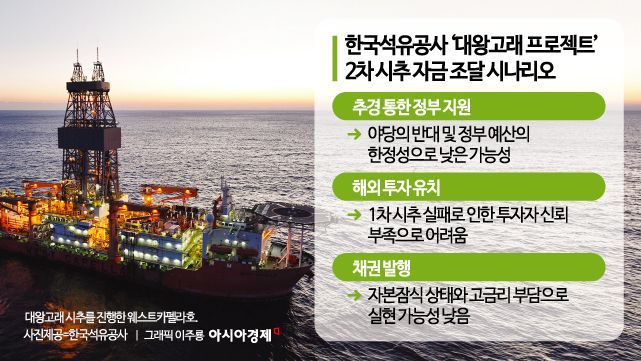
So far, three scenarios have been discussed as funding options for the second drilling: ▲government support through supplementary budget (Chugyeong) allocation ▲attracting overseas investment ▲bond issuance.
First, the possibility of the government providing additional budget support through a supplementary budget is low. Especially since the opposition party, the Democratic Party of Korea, has taken a more negative stance on the Daewang Whale Project after the first exploratory drilling, it is expected to be difficult to include it in the supplementary budget currently under discussion between the ruling and opposition parties.
Attracting overseas investment is also challenging given the increased uncertainty of the project. Considering that large energy companies or global investment funds are reluctant to invest in projects with a high risk of failure, attracting overseas investment is unlikely to be a realistic alternative.
Complete Capital Impairment... Bond Issuance Also Undecided
The most feasible option in reality is corporate bond issuance. KNOC planned to issue new corporate bonds worth 590 billion KRW earlier this year. However, the decision to proceed has not yet been made. A KNOC official said, "We reviewed bond issuance for new borrowing last year as well, but it did not actually proceed," adding, "It is highly likely that the same situation will repeat this year."
This is because KNOC has not been able to escape the 'debt swamp.' Since 2020, KNOC has been in a state of complete capital impairment. According to the Public Institution Management Information Disclosure System, as of the end of the first half of last year, KNOC's liabilities amounted to 21.1664 trillion KRW, exceeding its total assets of 19.78 trillion KRW. The debt-to-borrowing ratio is as high as 84.95%.
In such a heavy debt burden situation, even if new bonds are issued, the burden of funding could increase further due to the need to accept high interest rates. KNOC has only conducted refinancing of matured bonds in recent years and has not issued corporate bonds for new borrowing.
Political Change Variable... Denies Political Considerations
Some speculate that KNOC might be delaying decisions while observing the political situation, considering the possibility of a regime change this year. Since the Democratic Party, which is aiming for the next presidency, holds a negative stance on the Daewang Whale Project, there is a possibility that the project could be overturned in the future.
However, KNOC maintains that the project's progress is unrelated to political logic. A KNOC official stated, "If political factors were considered, bonds would have already been issued at the beginning of the year (when political resistance was low)," drawing a clear line.
© The Asia Business Daily(www.asiae.co.kr). All rights reserved.


















