"Supplementary Budget Should Exclude Contentious Issues Like Local Currency"
Proposes Abolishing the Semi-Proportional Representation System and Electoral District Reform
Maintains Stance on Semiconductor Act and Pension Reform
Kwon Seong-dong, floor leader of the People Power Party, proposed the formulation of a supplementary budget (supplementary budget) excluding local currency. He maintained his existing stance on discussions about fundamental reform based on the processing of the Semiconductor Special Act, including exceptions to the 52-hour workweek system, and the formation of a special committee on pension reform. As a political task, he mentioned a decentralized constitutional amendment as a solution to the imperial presidential system.
On the 11th, in a speech representing negotiation groups at the National Assembly, Floor Leader Kwon stated, "I do not oppose discussions on the supplementary budget, but clear principles and directions are necessary." He proposed formulating a supplementary budget aimed at domestic demand recovery, support for vulnerable groups, and strengthening industrial and trade competitiveness, excluding contentious issues such as local currency.
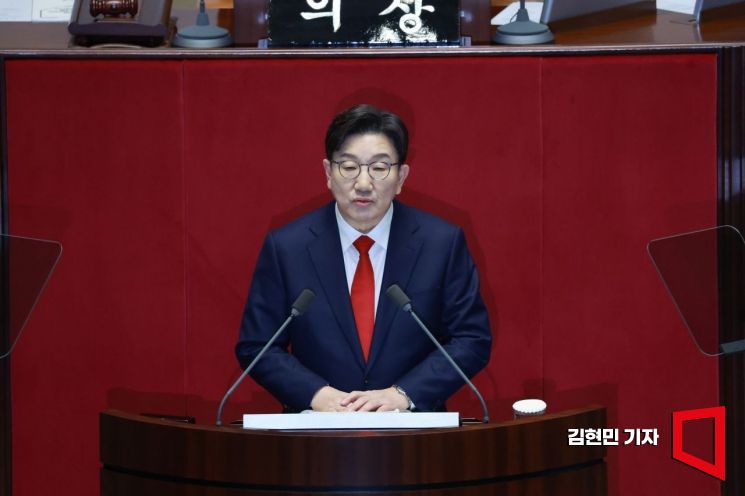 Kwon Seong-dong, floor leader of the People Power Party, is delivering a negotiation group representative speech at the plenary session held at the National Assembly on the 11th. 2025.2.11 Photo by Kim Hyun-min
Although he did not set the premise of reviewing the supplementary budget after examining the execution status of the first quarter's main budget, he reaffirmed his existing position that local currency cannot be supported through the supplementary budget. On the 10th, Lee Jae-myung, leader of the Democratic Party of Korea, proposed a supplementary budget of 30 trillion won, arguing that 2 trillion won of this should be used to support the issuance of local currency.
Regarding pension reform, he maintained his existing position of accepting discussions starting with fundamental reform on the premise of forming a special committee. Fundamental reform involves adjusting figures such as insurance premiums and income replacement rates to delay the depletion of the reserve fund. Floor Leader Kwon said, "Pension reform is linked to basic pensions, retirement pensions, and personal insurance," and argued, "It should be discussed by creating a large framework such as a special committee, not just at the level of the single standing committee called the Health and Welfare Committee."
He also emphasized that the Semiconductor Special Act, another contentious issue, must be processed within February, including exceptions to the 52-hour workweek. The day before, Lee had effectively rejected the 'semiconductor 52-hour exception,' stating that productivity improvements through artificial intelligence (AI) and advanced technology should lead to reduced working hours. Floor Leader Kwon criticized, "The Democratic Party, obsessed with the 52-hour regulation, is a political force lagging behind global standards," and evaluated it as "21st-century isolationism that betrays the value of pragmatism in a rapidly changing era."
As an energy policy for fostering advanced industries, he announced plans to establish a 'Comprehensive National Infrastructure Development Roadmap.' The idea is to induce the relocation of advanced industries, which require massive electricity, to regions equipped with energy sources and transmission and distribution infrastructure, and to provide various incentives such as tax benefits, subsidies, and infrastructure support in a groundbreaking manner.
As a political reform task, he proposed a decentralized constitutional amendment. Floor Leader Kwon emphasized, "We need to consider a structure that disperses imperial presidential power and also limits the abuse of imperial legislative power." He also mentioned the need for electoral law reform, including the abolition of the semi-proportional representation system and the reorganization of electoral districts. He questioned, "The Democratic Party and Leader Lee are ignoring constitutional amendments. Do they think the presidential election is just around the corner?" and said, "Let's find the best system with the determination to even shorten our own terms."
Meanwhile, Floor Leader Kwon devoted about half of his speech to criticism of Leader Lee and the Democratic Party. Citing the achievements of the Yoon Suk-yeol administration over three years, he claimed that the cause of the national crisis was Leader Lee and the Democratic Party. Floor Leader Kwon sharply stated, "The Democratic Party has destroyed parliamentary democracy, the separation of powers, and the rule of law, causing the government to become inoperable and in a state of cardiac arrest," and added, "The sole purpose of the national turmoil is the shielding of the Democratic Party's father, Leader Lee."
© The Asia Business Daily(www.asiae.co.kr). All rights reserved.

















