National Assembly vs. Choi Sang-mok Authority Dispute Hearing
Constitutional Court Concludes Resumed Session in About 50 Minutes
Participation in Yoon's Impeachment Trial Depends on 'Renewal Procedure'
Schedule May Be Adjusted Depending on Appointment Timing
Prime Minister and Acting President Choi Sang-mok, who is also the Minister of Economy and Finance, did not appoint nominee Ma Eun-hyuk as a Constitutional Court Justice, leading to the resumption of the authority dispute trial between the National Assembly and Acting President Choi. However, the trial concluded in a single session. The Constitutional Court judged that the need for additional arguments is low and plans to notify both parties of the ruling date after deliberation among the justices. If the Constitutional Court sides with the National Assembly, Acting President Choi is likely to appoint nominee Ma according to the trial outcome. Even in that case, whether Justice Ma can participate in the impeachment trial depends on the ‘renewal procedure’ of the arguments and the direction of the Constitutional Court’s exercise of litigation control authority.
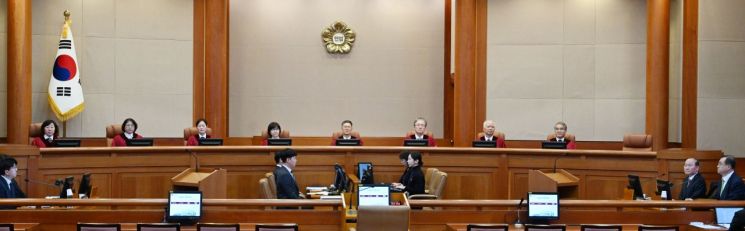 The Constitutional Court held the second hearing for the authority dispute trial regarding Ma Eun-hyeok's infertility designation. Yonhap News
On the 10th, the Constitutional Court held the second hearing on the authority dispute case regarding the suspension of nominee Ma’s appointment, filed by the National Assembly. Previously, the Constitutional Court had planned to deliver a ruling on the 3rd, but accepted Acting President Choi’s request for additional hearings made three days before the ruling and decided to resume the trial. The hearing also concluded in about 50 minutes. The court dismissed the request by Acting President Choi’s side to call Park Chan-dae, the Democratic Party floor leader, as a witness.
If this authority dispute trial concludes that the suspension is unconstitutional, the appointment of nominee Ma will depend on Acting President Choi. If Justice Ma is appointed, depending on the timing of the appointment, the ‘renewal procedure’ of the arguments and the Constitutional Court’s exercise of litigation control authority could affect the schedule of President Yoon Seok-yeol’s impeachment trial. The renewal procedure means that if the composition of justices changes, the previous process must be repeated. Since there are two remaining hearings scheduled for President Yoon’s impeachment trial, the schedule could be adjusted accordingly.
If Acting President Choi’s appointment procedure proceeds swiftly, nominee Ma can participate in the ruling after reviewing the trial records conducted so far. However, if President Yoon’s side does not agree to the renewal procedure, the process may have to start over from the investigation of documentary evidence to witness examination. However, if the Constitutional Court decides to minimize or simplify the renewal procedure through its litigation control authority, the parties will comply. Ultimately, the timing of the Constitutional Court’s ruling on the authority dispute and whether it actively exercises litigation control authority will greatly influence not only the schedule but also the outcome of the impeachment trial. Cheon Jae-hyun, the Constitutional Court’s spokesperson, said, “The specific details of the renewal of arguments are matters for the court’s decision. It is not the stage to disclose positions currently. The court will decide to what extent the Criminal Procedure Act will be applied.”
Meanwhile, the current schedule set by the Constitutional Court for President Yoon Seok-yeol’s impeachment trial includes the 7th hearing on the 11th and the 8th hearing on the 13th. If the Constitutional Court does not schedule additional hearings after deliberation among the justices, the procedures including the examination of 15 witnesses over eight hearings will conclude, leaving only the final arguments, President Yoon’s final statement, and the final ruling. However, so far, there is a widespread expectation that one or two more hearings may be scheduled before the ruling through additional acceptance of some witnesses requested by both the National Assembly and President Yoon’s side.
The key issues for the hearings on the 11th and 13th are expected to be the constitutionality and legality of the Cabinet meeting procedures immediately before the declaration of martial law and the search and seizure of the Central Election Commission. On the 11th, former Minister of the Interior and Safety Lee Sang-min, National Security Office Director Shin Won-sik, former 3rd Deputy Director of the National Intelligence Service Baek Jong-wook, and Secretary-General of the Election Commission Kim Yong-bin will appear as witnesses. On the 13th, National Intelligence Service Director Cho Tae-yong, former Seoul Police Chief Kim Bong-sik, former National Police Agency Commissioner Cho Ji-ho, and 1st Guard Battalion Commander of the Defense Security Command Cho Sung-hyun will testify.
© The Asia Business Daily(www.asiae.co.kr). All rights reserved.
![Clutching a Stolen Dior Bag, Saying "I Hate Being Poor but Real"... The Grotesque Con of a "Human Knockoff" [Slate]](https://cwcontent.asiae.co.kr/asiaresize/183/2026021902243444107_1771435474.jpg)















