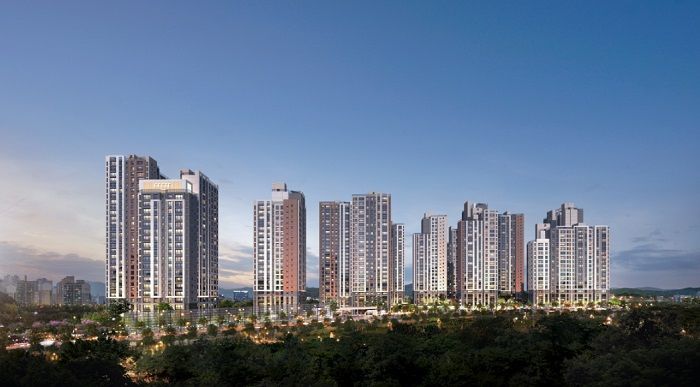
In Yongin, a city gaining attention as a semiconductor hub, the popular 84㎡ apartment units priced in the 400 million KRW range at ‘Yongin Dunjeon Station Epitet’ closed its non-priority subscription with an average competition rate of 6.13 to 1. According to the Korea Real Estate Board’s subscription homepage on the 10th, a non-priority subscription was held for 45 units of 68㎡ and 84㎡ at Yongin Dunjeon Station Epitet. As a result, 276 applications were received, showing a competition rate of 6.13 to 1.
For the exclusive B type, 66 applicants applied for 9 units, recording a 7.33 to 1 ratio, and for the 84B type, 210 applicants applied for 36 units, recording a 5.83 to 1 ratio. The non-priority subscription, known as ‘jubjub,’ is open to adults aged 19 or older residing in Korea regardless of their residential area or home ownership status.
In particular, this complex is a large-scale development with over 1,270 units, and its sale price is about 120 million KRW cheaper than surrounding prices, which heightened consumer interest in the non-priority subscription.
HL D&I Hanla Co., Ltd. is building ‘Yongin Dunjeon Station Epitet’ on 646 Geumeo-ri, Pogok-eup, Cheoin-gu, Yongin-si, a core residential area behind the semiconductor industry. The complex consists of 13 buildings with 1,275 units, ranging from three basement floors to a maximum of 29 floors above ground, and will be developed as a landmark apartment complex in Yongin, the semiconductor city. It will include various community facilities, resident convenience facilities, and commercial facilities, leveraging the advantages of a large-scale complex.
The announcement of winners will be on the 13th, and contracts will be signed on the 14th at the model house located in Pungdeokcheon-dong, Suji-gu, Yongin.
‘Yongin Dunjeon Station Epitet’ is an apartment complex developed as a rear residential area for the Yongin Semiconductor Cluster. The sale price is set about 120 million KRW lower than the average price of nearby apartments, offering potential capital gains. Additionally, regardless of the contract date, resale of the sale rights is possible anytime after March 10, and there is no mandatory residence period.
The unit sizes are ▲68㎡ (exclusive area) Type A with 149 units ▲68㎡ Type B with 124 units ▲84㎡ Type A with 366 units ▲84㎡ Type B with 471 units ▲101㎡ with 165 units. About 70% of the total units are 84㎡ apartments, which are the most popular among actual buyers.
Cheoin-gu, Yongin, which saw a land price increase rate more than twice the national average increase rate (2.15%) last year, is attracting attention. The Yongin Cheoin-gu area, highlighted by the semiconductor cluster development, had a higher land price increase rate than Gangnam-gu, Seoul, a core real estate area.
According to the Ministry of Land, Infrastructure and Transport and the Korea Real Estate Board on the 4th, the area with the highest land price increase among all cities and counties nationwide in 2024 is Cheoin-gu, Yongin (5.87%), known for the semiconductor cluster development and transportation network improvements. When comparing average land price change rates, it was higher than Gangnam-gu, Seoul (5.23%) and Sujeong-gu, Seongnam (4.92%). The government is currently promoting a project to build the world’s largest advanced semiconductor complex on a 7.28 million ㎡ (about 2.2 million pyeong) site in Namsa and Idong-eup, Cheoin-gu. Up to 360 trillion KRW in private investment is expected by the completion date, with anticipated employment of 1.6 million people and creation of 400 trillion KRW in added value.
‘Yongin Dunjeon Station Epitet’ is connected to this advanced semiconductor complex via Local Road No. 57 and is also close to the advanced system semiconductor national industrial complex in Idong and Namsa-eup, developed by Samsung Electronics, boasting an optimal location that offers both semiconductor-related infrastructure and living convenience. In conjunction with this large-scale investment, Yongin City is simultaneously expanding various transportation networks such as the extension of the Gyeonggang Line, establishing itself as a global semiconductor city.
As expectations rise for the lifting of waterfront zone restrictions in Pogok-eup and Mohyeon-eup areas of Cheoin-gu, Yongin, signs of change are emerging in the local real estate market. The Korea Environment Corporation officially announced the lifting of the Han River watershed waterfront zone in November last year. As a result, a total of 3.728㎢ (about 1.128 million pyeong) of land in Samgye-ri, Geumeo-ri, Dunjeon-ri, Sinwon-ri, Yeongmun-ri, Yuun-ri in Pogok-eup, and parts of Chobu-ri and Yubang-dong in Mohyeon-eup were removed from the waterfront zone.
With the waterfront zone lifted, joint housing development, which had been restricted in these areas, is now possible. This has increased interest from developers and raised expectations for land value appreciation. In particular, the Pogok-eup area is attracting attention in the real estate market due to its excellent transportation accessibility near Pogok IC and Yongin IC, and its high development potential due to surrounding road expansion projects. The deregulation from lifting the waterfront zone is expected to positively impact regional development and residents' property rights.
The opening of the Seoul-Sejong Expressway section from Guri to Anseong (72 km) has greatly improved accessibility between Seoul and Sejong.
In particular, Cheoin-gu has three interchanges: Bukyongin IC, Namyongin IC, and Dongyongin IC, making travel to Seoul and the metropolitan area more convenient. Additionally, the Gyeonggang Line extension project is underway, and Dunjeon Station is connected to the Everline light rail, providing excellent access to Giheung Station on the Suin-Bundang Line. The Seoul-Sejong Expressway is a 128 km highway connecting Seoul and Sejong Special Self-Governing City, running north-south through the middle area between the Gyeongbu Expressway and the Jungbu Expressway. It starts from Namguri, passes through Seohanam, Yongin, and Anseong, and reaches Sejong City.
Yongin City is also promoting the construction of a 32 km private expressway connecting Mohyeon-eup, Cheoin-gu, to Uiwang and Gwangju. An environmental impact assessment is currently underway. Yongin City plans to install ‘Mohyeon IC’ near National Road No. 43 passing through Neungwon-ri, Mohyeon-eup, and is also considering linking it with the Seoul-Sejong Expressway. Once this expressway opens, Mohyeon-eup will have easy access eastward to Gwangju via the ‘Second Yeongdong Expressway’ to Wonju and Gangneung, and westward to Uiwang via the ‘Second Gyeongin Expressway’ connecting to Anyang and Incheon Airport. This will establish a comprehensive transportation network.
‘Yongin Dunjeon Station Epitet’ will also be developed as a landmark high-end residential complex representing Yongin City by providing tailored education-specialized services such as safe education infrastructure and AI-based college aptitude consulting. Move-in is scheduled for July 2027.
Besides the expressways, this apartment complex is equipped with various transportation networks. It is located within walking distance of Dunjeon Station on the Everline light rail. Using the light rail, it takes about 20 minutes to reach Giheung Station on the Suin-Bundang Line (transfer available). From Giheung Station, residents can easily access Seoul Gangnam, Bundang, and Pangyo areas in Gyeonggi Province via the Bundang Line.
Using Local Road No. 57, the complex connects to the Yongin Semiconductor Cluster general industrial complex in Wonsam-myeon, where SK Hynix is developing. Additionally, National Road No. 45, exempted from preliminary feasibility studies, connects to the advanced system semiconductor national industrial complex in Idong and Namsa-eup led by Samsung Electronics. Furthermore, Yongin City is actively promoting the Gyeonggang Line extension project connecting Gyeonggi Gwangju Station and Namsa Station, which is expected to further expand the metropolitan transportation network.
© The Asia Business Daily(www.asiae.co.kr). All rights reserved.

















