"No Exceptions"... Tighter Tariffs Than 2018
Inevitable Impact on South Korea's 2.63 Million Tons Duty-Free Quota
U.S. President Donald Trump signed a plan on the 10th (local time) to impose a 25% universal tariff on steel and aluminum. He hinted at imposing tariffs on automobiles, semiconductors, and pharmaceuticals next, signaling the full-scale start of the trade war in his second term.
According to AP News, Bloomberg News, and CNN on the same day, President Trump signed a proclamation imposing a 25% tariff on steel and aluminum products imported into the United States, as previously announced.
President Trump said, "Basically, we plan to impose a 25% tariff on all aluminum and steel without exception, which means many companies will open their doors in the United States," adding, "We are being attacked by both friends and foes. It is time for great industries to return to America."
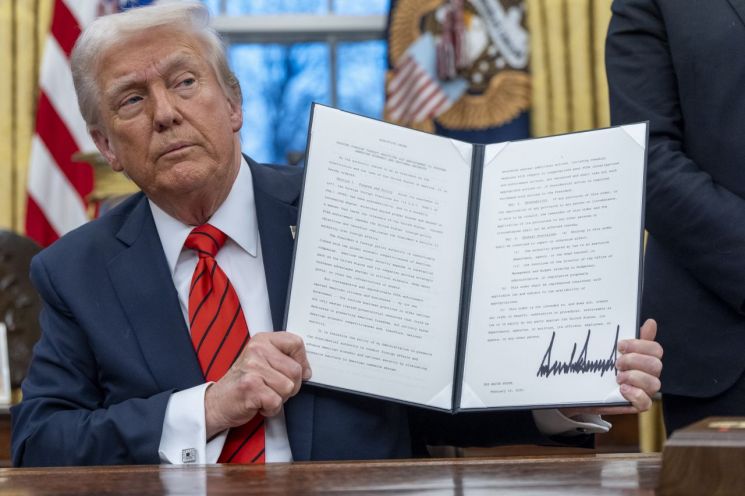 Donald Trump, President of the United States, is signing an executive order in the Oval Office at the White House on the 10th (local time). Photo by AP Yonhap News
This tariff is a stronger measure than the 2018 tariff as it includes finished products. During his first term in 2018, President Trump applied Section 232 of the Trade Expansion Act, imposing a 25% tariff on steel products and a 10% tariff on aluminum products for national security reasons. At that time, the focus was on crude steel and primary aluminum. However, this time, the scope has been expanded to include extrusions and slabs used in automobiles, window frames, and high-rise buildings. Bloomberg analyzed this as "a significant measure that will broadly affect U.S. consumer prices."
A senior official stated that the reason for expanding the tariffs was that steel and aluminum exporting companies exploited exceptions in past policies to harm U.S. companies. CNN also analyzed that this was to block export circumvention by China, the world's largest steel producer.
Due to the steel and aluminum tariffs initiated during President Trump's first term and continued under the Joe Biden administration, U.S. companies import steel from countries other than China. However, Chinese steel is being sold in the U.S. by circumventing tariffs through third countries or by mislabeling. For example, semi-finished products are imported from China, made into finished products, and then exported to the U.S.
President Trump is reportedly planning to instruct the U.S. Customs and Border Protection to strengthen supervision to prevent misclassification of steel products to evade tariffs.
Bloomberg News reported that according to U.S. officials, the new tariffs are scheduled to take effect on April 4.
President Trump stated that there would be "no exceptions" regarding these tariffs. Accordingly, the tariff imposition is expected to affect South Korea, a major steel exporter to the U.S. During President Trump's first term, South Korea negotiated with the U.S. to be exempted from steel tariffs in exchange for accepting a quota system limiting export volumes, currently applying a "2.63 million tons tariff-free" quota. However, it is expected that a 25% tariff will be applied to this as well in the future.
The Wall Street Journal (WSJ) reported, "This is the reimposition of global tariffs without exceptions on allies such as Canada, Mexico, South Korea, and Japan, which the Biden administration had eased."
However, there may be some room for relief depending on future negotiations. According to The Guardian, before announcing the tariffs, President Trump spoke with Australian Prime Minister Anthony Albanese and said he was considering exempting Australian steel and aluminum from tariffs. Bloomberg analyzed that President Trump’s praise of Australia's purchase of U.S.-made aircraft suggests Australia could be considered an exempt country.
As President Trump's tariff war intensifies, starting with tariffs on China on the 4th, the impact on South Korea is expected to grow. On the same day, President Trump stated in the White House Oval Office that "tariffs on automobiles, semiconductors, and pharmaceuticals are also under review." This means that automobiles and semiconductors, major export items of South Korea, could be added to the U.S. tariff list.
President Trump also said he plans to impose reciprocal tariffs within the next two days. When asked about retaliation from other countries, he responded, "I don't care."
Meanwhile, President Trump also signed an executive order encouraging the federal government and consumers to purchase plastic straws. This reverses the previous Biden administration's policy recommending paper straws and reaffirms a conservative environmental policy stance.
© The Asia Business Daily(www.asiae.co.kr). All rights reserved.

















