Selected for the Ministry of Science and ICT’s “GRIMBS Project”
International Symposium Held
Development of Muscle Regeneration Technology
Pioneering Innovation in Advanced Biomedical Science
The importance of muscle regeneration increases as people live longer. In an aging society, new biotechnology is needed to address this challenge.
UNIST has launched a global bio research institute to take on this task.
UNIST (President Jongrae Park) held the "International Symposium on Multiscale Biohybrid Systems" on February 9-10 at the Industry-Academic Cooperation Building.
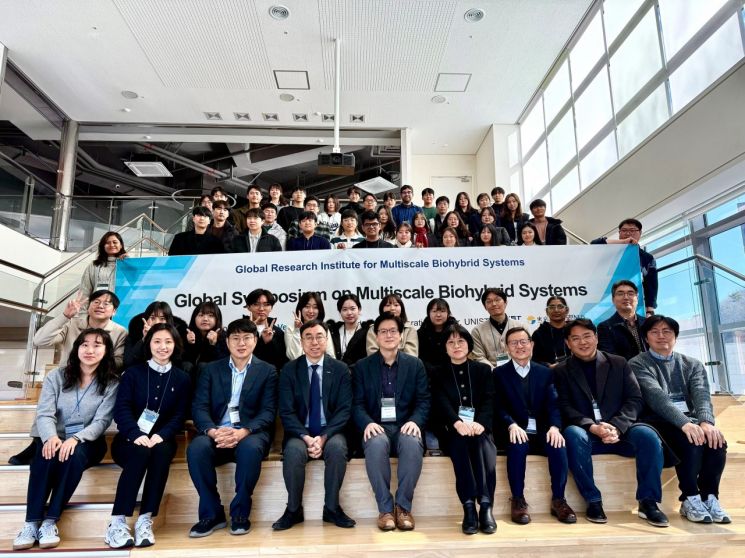 Participants of the "International Symposium on Multiscale Biohybrid Systems" are taking a commemorative photo. Photo by UNIST
To commemorate its selection as an Advanced Bio Global Joint Research Center supported by the Ministry of Science and ICT, UNIST announced the achievements of the "Global Research Institute for Multiscale Biohybrid Systems (GRIMBS)."
The GRIMBS institute develops biohybrid systems that precisely mimic biological tissue structures and restore human body functions. This technology is expected to help regenerate muscles and recover functions in the elderly, thereby improving quality of life.
More than 80 researchers from institutions such as the University of Tokyo and the National University of Singapore attended the symposium.
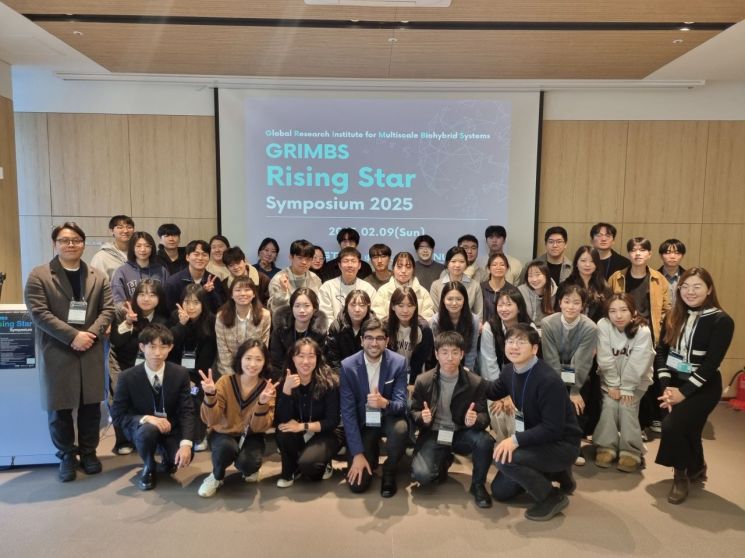
On the first day, the "Rising Star Symposium" was held. UNIST researcher Hyunmo Yang presented biomedical imaging analysis technology based on deep learning. Tomohiro Morita from the University of Tokyo showcased biohybrid robots operated by electrical stimulation, and Nishans Menon from the National University of Singapore introduced a system for culturing intestinal microbes and epithelial cells, drawing attention.
On the second day, world-renowned scholars delivered keynote lectures. Professor Qiutek Lim analyzed the principles of cell migration and explained how to apply them to biohybrid design.
Next, the iHealthtech Institute at the National University of Singapore introduced successful commercialization cases in various fields such as AI healthcare, metaverse, and disease diagnosis. The institute attracted $59 million in investment through six startups and created more than 65 jobs.
Professor Shoji Takeuchi from the University of Tokyo proposed ways to integrate muscle tissue into robotics, emphasizing its application potential.
UNIST researchers showcased diverse achievements from molecular to tissue levels. Professor Yoonkyung Cho developed a "multiscale lab-on-a-chip system" analyzing tumor spheroids, providing clues to overcoming anticancer drug resistance.
Professor Jinmyung Joo introduced nanoparticles that act only at specific disease sites and degrade themselves. Professor Jongho Park from the University of Tokyo unveiled a microneedle patch that detects real-time biosignals.
Important research was also presented in tissue regeneration and precision medicine. Professor Hyunwook Kang suggested the possibility of treating ischemic diseases through 3D bioprinting technology that precisely controls vascular orientation. Professor Woongkyu Jung revealed optical imaging technology that analyzes tissues without chemical staining, and Professor Youngbin Choi introduced real-time brain mapping technology that improves brain surgery accuracy. Professor Byungsoo Kim from Pusan National University explained technology that realizes complex biological tissues through 3D bioprinting.
In the poster session, over 20 research achievements were shared. Early-career researchers engaged in active discussions. Vice President Seongcheol Bae said, "The launch of the GRIMBS institute will be a turning point for UNIST to lead biomedical innovation," adding, "We will collaborate with world-class research institutions such as LIMMS at the University of Tokyo and iHealthtech at the National University of Singapore to solve challenges in biotechnology."
Professor Yoonkyung Cho stated, "GRIMBS will lead innovation in precision medicine through research spanning from molecules to tissues," and added, "We will expand international exchange programs to nurture next-generation research talents."
The GRIMBS institute plans to deepen research on biohybrid systems and establish itself as a global research hub by operating international joint research and talent development programs.
© The Asia Business Daily(www.asiae.co.kr). All rights reserved.
![Clutching a Stolen Dior Bag, Saying "I Hate Being Poor but Real"... The Grotesque Con of a "Human Knockoff" [Slate]](https://cwcontent.asiae.co.kr/asiaresize/183/2026021902243444107_1771435474.jpg)
















