On the 7th (local time), following the US-Japan summit, the joint statement included a phrase expressing opposition to "China's attempt to change the status quo in the East China Sea through force and coercion," which led the Chinese government to strongly protest, calling it 'interference in internal affairs.'
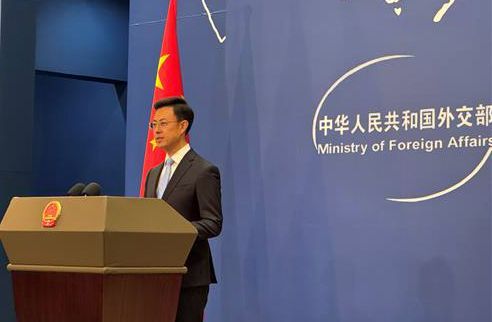
On the 10th, Guo Zhaokun, spokesperson for the Chinese Ministry of Foreign Affairs, stated at a briefing, "The China-related content in the US-Japan joint statement openly interferes in China's internal affairs and attacks and slanders China," adding, "We express strong dissatisfaction and firm opposition, and have submitted solemn representations to the United States and Japan." The term 'submitted solemn representations' is a Chinese diplomatic expression meaning a formal protest through diplomatic channels.
Earlier, after the summit held in Washington on the 7th between US President Donald Trump and Japanese Prime Minister Shigeru Ishiba, the joint statement targeted China with the phrase "changing the status quo by force and coercion." It also emphasized, "We reaffirm our strong opposition to China's illegal maritime claims, militarization of reclaimed land, and threatening and provocative activities in the South China Sea." Particularly regarding the Taiwan issue, which China is most sensitive about, the statement directly mentioned that "maintaining peace and stability in the Taiwan Strait is essential."
In response, spokesperson Guo said, "The Taiwan issue is purely an internal affair of China," and "It is at the core of China's core interests, and no external interference is allowed." He further criticized, "The governments of both the US and Japan have made polite commitments to China on the Taiwan issue, and especially Japan, given its serious historical guilt for invading and colonizing Taiwan, should be more cautious in its words and actions regarding the Taiwan issue."
In this regard, the Chinese Ministry of Foreign Affairs also announced that Liu Jin-song, Director-General of the Asian Affairs Department of the Ministry of Foreign Affairs, summoned Akira Yokochi, the Minister-Counselor of the Japanese Embassy in China, to lodge a protest on the same day.
© The Asia Business Daily(www.asiae.co.kr). All rights reserved.
![Clutching a Stolen Dior Bag, Saying "I Hate Being Poor but Real"... The Grotesque Con of a "Human Knockoff" [Slate]](https://cwcontent.asiae.co.kr/asiaresize/183/2026021902243444107_1771435474.jpg)















