Hyundai and Kia Export 1.1 Million Units Annually
U.S. Trade Expansion Act Section 232 "National Security"
Tariffs, Quotas, and Other Measures Possible
Considering Expansion of Local Production in the U.S.
Korea GM Also Faces Inevitable Decline in Competitiveness
Need to Expand Investment and Minimize Tariff Imposition
U.S. President Donald Trump has mentioned the possibility of imposing additional tariffs on automobiles and semiconductors, heightening tensions across the domestic manufacturing sector. Following steel and aluminum, key export items such as cars and semiconductors are now within the scope of potential tariff bombs, raising concerns that exports could be significantly curtailed.
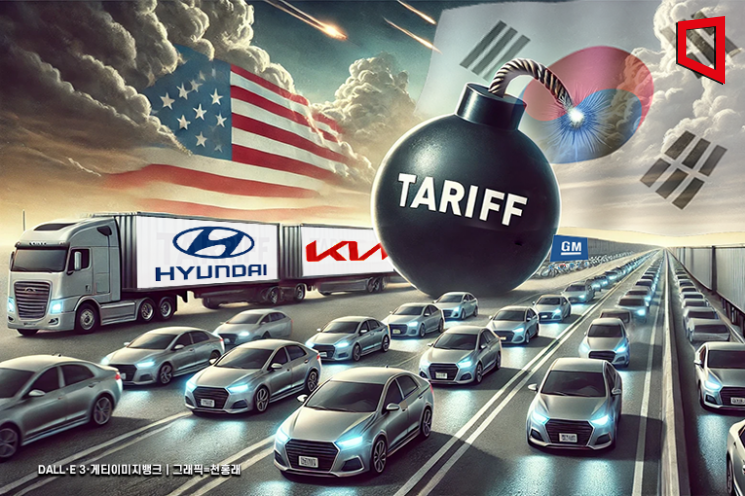
According to the automobile industry on the 11th, Korean-made passenger cars are currently exempt from tariffs when exported to the U.S. under the Korea-U.S. Free Trade Agreement (FTA). U.S.-made passenger cars also face a 0% tariff when exported to Korea. However, a 25% tariff is imposed only on trucks (pickup trucks). But with President Trump mentioning the possibility of additional tariffs on automobiles, Korean-made passenger cars, which export over one million units annually to the U.S., face the risk of tariff imposition.
Tariff imposition is difficult to apply under the reciprocity principle advocated by President Trump. However, based on Section 232 of the U.S. Trade Expansion Act, additional tariffs can be imposed if Korean-made automobiles are deemed a threat to U.S. national security. According to Section 232, if the U.S. president determines that certain products are being imported in quantities or circumstances that threaten national security, after receiving a report and recommendations from the Secretary of Commerce, measures to adjust imports of those products must be taken. These measures may include tariffs, quotas (import limits), and others.
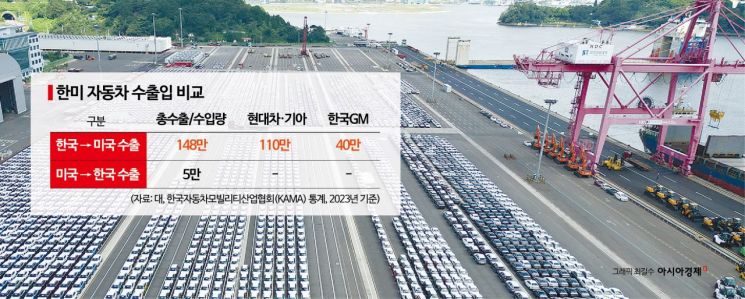
Currently, about 1.48 million vehicles are exported annually from Korea to the U.S., whereas only about 50,000 vehicles enter Korea from the U.S. annually. In terms of scale alone, there is sufficient room to apply the Trade Expansion Act.
If tariffs are applied, Hyundai Motor and Kia are expected to be most affected. Hyundai and Kia export 1.1 million units annually, accounting for two-thirds of total exports. Although Hyundai and Kia have increased local production through factories in Alabama and Georgia, they still maintain a significant export share. Korea GM also exports about 400,000 units, and Renault Korea and KG Mobility supply some vehicles to the U.S. market.
If tariffs are imposed on vehicles exported to the U.S., a weakening of price competitiveness is inevitable. Accordingly, Hyundai Motor Group is reportedly considering strategies to expand production in the U.S. and increase the proportion of locally sourced parts. In particular, they are expected to refer to their response during President Trump's first term, which involved expanding investment in the U.S. and renegotiating the Korea-U.S. FTA to counter protectionism. In 2017, Hyundai Motor Group announced a $3.1 billion investment plan, expanding plants in Alabama and Georgia to increase production of sport utility vehicles (SUVs) and electric vehicles. In 2019, anticipating the possibility of a 25% tariff under Section 232 of the Trade Expansion Act, they expanded local production and began manufacturing the pickup truck 'Santa Cruz' in the U.S. During the FTA renegotiations at that time, the deadline for eliminating tariffs on U.S.-made pickup trucks was extended to 2041, and some restrictions on U.S. vehicle exports to Korea were eased.
Hyundai Motor Group is likely to use investments in electric vehicle and battery production and job creation in the U.S. as negotiation cards during Trump's second term. They may secure incentives through plant expansions and strengthening research and development (R&D), but a strategy to prepare for changes in electric vehicle subsidy policies is necessary. The Georgia electric vehicle-only plant is expected to begin mass production soon, and the battery supply chain will be established in cooperation with local companies. Kia is also reviewing plans to localize electric vehicle production. Additionally, they are discussing expanding the range of models that can be produced at U.S. plants. However, Hyundai Motor Group has not issued an official statement regarding tariff responses.
The Korean branch of the American company General Motors (GM) is also deeply concerned. Korea GM has exported new cars from Korea to the U.S. leveraging low production costs, but if tariffs are imposed, a decline in price competitiveness is inevitable. GM headquarters is reportedly considering adjusting production volumes and relocating production in response to the possibility of tariffs. If production is moved to regions eligible for tariff exemptions, it is expected that the operating rates of Korea GM’s Bupyeong and Changwon plants will decline and some production lines will be reduced. A Korea GM official said, "We are closely monitoring all possibilities regarding market environment and policy changes."
Experts advise that negotiations to minimize tariff imposition should focus on Korea’s scale of investment in the U.S. automobile sector and the role of Korea GM. There are also calls for government-level responses. Han Areum, senior researcher at the Korea International Trade Association, said, "Unlike during the first term, President Trump is now saying he will impose tariffs uniformly without exceptions or exemptions for individual companies," emphasizing, "The card Korea can play is increasing manufacturing investment in the U.S. and the jobs created there." She added, "It should be stressed that if tariffs are imposed, it will inevitably affect the production of our companies within the U.S. as well."
© The Asia Business Daily(www.asiae.co.kr). All rights reserved.


















