Lee Jae Myung Proposes "Constitutional Defense Alliance" and "Jalsanism"
Emphasizes Strengthening Direct Democracy and Solutions Through Growth
On February 10, Lee Jae Myung, leader of the Democratic Party of Korea, delivered a negotiation group representative speech focused on overcoming the national crisis following the declaration of martial law. His speech reflected a determination to turn adversity into an opportunity for positive change.
During his address at the National Assembly plenary session, Lee presented solutions to the political situation that has emerged since the crisis. While he proposed political breakthroughs and ways to resolve social conflict, these were presented only in declarative terms, without specific details.
As a primary measure to overcome the current political crisis, he proposed the formation of a "Constitutional Defense Alliance." He stated, "Together with everyone who respects the values of a democratic republic, we will form a 'Constitutional Defense Alliance' and fight against the forces that seek to destroy the constitutional order." However, he did not elaborate on the specific methods or targets of this alliance.
Lee also promised changes within the Democratic Party in response to the political turmoil and confusion following martial law. He said, "We must seriously reflect on whether a Democratic Party that cannot change itself can truly change Korea," and added, "We will respond more earnestly to the question of whether the next era will truly be a better world, just as those who stood unarmed against armored vehicles and fought the martial law troops armed with guns and bombs did. We will strengthen direct democracy so that the will of the people is routinely reflected in state affairs." By proposing direct democracy as a solution, Lee addressed the decline in the Democratic Party's approval ratings after the impeachment by suggesting that strengthening direct democracy is the answer.
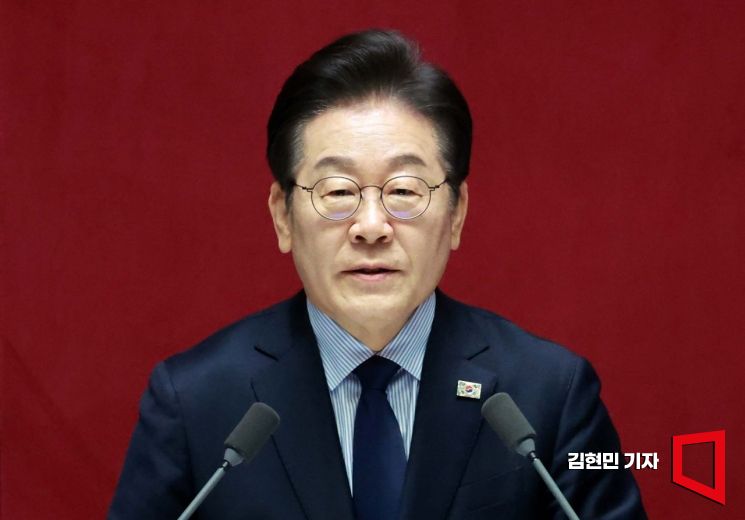 Lee Jae Myung, leader of the Democratic Party of Korea, is delivering a negotiation group representative speech at the plenary session held at the National Assembly on the 10th. 2025.2.10 Photo by Kim Hyun Min
Alongside "Meoksanism," which addresses livelihood issues, Lee also presented "Jalsanism," a vision for a society where everyone prospers together. Jalsanism, which emphasizes achieving major social reforms through political balance, was proposed as a means of reaching a grand social compromise. In particular, regarding corporate development and the protection of labor rights, Lee said, "Although it will require significant time and effort, we must achieve a virtuous cycle of 'grand social compromise' by increasing corporate responsibility through dialogue and trust-building, expanding the national social safety net, and broadening stable employment through greater labor flexibility." He also suggested topics for discussion such as reducing working hours, extending the retirement age, and reforming the pension system.
Additionally, Lee proposed the introduction of a "recall system for members of the National Assembly" as a political reform task.
The majority of Lee's speech was devoted to economic issues. He emphasized the need to revive the people's livelihoods and address crises across various industries in the wake of martial law. To this end, Lee specifically proposed a supplementary budget and support measures for future growth industries.
Lee stated, "The most urgent task for recovery and growth is an emergency prescription for the people's livelihood economy, namely a supplementary budget." He proposed a supplementary budget of at least 30 trillion won to support the recovery of people's livelihoods and the economy. The proposed supplementary budget would include support measures for small business owners such as win-win consumption coupons, compensation for losses, and support for local currency, as well as public safety budgets for infectious disease response and the training of trauma specialists. In addition, Lee mentioned public housing, local social overhead capital (SOC), national funding for free high school education, and additional investments in future industries such as artificial intelligence (AI) and semiconductors. However, he also expressed flexibility by stating, "If necessary for the supplementary budget, I will not insist on any particular item."
Furthermore, Lee introduced an economic and industrial vision using the initials A to F. He proposed fostering the AI industry as a strategic sector and training 100,000 professionals for this purpose. For Bio, he suggested strengthening the ecosystem through national investment; for Culture, supporting the cultural industry and expanding tourism; for Defense, continued investment in research and development (R&D); for Energy, expanding renewable energy and constructing an "energy superhighway"; and for Factory, supporting the localization of materials, parts, and equipment and creating an innovation ecosystem through industry-academia cooperation. In particular, regarding manufacturing, Lee said, "We need to support demonstration projects for industrial restructuring and the development of high value-added products," and suggested that both the ruling and opposition parties discuss structural solutions such as worker retraining and revitalizing local economies.
In this speech, Lee also addressed the controversy over his perceived "shift to the right" by focusing on the relationship between growth and distribution. He spoke of building "a nation with a solid foundation where every citizen's basic life is guaranteed," and, in response to changes in the labor environment brought about by the AI revolution, emphasized the need to "prepare for a universal basic society." To do so, he argued, "The community must take collective responsibility for the basic lives of the people in all areas, including housing, finance, education, healthcare, and public services, to reduce anxiety about the future and pave the way for sustainable growth." He stressed that "recovery and growth" must be prerequisites for solving these challenges, advocating for growth as the foundation for equitable distribution. Lee referred to this virtuous cycle of distribution and growth as "fair growth."
© The Asia Business Daily(www.asiae.co.kr). All rights reserved.

















