A technology capable of measuring carbon dioxide concentration using a sensor attached to a mask has been developed domestically. Carbon dioxide is a major product of respiratory metabolism, and monitoring the carbon dioxide concentration in exhaled breath can be widely used not only to detect and diagnose respiratory and circulatory diseases early but also to check individual exercise status.
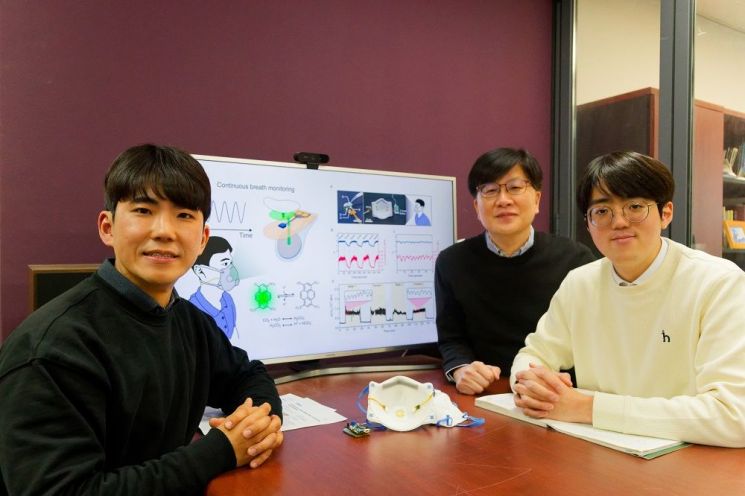 (From left) Dongho Choi, Ph.D. candidate, Department of Electrical Engineering; Seunghyup Yoo, Professor; Minjae Kim, undergraduate student, Department of Materials Science and Engineering. Provided by KAIST
On the 10th, KAIST announced that Professor Seung-Hyup Yoo's research team from the Department of Electrical Engineering and Computer Science developed a low-power, high-speed wearable carbon dioxide sensor capable of real-time respiratory monitoring.
Existing non-invasive carbon dioxide sensors had limitations such as large size and high power consumption. Optical carbon dioxide sensors using fluorescent molecules had the advantage of being compact and lightweight, but due to the photodegradation of dye molecules, they were difficult to use stably for long periods, limiting their application as wearable healthcare sensors.
Photochemical carbon dioxide sensors utilize the fact that the intensity of fluorescence emitted from fluorescent molecules decreases according to the carbon dioxide concentration. At this time, effectively detecting changes in fluorescent light is important.
Based on this, the research team developed a low-power carbon dioxide sensor composed of an LED and an organic photodiode surrounding it. The developed sensor features minimizing the amount of light irradiated on the fluorescent molecules based on high light-receiving efficiency. Compared to existing sensors consuming several milliwatts, the team succeeded in achieving a device power consumption of 171μW, which is tens of times lower.
Additionally, the team identified the photodegradation pathway of fluorescent molecules used in carbon dioxide sensors, revealing the cause of increasing errors over time in photochemical sensors, and proposed an optical design method to suppress error occurrence.
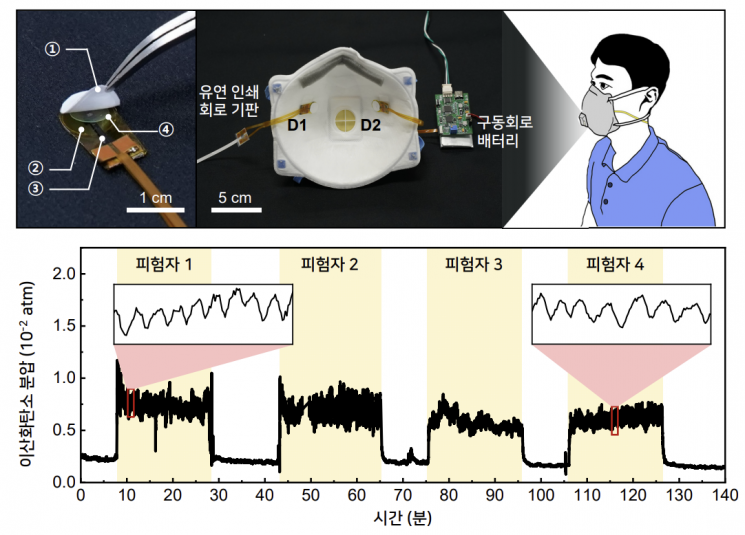 This material explains the principle of attaching and utilizing a low-power, high-speed wearable carbon dioxide sensor on a wearable smart mask. The sensor is attached inside the mask to monitor the wearer's breathing in real time. Provided by KAIST
Based on this, the research team efficiently reduced errors caused by photodegradation, a chronic problem of existing photochemical sensors. While existing technologies based on the same materials last less than 20 minutes, the sensor developed by the team can be used continuously and stably for up to 9 hours, which is also considered an advantage. The team explained that the sensor can be reused multiple times by replacing the carbon dioxide detection fluorescent film.
Above all, the newly developed sensor boasts strengths in weight (0.12 g), thickness (0.7 mm), and flexibility. This allows the sensor to be attached inside a mask to accurately measure carbon dioxide concentration. It also features fast speed and high resolution capable of distinguishing inhalation and exhalation in real time and monitoring respiratory rate.
Professor Seung-Hyup Yoo said, "The sensor developed by the research team has excellent characteristics such as low power consumption, high stability, and flexibility, making it widely applicable to wearable devices," and added, "This increases the possibility of its use in early diagnosis of various diseases such as hypercapnia, chronic obstructive pulmonary disease, and sleep apnea."
Meanwhile, this research was conducted with support from the Ministry of Trade, Industry and Energy's Materials and Components Technology Development Project, the National Research Foundation of Korea's Fundamental Technology Development Project, and the KAIST Undergraduate Research Participation (URP) program.
© The Asia Business Daily(www.asiae.co.kr). All rights reserved.
![Clutching a Stolen Dior Bag, Saying "I Hate Being Poor but Real"... The Grotesque Con of a "Human Knockoff" [Slate]](https://cwcontent.asiae.co.kr/asiaresize/183/2026021902243444107_1771435474.jpg)
















