79% Patent Growth Rate in 5 Years, Ranking First
Patent Application Share Surpassed 34% Last Year
Diverse Fields Including Semiconductors and Batteries
Strategy to Prevent Patent Infringement Lawsuits
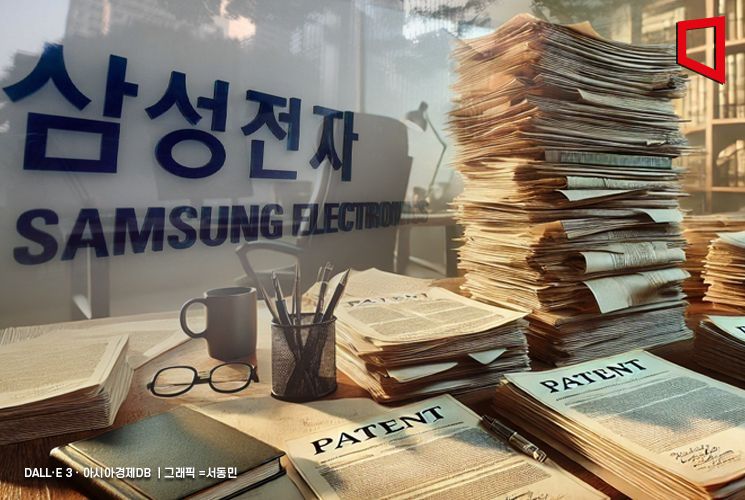
Last year, Samsung Electronics surpassed 13,000 patent applications, setting a new record high. Samsung Electronics accounted for more than 34% of the top 10 companies in patent applications. Although the proportion decreased slightly from the 37% range in 2023, when it was the largest, due to an increase in patent applications from other domestic companies, it is evaluated as a result of massive investments in developing technological capabilities. This is also analyzed to have influenced the commercialization of actual products.
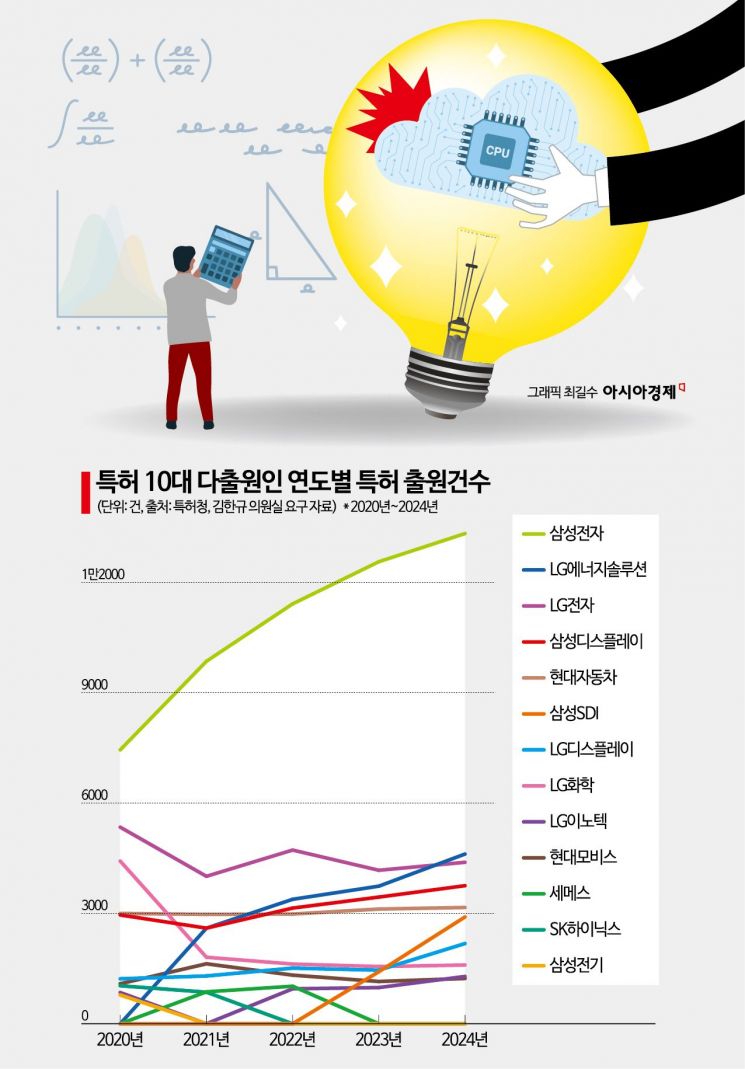
According to data titled ‘Patent Application Status by Top 10 Applicants Over the Past 5 Years (2020?2024)’ received by Rep. Kim Han-gyu’s office from the Korean Intellectual Property Office on the 10th, Samsung Electronics filed 13,329 patent applications last year, nearly double the 7,447 applications in 2020, five years earlier. The patent application growth rate over five years was also 79%, ranking first.
The share of patent applications also jumped from 26.5% among the top 10 companies in 2020 to 37.4% in 2023. Last year, the share slightly decreased to 34.7% as other companies increased their patent filings.
Samsung Electronics’ patent applications cover most technology fields including semiconductors, displays, smartphones, artificial intelligence (AI), 5G and communication equipment, and batteries. Emphasizing patents is essential for survival amid increasingly fierce technological competition. In 2011, Samsung Electronics engaged in nearly seven years of litigation after Apple filed a lawsuit alleging infringement of iPhone design and screen layout patents. In 2020, global telecommunications equipment company Ericsson also filed a lawsuit claiming Samsung infringed on 5G and LTE-related patents. Recently, a U.S. patent management firm claimed that Samsung’s foldable phones infringed on its translator device patents.
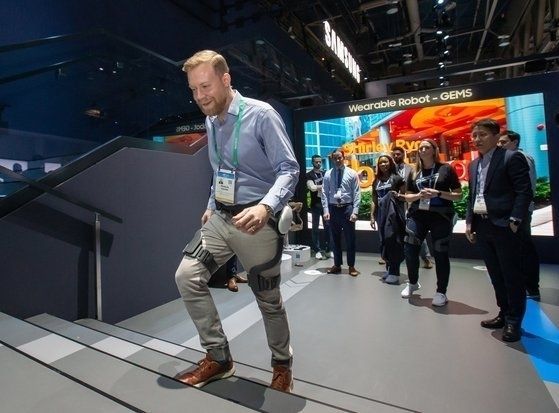
Because of this, Samsung Electronics internally emphasizes that securing patents can provide various advantages in global competition. A recent example is applying its patented technology to new products such as the Galaxy Watch’s bioelectrical impedance analysis (BIA) measurement device and the wearable robot ‘BotFit’ for walking assistance. The BIA measurement patent enabled the Galaxy Watch to include body composition analysis functions, securing competitiveness in the smart healthcare market. Samsung Electronics developed ‘BotFit’ using patents related to walking assistance technology and robot control algorithms. This is expected to be commercialized as a customized wearable robot for users with rehabilitation and walking difficulties.
In particular, even when Samsung Electronics led the memory semiconductor revolution in the past, consistent patent applications played a significant role in enhancing technological capabilities. Since the 1990s, the company has encouraged publishing papers and filing patents company-wide to raise technology levels, culminating in the world’s first successful development of the 64Mb DRAM in 1992. Im Hyung-kyu, former president who led Samsung Electronics’ semiconductor industry for over 30 years, stated in his book ‘Hidden Heroes’ that "to overcome the situation of having to pay large patent fees to advanced companies, great efforts were made to secure valid patents," and "patent applications were emphasized from the early stages of the business, and meaningful international patents began to emerge from the mid-1990s."
Samsung Electronics encourages presenting outstanding papers at overseas academic conferences after patent application, which is said to have increased the publication rate in global academic journals.
Looking at global statistics, Samsung Electronics ranks among the top in the number of patents. Last year, Samsung Electronics ranked second by filing 3,924 patents according to the World Intellectual Property Organization (WIPO) global patent activity statistics. LG was the only other Korean company in the global rankings, while Huawei ranked first with 6,494 patents.
A Samsung Electronics official explained, "Patents are the source of all technology, and it is a global trend for companies to proactively secure many patents," adding, "Due to frequent overseas patent disputes, we secure patent rights to respond accordingly."
LG Energy Solution Surpasses LG Electronics in Patents... K-Battery Patent Applications Surge
Patent applications from battery companies have increased significantly. As competition intensifies to dominate next-generation battery technologies such as solid-state batteries and lithium-sulfur batteries, companies are accelerating research and development (R&D). Samsung SDI and LG Energy Solution are competing to secure technology leadership by actively acquiring numerous patents through aggressive R&D.
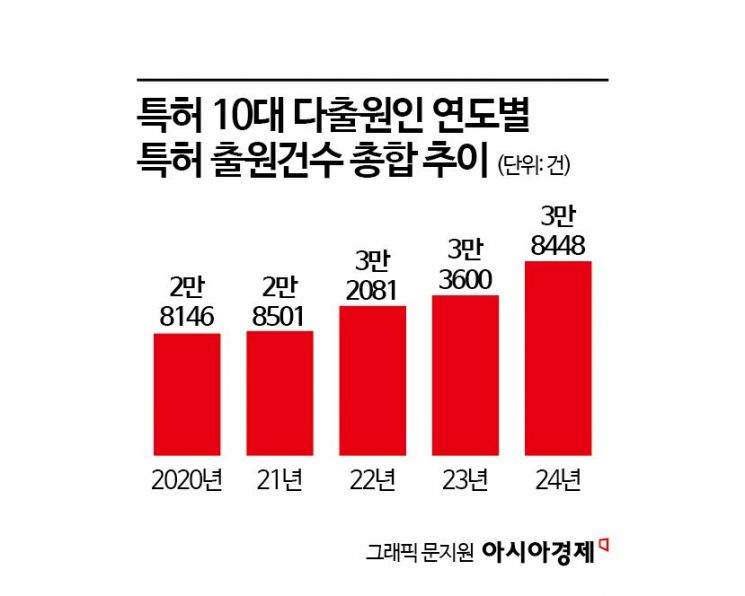
According to data requested by Rep. Kim’s office, the number of patent applications from the top 10 companies has increased every year over the past five years. The top 10 companies filed 28,146 patent applications in 2020, which rose to 38,448 in 2024, an increase of about 36.7%. This is interpreted as a result of companies’ active patent strategies to secure technological superiority amid intensifying global technology hegemony competition.
Notably, LG Electronics ranked second in total patent applications in 2020, but LG Energy Solution rose to second place in 2024. This indicates that competition in the battery industry has become fiercer. The increase in patent applications from battery companies such as Samsung SDI and LG Energy Solution was remarkable. Samsung SDI’s applications rose sharply from 1,414 in 2023 to 2,904 in 2024. LG Energy Solution also increased from 2,599 in 2021 to 4,615 in 2024, recording about a 78% growth rate over four years. This is because battery companies are strengthening competition in next-generation battery technologies by expanding R&D in production processes, material innovation, and energy density improvement. Especially with the growth of the global electric vehicle market, demand for high-performance, long-life batteries is increasing, leading to a surge in patent applications to secure technological capabilities.
Patent applications in the display sector also increased. LG Display’s applications rose 78.5% from 1,222 in 2020 to 2,181 in 2024. Samsung Display also showed active technology development, increasing from 2,957 to 3,754 applications during the same period, a 27.0% increase.
On the other hand, SK Hynix and Samsung Electro-Mechanics were excluded from the top 10 companies list starting in 2022 and 2021, respectively. LG Chem’s patent applications sharply declined after LG Energy Solution was spun off in 2020. Patent applications, which were in the 4,000 range in 2020, recently dropped to the 1,000 range. This is interpreted as a shift in R&D focus from the battery business to petrochemicals, bio, and eco-friendly materials. However, patent applications related to eco-friendly plastics, biodegradable materials, and carbon neutrality technologies are increasing recently.
Hyundai Motor Company and Hyundai Mobis have maintained top rankings every year. Hyundai Motor Company files 2,000 to 3,000 patents annually, and Hyundai Mobis files around 1,000 patents, continuously developing technologies related to electric vehicles, autonomous driving, and eco-friendly vehicles.
© The Asia Business Daily(www.asiae.co.kr). All rights reserved.
![Clutching a Stolen Dior Bag, Saying "I Hate Being Poor but Real"... The Grotesque Con of a "Human Knockoff" [Slate]](https://cwcontent.asiae.co.kr/asiaresize/183/2026021902243444107_1771435474.jpg)

















