NHIS Reports Decline in Reimbursable Oral Treatments from 18 Billion to 14.2 Billion KRW
Simple Administration Drives Patient Demand; Influenza Indemnity Insurance Sales Also a Factor
Non-insurance-covered influenza non-reimbursable tests and treatment injection services have been rapidly increasing. The influenza indemnity insurance introduced in 2023 has also been identified as a cause encouraging non-reimbursable treatments.

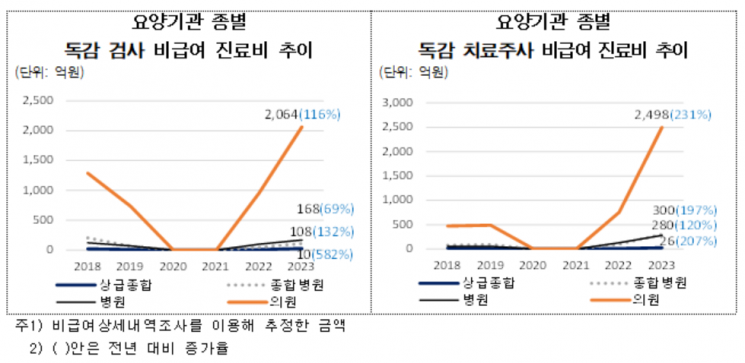
According to the 10th analysis of health insurance patient medical expenses conducted by the National Health Insurance Service, influenza-related test costs at tertiary general hospitals, general hospitals, hospitals, and clinics in 2023 amounted to 235 billion KRW, and non-reimbursable treatment injection costs such as Peramiflu and Peraones injections reached 310.3 billion KRW, showing increases of 113% and 213% respectively compared to the previous year.
During the COVID-19 pandemic, influenza cases significantly decreased, with the number of influenza treatments dropping from 8.33 million cases in 2018 to 4.99 million in 2019, 1.95 million in 2020, and 30,000 in 2021. However, cases rose again to 1.95 million in 2022 and 8.65 million in 2023. During this period, reimbursable oral influenza treatment expenses decreased from 18 billion KRW in 2018 to 14.2 billion KRW in 2023, whereas non-reimbursable injection treatment expenses surged nearly fivefold from 62.6 billion KRW to 310.3 billion KRW.
The increase in non-reimbursable influenza tests and treatment injection expenses was mainly observed at the clinic level. In 2023, clinics accounted for 206.4 billion KRW and 249.8 billion KRW in non-reimbursable influenza test and treatment injection expenses respectively, representing 87.8% of all non-reimbursable influenza tests and 80.5% of non-reimbursable treatment injections. The growth rates of non-reimbursable influenza tests and treatment injections at clinics were 116% and 231% respectively compared to the previous year, exceeding the overall growth rates (tests 113%↑, treatment injections 213%↑).
As non-reimbursable influenza tests and treatment injections surged, the health insurance coverage rate at clinics dropped to 57.3% in 2023, a 3.4 percentage point decrease from the previous year, according to the National Health Insurance Service. The non-reimbursable rate for influenza diseases at clinics was 71.0% in 2023, up 11.6 percentage points from 59.4% in 2022 and 17.0 percentage points from 54.0% in 2018. The proportion of influenza treatment expenses within clinics’ non-reimbursable medical expenses also rose by 4.5 percentage points to 7.2% compared to the previous year.
The increase in non-reimbursable influenza treatments is attributed to the rise in sales of private insurance policies that pay benefits upon confirmed influenza diagnosis and antiviral prescriptions, known as 'Influenza Insurance.' Additionally, the diversification of injection treatments and their simpler administration compared to oral treatments have likely contributed to increased demand.
Professor Jang Gwangcheon of the National Health Insurance pediatric and adolescent department emphasized, "The effectiveness of oral influenza treatments (covered by insurance) and injection treatments (non-covered) is similar, and both can cause side effects such as diarrhea, nausea, vomiting, elevated liver enzymes, and rarely delirium. Therefore, patients should consult experts before treatment to understand side effects and precautions."
During current influenza epidemic warnings, high-risk groups such as children, pregnant women, mothers within two weeks postpartum, those aged 65 and older, immunocompromised individuals, and patients with underlying conditions can receive reimbursable antiviral prescriptions such as oral Oseltamivir (Tamiflu) and inhaled Zanamivir (Relenza Rotadisk) without testing if symptoms are suspected.
A National Health Insurance Service official stated, "We will continue analyzing non-reimbursable services through the non-reimbursable reporting system and medical expense surveys, and based on this, strive to provide medical expense information to ensure patients’ right to choose."
© The Asia Business Daily(www.asiae.co.kr). All rights reserved.


















