China Joins the AI Rift Between Europe and the United States
U.S. Vice President and Chinese Vice Premier Expected to Face Off
Conflict Unavoidable with Trump Administration Pushing AI Innovation
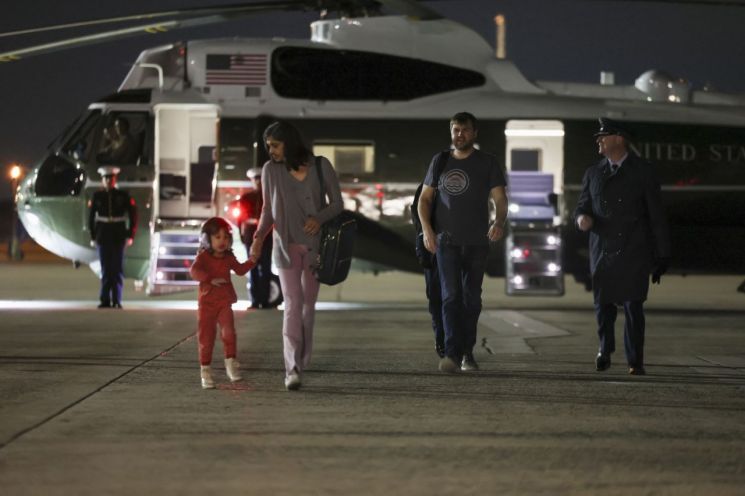 JD Vance, Vice President of the United States (second from the right), and his family are moving to the airport in Washington DC on the 9th (local time). Vice President Vance chose the AI Summit held in Paris from the 10th as his first international diplomatic stage. Photo by AP Yonhap News
Concerns are rising that the AI Summit (AI Action Summit), held in Paris, France from the 10th (local time) to the 11th, will become a turning point for conflict rather than easing the reckless competition in AI development. It is expected that the summit could lead to divisions between the United States and other countries amid the shock of the inauguration of the Donald Trump administration and China's Deepseek. There is also a high possibility that a joint declaration will not be issued.
The AI Summit is being held again in Europe following the 2023 meeting in the UK and last year’s meeting in South Korea. The third summit is led by French President Emmanuel Macron and Indian Prime Minister Narendra Modi. The intention appears to be to expand discussions on AI development and safety through solidarity between developed and developing countries.
The core of the meeting can be seen as a confrontation between the United States, which is leading AI development, and Europe, which has lagged behind in AI development but has focused on AI safety. Especially with the inauguration of the Trump administration, which is negative toward AI regulation, doubts are growing about whether a unified opinion on AI safety can be presented.
According to Reuters, a binding agreement on AI safety is unlikely to emerge from this meeting. Although President Macron asserted that "this cannot be the American Wild West era of AI," diplomatic circles predict that it is uncertain whether the United States will agree to a joint statement.
Rather, there is a high possibility of an AI standoff between the United States and China. The U.S. will be represented by Vice President J.D. Vance at the summit, while China will send Vice Premier Zhang Guoqing (張國?) as a special envoy. China sent the Vice Minister of Science and Technology to the first summit held in the UK in 2023, but sending Vice Premier Zhang, who is a special representative of Chinese President Xi Jinping and a member of the Central Political Bureau, this time is interpreted as signaling that China intends to have a stronger voice. Given that this comes right after China’s Deepseek introduced AI that threatens U.S. AI dominance despite U.S. regulations, it is highly likely that China will try to reflect its opinions. In particular, China may lead AI division by attempting to form an alliance of countries opposed to U.S. pressure.
The U.S. intention can also be understood from Sam Altman, CEO of OpenAI, who pressured the European Union (EU) to create an environment conducive to AI technological development in an op-ed published in the French daily Le Monde ahead of the summit. The EU is about to implement the world’s first comprehensive AI regulatory law. Following the EU, South Korea has also enacted a basic AI law and established standards for AI development and safety. Even President Macron, who is leading this summit, has announced active investment in France. The French AI startup Mistral is taking the lead in AI investment.
Meanwhile, South Korea will be represented at the summit by Minister of Science and ICT Yang Sang-in, who plans to share the country’s AI Basic Act, the second in the world, promote the Digital Inclusion Act to eliminate digital inequality among all members of society, and propose South Korea’s chairmanship of the ‘International AI Safety Research Institute Network.’ It remains unclear whether the United States will agree to the International AI Safety Research Institute Network. Government officials such as Ko Hak-su, Chairperson of the Personal Information Protection Commission, and Kim Myung-joo, Director of the AI Safety Research Institute, as well as industry leaders including Jeon Kyung-hoon, Chief Technology Officer (CTO) of Samsung Electronics, Choi Soo-yeon, CEO of Naver, and Kim Yoo-cheol, Head of Strategy at LG AI Research Institute, will also attend the event.
© The Asia Business Daily(www.asiae.co.kr). All rights reserved.

















