A Total of 1,587.76 kW of Renewable Energy Supplied Last Year
Hydrogen Fuel Cell Power Plants Planned for Areas Without Urban Gas
Mini Hydrogen City Project Begins with Master Plan Development in the First Half of the Year
Goyang Special City, Gyeonggi Province (Mayor Lee Dong-hwan) is working to promote the spread of renewable energy to move toward a sustainable energy transition society. In particular, efforts are being made to establish various infrastructure to build a hydrogen economy ecosystem based on the creation of a mini hydrogen city.
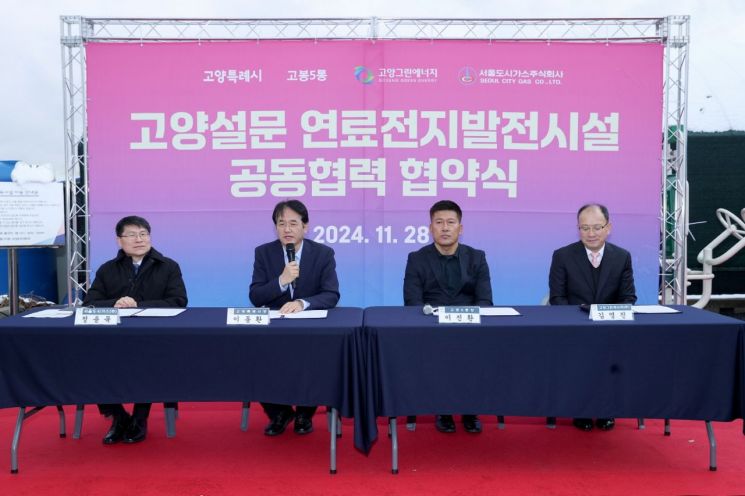 The scene of the joint cooperation agreement ceremony for the Goyang Seolmun fuel cell power generation facility. Provided by Goyang Special City
According to Goyang Special City on the 10th, the city secured about 5.6 billion KRW in national and provincial government budgets last year and carried out various projects to expand the spread of renewable energy.
Through the renewable energy housing support project and mini solar power support project, the city supplied solar power facilities with a total capacity of 401 kW to 176 households. As part of the renewable energy building support project, 186.5 kW of solar power facilities were supported at 12 private buildings. Additionally, through a hybrid support project, solar power facilities of 315 kW, geothermal facilities of 175 kW, and solar thermal facilities covering 32㎡ were being supplied to 94 private buildings. Furthermore, the 14th Citizen Sunlight Power Plant, with a capacity of 298.2 kW, was completed in Gusan-dong last December.
Thanks to these efforts, Goyang City received the highest S grade in the ‘RE100 Renewable Energy Supply Achievement Rate’ category in last year’s comprehensive evaluation of cities and counties. This marks the fifth consecutive year since 2020 that the city has achieved the highest grade in evaluations related to renewable energy supply.
This year, support for renewable energy facilities in public and private facilities will continue. A solar power facility with a capacity of 262.2 kW is planned to be installed at KINTEX Exhibition Hall 1, and the hybrid support project, which secured about 600 million KRW in national funding, will be expanded to support installations at 57 solar power sites, 10 geothermal sites, and 1 solar thermal site. Additionally, solar power installations are planned for 110 households under the housing support project and about 50 households under the mini solar power support project.
Goyang City aims to expand power generation facilities using hydrogen fuel cells and establish a distributed energy self-sufficiency system. Currently, the city is promoting the installation of hydrogen fuel cell power generation facilities in Seolmun-dong, Ilsandong-gu, an area without urban gas supply. The site area is approximately 4,166㎡, and the power generation capacity is 9.9 MW, enough to supply about 18,000 households.
In November last year, the city signed a business agreement with Gobong 5-dong Village, Goyang Green Energy Co., Ltd., and Seoul City Gas Co., Ltd. for the installation of the Goyang Seolmun hydrogen fuel cell power generation facility and the supply of urban gas to the surrounding area.
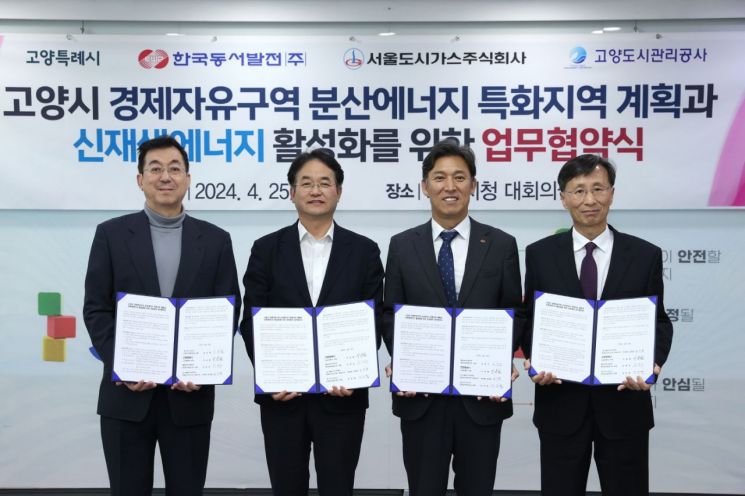 The signing ceremony for the plan of the Goyang City Economic Free Zone Distributed Energy Specialized Area and the activation of renewable energy. Provided by Goyang Special City
After completing various permits and approvals, construction of the power generation facility is scheduled to begin in June and be completed by May next year. In addition, the installation of hydrogen fuel cell power plants is being considered for other urban gas non-supplied areas besides Seolmun-dong.
Meanwhile, the city is also planning to designate the Goyang JDS District Economic Free Zone as a specialized area for distributed energy. Distributed energy refers to energy produced and supplied in the area where it is used, and when a development project of more than 1 million㎡ is pursued, distributed energy facilities must be mandatorily installed according to the ‘Special Act on the Activation of Distributed Energy.’ The designation of a specialized distributed energy area will expand the construction of renewable energy facilities such as hydrogen fuel cells.
In October last year, Goyang City was selected for the Gyeonggi-do Mini Hydrogen City Creation Project and secured 5 billion KRW in provincial funding. The Gyeonggi-do Mini Hydrogen City Creation Project, which is promoted to actively respond to hydrogen demand, has a total project cost of 10 billion KRW (5 billion KRW from the province and 5 billion KRW from the city) and will be carried out over three years.
The city plans to start a master plan establishment project in the first half of this year, which will proceed for one year. Through this research project, a basic plan for the mini hydrogen city creation project will be established, and a comprehensive hydrogen city plan for the entire Goyang City will be formulated.
Subsequently, hydrogen production facilities will be installed between 2026 and 2027, and commercial operation will begin. Once the mini hydrogen city is established, it is expected to produce 1 ton of hydrogen per day, which is enough to charge about 50 hydrogen buses and approximately 200 hydrogen cars.
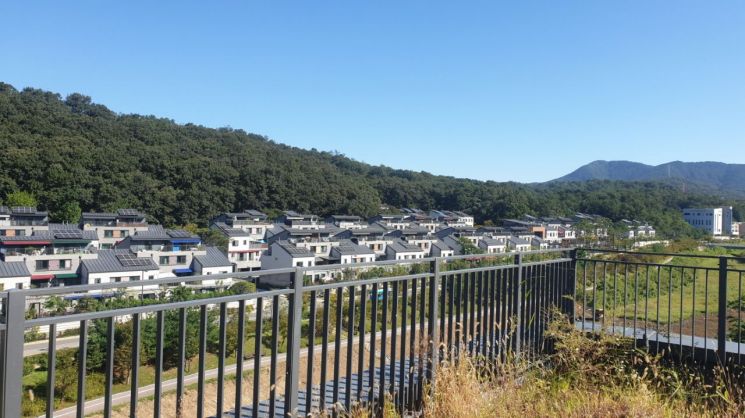 Solar panels installed in Ogeum-dong through the renewable energy convergence support project. Provided by Goyang Special City
The city is making multifaceted efforts to become a leading hydrogen energy city by building and expanding hydrogen economy ecosystem infrastructure to secure a stable hydrogen supply source and expanding the budget for hydrogen vehicle purchase support.
Mayor Lee Dong-hwan of Goyang Special City said, “We will focus on the production and utilization of eco-friendly energy sources that are effective in responding to climate change,” adding, “We will lay the foundation for revitalizing the hydrogen economy and establish ourselves as a model city for energy transition that minimizes carbon emissions.”
© The Asia Business Daily(www.asiae.co.kr). All rights reserved.
![Clutching a Stolen Dior Bag, Saying "I Hate Being Poor but Real"... The Grotesque Con of a "Human Knockoff" [Slate]](https://cwcontent.asiae.co.kr/asiaresize/183/2026021902243444107_1771435474.jpg)

















