China Implements Retaliatory Tariffs on June 10
Additional 10-15% Tariffs Imposed on Certain U.S. Products
Including U.S. Coal and LNG
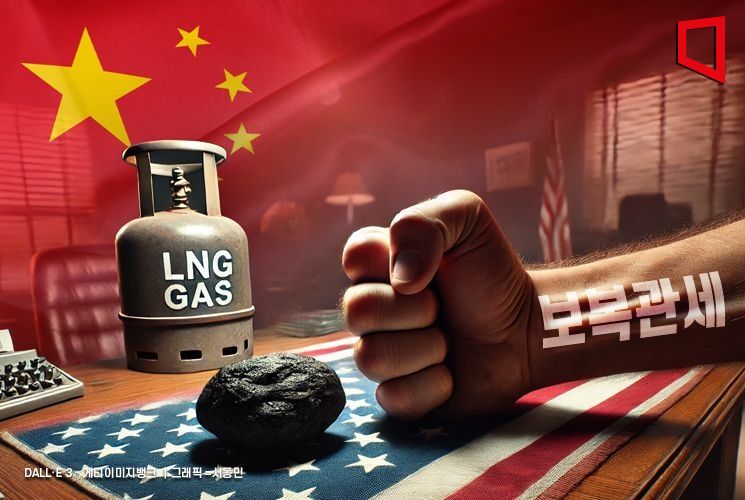
In response to the U.S. president's 10% universal tariff increase on China, China began imposing retaliatory tariffs on certain products starting at midnight on the 10th (local time) as previously announced. Although early negotiations between the two countries were anticipated, the second round of the 'trade war' began without any concrete progress in discussions.
The Chinese government announced retaliatory tariffs immediately after the U.S. implemented its 10% universal tariff policy on China at midnight on the 4th. Additional tariffs of 15% will be imposed on U.S. coal and liquefied natural gas (LNG), and 10% on crude oil, agricultural machinery, large-displacement vehicles, and pickup trucks.
On the same day, China also introduced several other retaliatory measures, including an antitrust investigation into Google, export controls on minerals such as tungsten and tellurium, and sanctions against the fashion company PVH Group, the parent company of Calvin Klein, as well as the biotechnology firm Illumina.
Furthermore, when China announced its retaliatory measures, it allowed a six-day grace period until the 10th and expressed willingness to negotiate through state media, leading to speculation that the U.S. and China might reach an agreement before China’s retaliation began.
However, U.S. President Donald Trump delayed the full implementation of tariffs on Canada and Mexico?who were also targeted simultaneously with China?by one month after negotiations, but stated that he would "not rush" talks with China.
China, too, stated at a Ministry of Commerce briefing on the 6th that it "will not proactively initiate trade disputes and is willing to resolve issues through dialogue and negotiation," but did not mention whether communication was currently taking place.
The Hong Kong South China Morning Post (SCMP) analyzed that Chinese President Xi Jinping is reluctant to have a hurried phone call with President Trump. Citing diplomatic sources, SCMP reported, "The Chinese leadership was hesitant to simply pick up the phone and talk," adding, "The timing and nature of the conversation could provide more clues about China’s approach to responding to President Trump."
Fang Zhongying, a visiting senior fellow at the ISEAS-Yusof Ishak Institute in Singapore, told SCMP, "It is not common practice for China’s top leaders to call to resolve issues," adding, "The Chinese approach differs from Donald Trump’s style."
Nevertheless, the market believes that both countries have clearly expressed their willingness to negotiate, and there is a consensus on the need to prevent a prolonged trade war, raising expectations that they will seek a point of agreement in some form and at some time.
Previously, during Trump’s first administration, the trade conflict was resolved when the two countries signed the so-called 'Phase One Trade Agreement' in January 2020, 18 months after the trade war began. At that time, China agreed to increase purchases of U.S. products by at least $200 billion from 2020 to 2021, and the Trump administration postponed imposing additional high tariffs on a wide range of Chinese goods in exchange for China’s expanded imports from the U.S.
© The Asia Business Daily(www.asiae.co.kr). All rights reserved.
![Clutching a Stolen Dior Bag, Saying "I Hate Being Poor but Real"... The Grotesque Con of a "Human Knockoff" [Slate]](https://cwcontent.asiae.co.kr/asiaresize/183/2026021902243444107_1771435474.jpg)
















