Professor Kim Haedong: "South Korea is Approaching a Subtropical Climate"
January Recorded as the Hottest January in History
January this year was recorded as the hottest January in Earth's history, intensifying the impact of global warming. Consequently, there are forecasts that the heat in South Korea will continue from April to November this year.
 Last August, heat haze caused by geothermal heat was rising above Yeouidaero, Yeongdeungpo-gu, Seoul. Photo by Yonhap News.
Climate scientist Professor Kim Haedong of the Department of Environmental Engineering at Keimyung University stated on CBS's 'Kim Hyun-jung's News Show' on the 5th, "Temperatures will rise sharply from late February to early March, marking the start of a warm spring," making this prediction.
Professor Kim gained attention as a 'precise meteorologist' by accurately forecasting in media interviews in June last year that a heatwave with temperatures exceeding 40 degrees Celsius would hit that summer.
He said, "Last winter was very warm, and it remained warm until early March, followed by a sudden cold snap in mid-March known as 'kkot-saem-chu-wi' (flower-bud cold), but I don't think we need to worry about that this spring. Since it will warm up from late February to early March, the blooming period of spring flowers is expected to be earlier than usual."
He added, "With the highest temperature exceeding 20 degrees Celsius in early April, I think this spring will feel like a summer-like spring."
Professor Kim also mentioned, "I once said that summer in South Korea could last from April to November last year, and it seems we might see such a pattern this year." This indicates that South Korea's climate is approaching a subtropical climate, where the monthly average temperature remains above 10 degrees Celsius for about eight months or more.
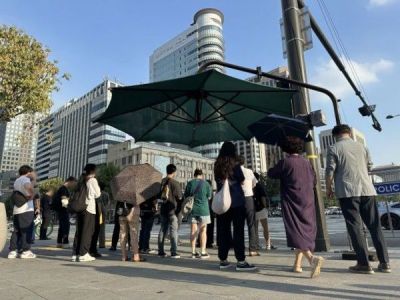 Last September, at the Sejongno intersection in Jongno-gu, Seoul, where a heatwave warning was issued, citizens are waiting for the signal while escaping the heat under a shade tent. Photo by Yonhap News
Professor Kim predicted that the highest temperature this summer could also approach 40 degrees Celsius, similar to last year. He said, "Although summer climate outlook data has not yet been released, making definitive statements now is difficult, but globally, except for a few narrow regions, summer climates are expected to be very hot."
He elaborated, "Due to global warming, sea surface temperatures have risen significantly, and this effect is likely to become more pronounced. This is a situation anyone can anticipate."
In fact, the Copernicus Climate Change Service, the European Union's climate change monitoring agency, announced that the surface temperature in January this year was 13.23 degrees Celsius, 1.75 degrees higher than the pre-industrial average for January. This marks the hottest January for two consecutive years, following January last year.
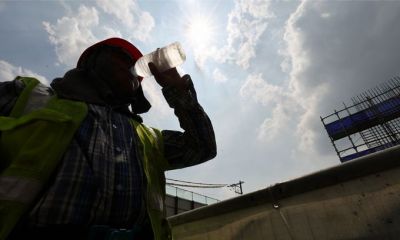 A construction worker is drinking water at a construction site under the summer heatwave. Photo by Yonhap News
The high temperatures in January last year were due to the El Ni?o phenomenon, which persisted until May of the same year. El Ni?o refers to a phenomenon where the sea surface temperature in the monitoring area of the equatorial eastern Pacific rises by more than 0.5 degrees Celsius for over five months.
In December last year, the opposite phenomenon, La Ni?a, occurred, leading experts to expect a drop in January temperatures this year. La Ni?a is a meteorological phenomenon where sea surface temperatures in the eastern equatorial Pacific are lower than average. Global warming is known to affect the frequency and intensity of La Ni?a events. However, the actual temperature in January this year was about 0.1 degrees higher than the same month last year.
Bill McGuire, Honorary Professor of Geophysics and Climate Risk at University College London (UCL), said, "The data for January this year is shocking and frightening," expressing concern that "despite clear signs of climate collapse, such as the floods in Valencia and apocalyptic wildfires in Los Angeles, carbon emissions continue to rise."
Professor Kim analyzed, "Due to global warming, hot air from the south has risen to the Arctic Circle, making the Arctic warmer than South Korea. Meanwhile, the cold air pushed out from the Arctic Circle descends southward to the Korean Peninsula, causing unusual severe cold spells in South Korea."
© The Asia Business Daily(www.asiae.co.kr). All rights reserved.
![Clutching a Stolen Dior Bag, Saying "I Hate Being Poor but Real"... The Grotesque Con of a "Human Knockoff" [Slate]](https://cwcontent.asiae.co.kr/asiaresize/183/2026021902243444107_1771435474.jpg)

















